
Data matching techniques are the methods a data pipeline uses to decide whether two records refer to the same real-world entity. The three primary categories are deterministic (exact rule-based), fuzzy or probabilistic (similarity-scored), and graph-based entity resolution. Choosing the wrong technique for your data type is the single most common cause of match failure in enterprise pipelines.
Most teams need all three techniques operating together. A CRM consolidation might use deterministic rules to link records with matching email addresses, fuzzy algorithms to catch “Jon Smith” and “Jonathan Smith” as the same person, and entity resolution to cluster individuals into households or organisations.
Start a free trial of Match Data Pro and apply all three data matching techniques to your own dataset in under an hour.
Deterministic Matching: When You Have a Reliable Identifier
Deterministic matching applies exact rules to fields that should be unique: email address, tax ID, national insurance number, or a system-assigned primary key. If the values match, the records merge. If they do not, the pair is rejected.
When deterministic matching works well
It works at scale with zero ambiguity when identifiers are clean and consistently formatted. A financial services firm matching counterparty records by LEI code, or a healthcare system linking claims by member ID, can achieve near-100% precision at millions of records per hour.
Where it breaks down
Deterministic matching fails the moment a source field is missing, reformatted, or populated with a different identifier variant. A customer record from one system stores j.smith@acme.com; otra tienda jsmith@acme.com. Both identify the same person. Exact matching misses it entirely. This is where fuzzy matching algorithms become essential.
Fuzzy Matching: Scoring Similarity Across Noisy Fields
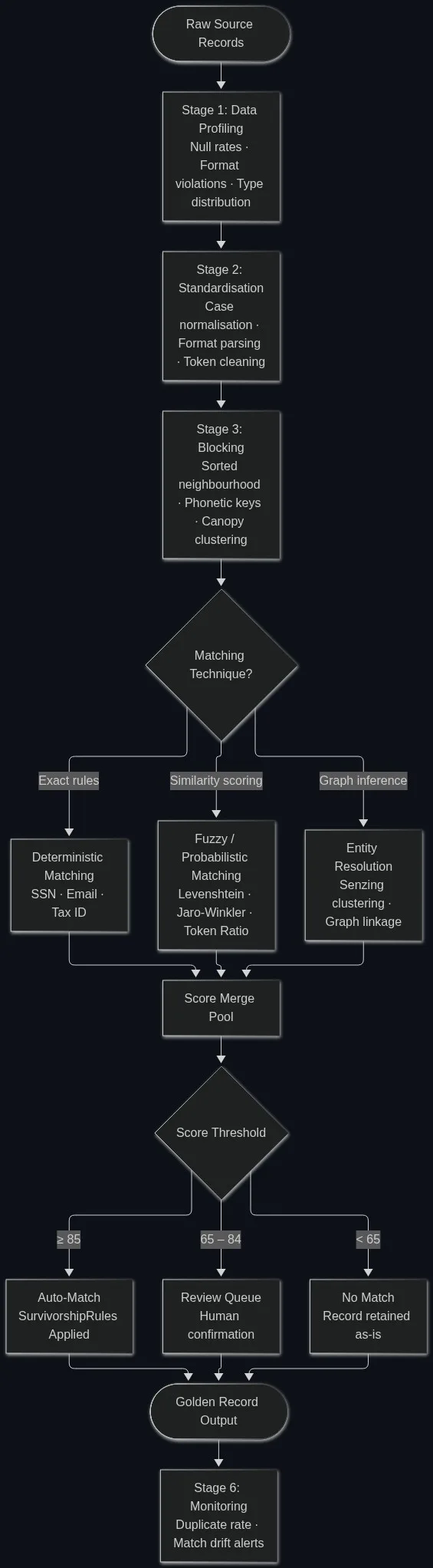
Fuzzy matching calculates a similarity score between 0 and 100 for each field pair, then combines scores into a composite match score. Records above a threshold are matched; those below are rejected; those in between go to a review queue.
Key fuzzy matching algorithms
The choice of algorithm should follow the structure of the field being compared:
- Levenshtein edit distance — counts single-character insertions, deletions, and substitutions. Best for short codes, postcodes, and IDs where transpositions are common. “12345” vs “12354” scores around 80.
- Jaro-Winkler — weights character agreement at the start of a string. Best for personal names where prefixes matter. “Smith” vs “Smithe” scores 97; “Smith” vs “Smyth” scores 91.
- Token sort / token set ratio — splits strings into tokens, sorts them, then compares. Best for company names and addresses where word order varies. “Acme Corp Ltd” vs “Ltd Acme Corporation” scores 94 on token set ratio vs 54 on Levenshtein.
- Phonetic encoding (Soundex, Metaphone) — converts names to a phonetic key. “Catherine” and “Kathryn” share the same Soundex code. Use as a blocking key rather than a final score.
Match Data Pro lets you configure weights across multiple algorithms in a single match definition. A person-name field might use 40% Jaro-Winkler, 30% token sort, and 30% phonetic similarity — giving a composite score that handles spelling variants, transpositions, and phonetic equivalents simultaneously. Learn more about multi-algorithm record linkage engineering.
Configuración de umbrales
Thresholds determine match disposition. A typical three-tier setup:
- Score 85-100: auto-match, apply survivorship rules
- Score 65-84: route to human review queue
- Score below 65: no match, record is kept as-is
These thresholds are not universal. A healthcare patient match requires tighter thresholds (90+) because false positives create safety risks. A marketing list deduplication can tolerate a lower threshold (75+) because the cost of a false positive — sending one extra email — is low.
Probabilistic Matching: Weighted Evidence Across Multiple Fields
Probabilistic matching formalises the multi-field scoring approach using statistical weights derived from the data itself. The Fellegi-Sunter model — the theoretical foundation for most probabilistic matchers — assigns a weight to each field based on how discriminating it is in the dataset.
In practice, this means a match on a rare surname like “Featherington” contributes more evidence than a match on “Smith”. A system trained on your data calculates these field weights automatically, producing a log-likelihood score that reflects the probability that two records represent the same entity.
Understand when to use deterministic vs probabilistic matching to avoid over-engineering low-complexity matching scenarios.
Where probabilistic matching adds value
Probabilistic techniques are most useful when no single field is reliable enough for deterministic matching, and when record volume is large enough to train meaningful weights. A database of 5 million customer records across a CRM and an acquired company’s ERP, with no common customer ID, is exactly the scenario where probabilistic matching outperforms hand-tuned fuzzy rules.
Entity Resolution: Linking at the Graph Level
Entity resolution extends record linkage from pairs to clusters. Rather than asking “do these two records match?”, it asks “which set of records all refer to the same entity?” This distinction matters enormously at scale.
Consider three records:
- Record A: “Jon Smith, 45 Oak St, Chicago”
- Record B: “Jonathan Smith, 45 Oak Street, Chicago IL”
- Record C: “J. Smith, 45 Oak St, Chicago, IL 60601”
Pairwise fuzzy matching might link A-B and B-C but miss A-C if the threshold is tight. A graph-based entity resolver sees all three as a connected cluster and outputs a single golden record. Match Data Pro integrates Senzing entity resolution, which uses pre-trained probabilistic graphs to cluster records in real time — no hand-crafted rules required.
For large-scale entity resolution, agentic entity resolution pipelines can automate the entire match-cluster-merge cycle with AI-driven threshold tuning and exception routing.
Blocking: The Prerequisite That Makes Scale Possible
Comparing every record pair in a 10-million-record dataset produces 50 trillion comparisons. That is computationally impossible without blocking — a technique that reduces the comparison space by grouping records that share a common property before scoring begins.
Common blocking strategies
- Sorted neighbourhood — sort records on a key field (e.g. surname), then compare within a sliding window of N records. Efficient for sorted text data.
- Phonetic blocking — group records by their Soundex or Metaphone code. “Thompson” and “Thomson” land in the same block.
- Canopy clustering — use a cheap distance metric (e.g. shared token) to form candidate pairs, then apply expensive metrics only within canopies.
- Multi-pass blocking — run multiple blocking passes (by postcode, by phone number, by company name token) and take the union of candidate pairs. Improves recall at the cost of more comparisons.
Match Data Pro’s data matching and merging pipeline implements multi-pass blocking automatically, reducing the comparison space by 95%+ while keeping recall above 99% on well-standardised data.
Standardisation: The Step That Decides Match Quality Before Scoring Starts
No matching technique produces good results on unstandardised data. “123 Main Street” and “123 Main St” score 74 on Levenshtein — below most thresholds — but are clearly the same address once standardised. Data standardisation must run before any matching technique is applied.
Key standardisation steps for matching:
- Case normalisation (uppercase or lowercase all text)
- Punctuation stripping (remove commas, periods, hyphens)
- Abbreviation expansion (“St” to “Street”, “Corp” to “Corporation”)
- Phone number E.164 formatting (+1XXXXXXXXXX)
- Date normalisation (ISO 8601: YYYY-MM-DD)
- Address parsing and CASS verification for US postal records
Match Data Pro runs CASS address verification as a standardisation step before fuzzy address matching begins — converting free-text addresses into parsed, postcode-confirmed components that score 95+ on Jaro-Winkler even when the original records look different.
Choosing the Right Technique for Each Field Type
The table below maps field types to their recommended primary technique and algorithm:
| Tipo de campo | Primary Technique | Algoritmo recomendado | Umbral |
|---|---|---|---|
| Email address | Deterministic, then fuzzy | Exact match / Levenshtein | 100 / 90+ |
| Tax ID / SSN | Deterministic | Coincidencia exacta | 100 |
| Personal name | Difuso | Jaro-Winkler + fonética | 85+ |
| Nombre de empresa | Difuso | Proporción del conjunto de fichas | 80+ |
| Dirección postal | Fuzzy (post-CASS) | Levenshtein + ordenación por tokens | 88+ |
| Número de teléfono | Deterministic (post-normalisation) | Coincidencia exacta | 100 |
| Multi-field entity | Resolución de entidades | Graph clustering (Senzing) | N / A |
Ready to apply these techniques to your data? Register for a free trial of Match Data Pro — no contract, no commitment. Or book a demo to see the full multi-technique pipeline applied to your own records.
Preguntas frecuentes
What is the difference between fuzzy matching and probabilistic matching?
Fuzzy matching calculates string similarity scores using algorithms like Levenshtein or Jaro-Winkler. Probabilistic matching formalises multi-field evidence using statistically derived field weights — fields that are more discriminating contribute more to the final match score. In practice, most enterprise tools use a hybrid of both approaches for best results.
When should I use deterministic matching instead of fuzzy matching?
Use deterministic matching when you have a clean, consistent unique identifier — email address, tax ID, government ID — that is reliably populated in both datasets. Fuzzy matching is the right choice when identifiers are absent, inconsistent, or formatted differently across sources. Many pipelines run deterministic first and fall through to fuzzy for unresolved records.
How do blocking techniques improve matching performance?
Blocking reduces the number of record pairs compared before scoring begins. Without it, a 10-million-record dataset requires 50 trillion comparisons. Phonetic blocking, sorted neighbourhood, and canopy clustering cut the comparison space by 95%+ while maintaining 99%+ recall on well-standardised data, making large-scale matching computationally feasible.
What is entity resolution and how does it differ from record linkage?
Record linkage identifies matching pairs of records. Entity resolution extends this to clusters — grouping all records that refer to the same real-world entity, regardless of how many records are involved. Entity resolution handles transitive matches (A matches B, B matches C, therefore A, B, and C form one entity) that pairwise record linkage misses.
How do I choose the right match threshold for my use case?
Threshold selection depends on the cost of a false positive versus a false negative. Healthcare patient matching uses 90+ because misidentifying two patients creates safety risk. Marketing list deduplication can use 75-80 because a false positive means one extra email. Run your pipeline on a labelled sample set, measure precision and recall at each threshold, and choose the point that fits your acceptable error rate.