
Deterministic matching fires when two records share an exact identifier — a Social Security Number, an account ID, a verified email. Probabilistic matching fires when no exact key exists, instead computing a weighted similarity score across multiple fields. Most enterprise data quality programs need both: deterministic for high-trust core records, probabilistic for the messy edge cases that represent 30–60% of real-world data.
Start a free trial of Match Data Pro and run both strategies on your own data today — no contract required.
What Deterministic Matching Is and How It Works
Deterministic matching — also called rule-based matching — evaluates a fixed set of exact conditions. If all conditions are met, the records match. If any condition fails, they do not. There is no score, no threshold, no uncertainty.
Common deterministic rules
A typical ruleset might look like this:
| Rule | Field A | Operator | Field B |
|---|---|---|---|
| 1 | = | ||
| 2 | ssn | = | ssn |
| 3 | account_id | = | account_id |
| 4 | phone_normalized | = | phone_normalized |
Rules run in priority order. A record pair that satisfies Rule 1 is immediately classified as a match without evaluating Rules 2–4. This makes deterministic engines extremely fast and fully auditable — critical for regulated industries where you need to explain every link decision to a compliance officer.
When deterministic matching works
Deterministic matching excels when:
- Your data contains a reliable shared key (customer ID, NPI number, EIN)
- Field formats are standardised before matching runs
- A false positive carries high regulatory or financial cost
- Audit logs must show a binary, explainable match reason
The limitation is brittleness. “Jonathan Smith” and “Jon Smith” will never deterministically match on name. “john.smith@acme.com” and “johnsmith@acme.com” will not match on email. The moment data entry variation enters the picture, recall — the percentage of true matches found — collapses.
What Probabilistic Matching Is and How It Works
Probabilistic matching computes a composite similarity score across multiple fields. Each field gets a weight based on its discriminating power, and an algorithm measures how similar the two field values are. The weighted scores sum to a single confidence value, typically 0–1 or 0–100.
How a probabilistic score is built
Consider matching these two customer records:
| Field | Record A | Record B | Algorithm | Score | Weight |
|---|---|---|---|---|---|
| First name | Jonathan | Jon | Jaro-Winkler | 0.84 | 0.15 |
| Apellido | Smithe | Smith | Levenshtein | 0.91 | 0.20 |
| DIRECCIÓN | 123 Oak St Apt 4B | 123 Oak Street #4B | Token Sort | 0.96 | 0.25 |
| Phone | 555-210-3344 | 5552103344 | Exact (normalised) | 1.00 | 0.30 |
| DOB | 1982-03-15 | 1982-03-15 | Exact | 1.00 | 0.10 |
Composite score: (0.84×0.15) + (0.91×0.20) + (0.96×0.25) + (1.00×0.30) + (1.00×0.10) = 0.96. At a threshold of 0.85, this pair is a confirmed match — despite the name abbreviation, surname typo, and address format difference that would defeat any deterministic rule.
Match Data Pro’s fuzzy matching engine lets you configure per-field algorithms and weights through a no-code interface, so you can tune scores to your specific data distribution without writing a single SQL rule.
Threshold bands and human review
Most probabilistic pipelines define three zones:
- Auto-match band (e.g., score >= 0.90): system accepts the link immediately
- Review band (e.g., 0.70–0.89): routed to a human reviewer
- Auto-reject band (e.g., score < 0.70): records are not linked
Setting thresholds correctly is the most consequential tuning decision in a probabilistic pipeline. Set the auto-match band too low and you create false positives — merging records that represent different people. Set it too high and you generate false negatives — leaving duplicates undetected. Matching rule scoring in Match Data Pro includes built-in threshold analysis tooling to show precision-recall tradeoffs at each cutpoint.
The Matching Strategy Decision Framework
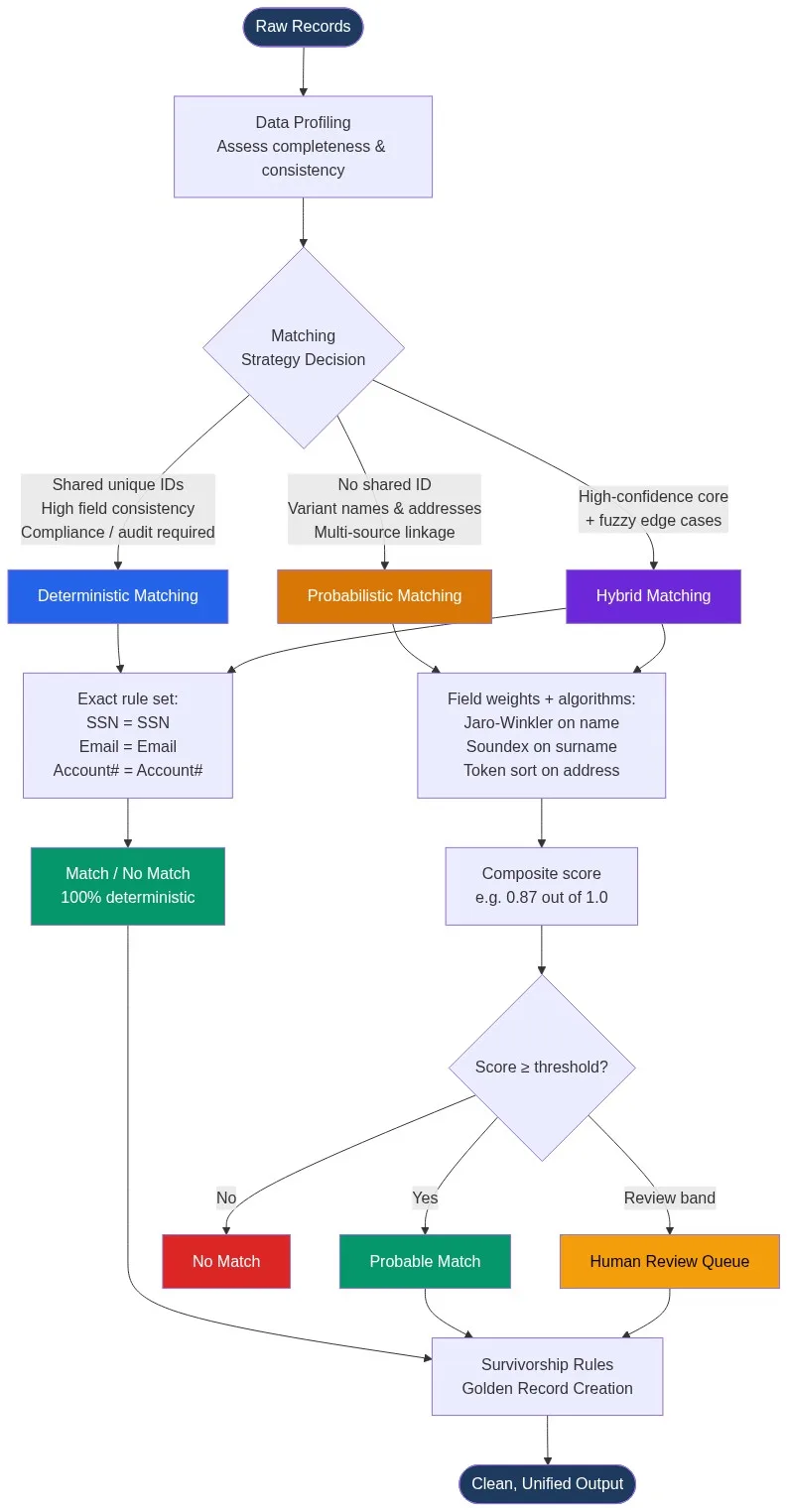
The diagram above maps the full decision pipeline: start with data profiling to assess field completeness and consistency, then branch into deterministic, probabilistic, or hybrid based on your data characteristics.
Choose deterministic when
- A reliable unique identifier exists in both datasets (90%+ population rate)
- Data has been standardised and normalised upstream
- You operate in a regulated environment requiring explainable decisions
- Match volume is high and latency must be sub-millisecond
Choose probabilistic when
- No shared key exists across your data sources
- Name and address data contains known entry variations
- You are linking records across systems that were never designed to integrate
- Recall (finding all true matches) matters as much as precision
When hybrid is the right answer
In practice, most enterprise matching projects use a hybrid approach. Deterministic rules handle the 40–70% of record pairs where a reliable key exists. Probabilistic scoring handles the remainder. This maximises throughput — fast exact matching for the easy cases — while maintaining recall for the hard ones.
Match Data Pro’s entity resolution pipeline supports both strategies in a single job definition. You configure deterministic pass-through rules first, then apply probabilistic scoring to unresolved pairs in the same run.
Entity Resolution: Taking Matching to the Next Level
When records span more than two sources — a CRM, an ERP, a marketing platform, and a legacy database — pairwise matching is no longer sufficient. You need entity resolution: the ability to cluster all records that refer to the same real-world entity into one canonical profile.
Match Data Pro integrates Senzing entity resolution, which applies graph-based probabilistic linking across unlimited sources. Senzing operates without a pre-defined unique key. It builds entity clusters incrementally as new records arrive, making it suitable for streaming ingestion pipelines as well as bulk batch jobs.
Key capabilities for multi-source entity resolution:
- Cross-source blocking to avoid comparing every record against every other record
- Relationship graphs that link entities even through indirect connections
- Automated survivorship to select the best field value for the golden record
- Full audit trail showing which records contributed to each entity cluster
Survivorship rules and golden record creation are configured inside Match Data Pro’s job scheduler, so the merge step runs automatically after every matching cycle.
Practical Workflow: Running Both Strategies in Match Data Pro
Here is a condensed workflow for a CRM deduplication project that combines both approaches:
- Profile the data. Match Data Pro’s AI data profiling scans every field — population rate, format consistency, distinct value count, and null rate. Fields with >95% population and low cardinality (e.g., a normalised phone number) are good deterministic candidates.
- Define deterministic rules. Configure exact-match rules on email and normalised phone. These resolve the fast, easy matches first.
- Configure probabilistic scoring. For remaining unresolved pairs, apply Jaro-Winkler on first name, Levenshtein on last name, and token-sort ratio on address. Assign weights based on discriminating power revealed by profiling.
- Set threshold bands. Review the precision-recall curve. Set auto-match at 0.88, review band at 0.72–0.87, auto-reject below 0.72.
- Review the queue. Human reviewers confirm or reject pairs in the review band via the Match Data Pro review UI. Each decision trains the model for future runs.
- Build golden records. Survivorship rules select the most-populated, most-recently-updated value per field. The merged record is written back to the CRM via the Match Data Pro REST API or export connector.
- Schedule recurring runs. Match Data Pro’s job automation schedules incremental matching on new records — so duplicates are caught at ingestion rather than accumulating over months.
Ready to run this on your own data? Register for a free trial or book a demo to see the full hybrid pipeline in action.
Frequently Asked Questions
What is the difference between deterministic and probabilistic matching?
Deterministic matching uses fixed rules that must be satisfied exactly — two records either match or they do not, with no ambiguity. Probabilistic matching computes a weighted similarity score across multiple fields and classifies pairs above a threshold as matches. Deterministic is faster and fully auditable; probabilistic handles data variation and achieves higher recall on messy, inconsistent records.
Which method produces fewer false positives?
Deterministic matching produces virtually zero false positives because it requires exact field agreement. Probabilistic matching introduces the possibility of false positives if thresholds are set too low — but tuning the auto-match threshold higher (e.g., 0.90+) and routing edge cases to human review keeps false positive rates well below 1% in most enterprise projects.
Can I run deterministic and probabilistic matching together in one job?
Yes. Most enterprise platforms, including Match Data Pro, support hybrid matching: deterministic rules resolve high-confidence pairs first, then probabilistic scoring handles remaining unresolved records in the same pipeline run. This approach maximises throughput and recall simultaneously without requiring two separate jobs or data passes.
How do I set the right threshold for probabilistic matching?
Start by running your matching job on a labelled sample — a set of record pairs where you know the ground truth (match or non-match). Plot the precision-recall curve at each threshold increment. Choose the threshold that meets your acceptable false positive rate. Most teams set the auto-match band at 0.85–0.92 and route the 0.70–0.84 range to human review.
What is entity resolution and how does it differ from pairwise matching?
Pairwise matching compares two records and returns a match/no-match decision. Entity resolution clusters all records — across any number of sources — that refer to the same real-world entity. It handles transitive links: if Record A matches Record B and Record B matches Record C, all three are grouped into one entity even if A and C would not match directly. This is essential for multi-source data integration projects.