
When teams search for fuzzy AI alternatives, they are looking for a data matching platform that goes beyond simple string similarity scoring. The right tool handles nicknames, transposed digits, variant spellings, and cross-system entity resolution at scale — not just Levenshtein distance on a name field. This guide breaks down the real differences between platforms, the algorithms that matter, and the decision criteria that separate a good fit from a costly mistake.

Gartner estimates that poor data quality costs the average organisation $12.9 million per year. Much of that loss traces back to matching failures: duplicates that inflate pipeline metrics, records that never link across CRM and ERP, and entities that resolve incorrectly because the tool used was not built for the complexity of real-world data. Start a free trial of Match Data Pro and test your own records before committing to any platform.
What Makes a Fuzzy AI Matching Tool Different from Basic String Similarity
Basic string similarity tools — including many open-source libraries — apply a single algorithm to every field. They score “Jon Smith” against “John Smyth” using Levenshtein edit distance and return a number. That is the beginning of matching, not the end.
A production-grade fuzzy AI platform does several things differently:
- Field-specific algorithms. Name fields use Jaro-Winkler or Soundex. Address fields use CASS verification and phonetic rules. Date fields use numeric proximity scoring. Applying one algorithm to all field types produces both false positives and false negatives.
- Composite scoring. A match is determined by a weighted combination of field scores, not a single field. First name, last name, company, ZIP, and phone each contribute a configured weight. The final match score reflects the overall record similarity.
- AI-assisted threshold suggestions. Platforms with machine learning review borderline pairs and recommend threshold adjustments based on historical review decisions. This reduces manual calibration time by a measurable margin.
- Blocking and indexing. Without blocking, every record is compared to every other record. At one million records, that is 500 billion comparisons. Proper blocking — by ZIP prefix, phonetic key, or first three characters — reduces candidate pairs by 90% or more before scoring begins.
See how algorithms interact in a real pipeline in our breakdown of data matching techniques for data engineers.
The Main Categories of Fuzzy AI Alternatives
The market breaks into five categories. Each solves a different part of the problem. Knowing which category fits your use case is more important than comparing feature bullet points.
1. Open-Source Clustering Tools
Example: OpenRefine. OpenRefine applies key collision and nearest neighbour clustering to find similar values in a column. It is effective for one-off cleansing of a few thousand records. It has no production scheduling, no cross-dataset entity resolution, no CASS address verification, and no survivorship logic. Teams that start here typically outgrow it within three months of a real data quality initiative.
2. Single-Algorithm Python Libraries
Examples: RapidFuzz, fuzzywuzzy, Dedupe.io. These are code-first tools that give a data engineer fine-grained control over algorithm selection. They require significant development effort to build a full pipeline: blocking, scoring, threshold logic, survivorship, output formatting, and scheduling. They scale well for teams with engineering bandwidth, but they produce no audit trail and no configurable UI for business users to review match decisions.
3. ETL-Embedded Quality Modules
Examples: Talend Data Quality, Informatica Data Quality. These tools embed data quality steps inside a broader ETL or data integration workflow. Matching is a module within a larger pipeline. They are appropriate for organisations already standardised on those platforms. Outside of that ecosystem, licensing costs and implementation complexity are both high. Neither offers no-contract monthly SaaS for teams that want to start quickly.
4. Enterprise MDM Platforms
Examples: IBM InfoSphere QualityStage, Informatica MDM, Precisely Trillium. These are full master data management platforms. Matching is one component. Implementation timelines run six to eighteen months. Licensing is enterprise-tier. For organisations that need a full MDM platform and have the budget and timeline, they are appropriate. For data teams that need accurate matching within weeks, they are not the right starting point.
5. Purpose-Built Fuzzy Matching and Entity Resolution Platforms
Example: Match Data Pro. Purpose-built platforms combine configurable fuzzy algorithms, AI-assisted match suggestions, CASS address verification, Senzing entity resolution, and job automation in a single product. They deploy as SaaS or on-premise. They support both no-code configuration and API access. This category is the most direct fit for data teams that need production-grade matching without a twelve-month implementation project.
Platform Comparison: Key Evaluation Criteria
Use this table to benchmark any platform you are evaluating. These criteria come directly from the questions data engineers ask when a matching tool fails in production. We have a full evaluation framework in our guide to how to evaluate a data matching solution.
| Criterio | OpenRefine | Python Libraries | ETL-Embedded | Enterprise MDM | Datos de partidos Pro |
|---|---|---|---|---|---|
| Multiple fuzzy algorithms | Limitado | Yes (custom dev) | Sí | Sí | Sí |
| Composite weighted scoring | No | Custom dev | Sí | Sí | Sí |
| AI match suggestions | No | No | Parcial | Sí | Sí |
| Blocking / indexing | Basic | Custom dev | Sí | Sí | Sí |
| Verificación de direcciones CASS | No | No | Parcial | Parcial | Sí |
| Senzing entity resolution | No | No | No | No | Sí |
| Live fuzzy search API | No | Parcial | No | No | Sí |
| No-contract SaaS | Free / open | Free / open | No | No | Sí |
| On-premise deployment | Sí | Sí | Sí | Sí | Sí |
| Free trial available | Sí | Sí | No | No | Sí |
| Time to first match result | Minutos | Hours (dev) | Days–Weeks | Months | Minutos |
How to Choose: A Decision Framework
The right platform is determined by four variables: record volume, field complexity, available engineering bandwidth, and deployment constraints. This diagram maps those variables to the right tool category.
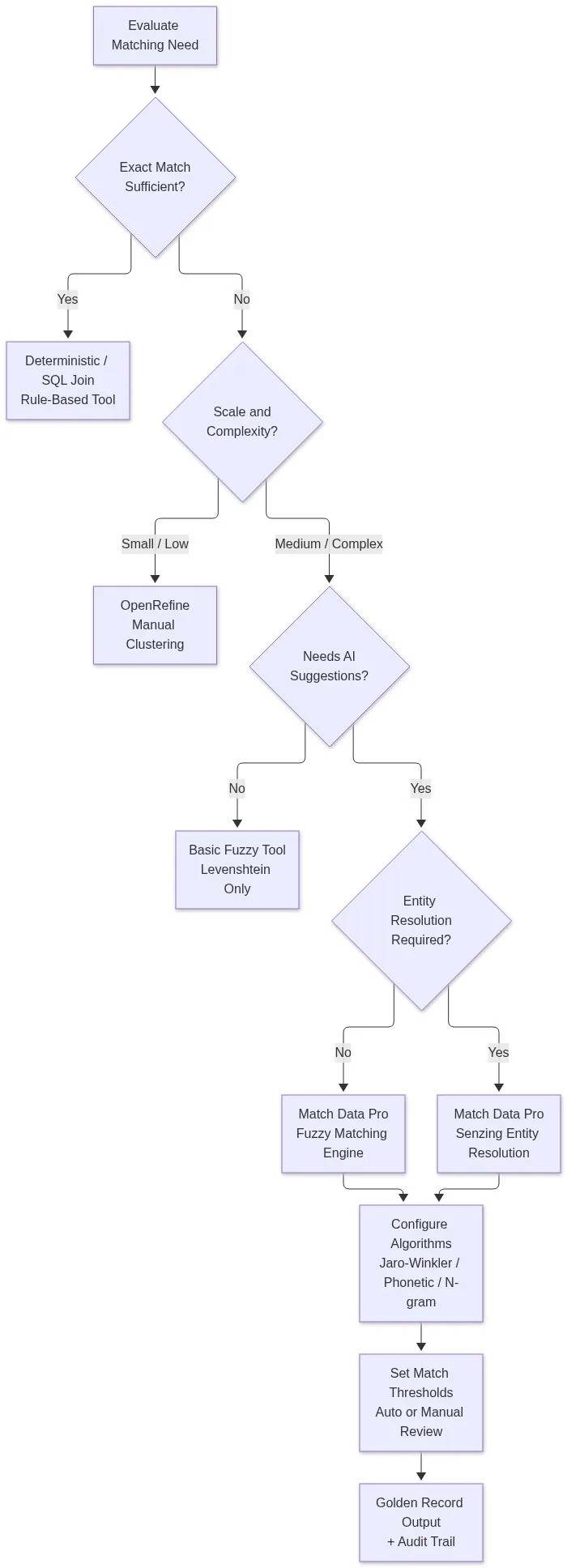
Volume Thresholds
Under 50,000 records with low complexity: OpenRefine or a Python script can work for a one-time project. Over 100,000 records, recurring jobs, or cross-system matching: you need a platform with blocking, scheduling, and an audit trail. For data deduplication at scale, even simple-looking pipelines become unmanageable without a production-grade engine.
Field Complexity
Consider a healthcare organisation matching patient records across three systems. A single patient may appear as:
| System | Nombre | Fecha de nacimiento | DIRECCIÓN |
|---|---|---|---|
| CRM | Robert Johnson | 1968-03-14 | 142 Elm St, Chicago IL 60614 |
| EHR | Bob Johnson | 14/03/1968 | 142 Elm Street, Chicago, Illinois |
| Billing | R. Johnson | 03-14-68 | 142 Elm St Apt 3B, Chicago IL 60614-2211 |
A single-algorithm tool scores “Robert” against “Bob” low because Levenshtein distance is 4. A platform with nickname tables, phonetic keys, and date format normalisation resolves all three as the same person with high confidence. This is where fuzzy name matching must handle real-world variants, not idealised test data.
Engineering Bandwidth
Python libraries require a data engineer to build, maintain, and schedule every component. If your team has the capacity and the matching problem is well-defined, that is a reasonable path. If the matching logic will evolve — new fields, new data sources, new threshold requirements — a configurable platform absorbs that change without code rewrites.
Deployment Constraints
Financial services, healthcare, and government teams frequently cannot send data to a third-party cloud. On-premise deployment or private cloud is a hard requirement. Match Data Pro deploys both ways. Most enterprise MDM platforms also support on-premise, but at significantly higher implementation cost. Cloud-only tools immediately fail this requirement.
Algorithm Reference: What Each One Actually Does
When evaluating any fuzzy AI alternative, ask the vendor which of these algorithms are natively supported, not just available via plugin or custom code. For a full technical breakdown, see our guide to fuzzy matching algorithms, scoring, and thresholds.
- Levenshtein distance. Counts the minimum single-character edits (insertions, deletions, substitutions) to transform one string into another. Useful for catching typos. Poor at phonetic variants or abbreviations.
- Jaro-Winkler. Gives extra weight to prefix matches. Performs well on names, particularly short names where early characters are reliable. Standard for person name matching.
- Soundex / Metaphone / Double Metaphone. Phonetic encoding algorithms. Convert “Smith” and “Smyth” to the same code. Essential for name matching across data entry systems where spelling is inconsistent.
- N-gram similarity. Breaks strings into overlapping character groups and measures overlap. Handles transpositions and partial matches that Levenshtein penalises too heavily.
- Token sort / token set ratio. Tokenises strings and compares in sorted order, eliminating word-order differences. Useful for company names: “Acme Corp LLC” vs “LLC Acme Corporation”.
- Probabilistic / Fellegi-Sunter. Assigns field-level match and non-match probabilities based on field frequency distributions. Statistically robust but requires a training corpus to calibrate weights.
Entity Resolution: Where Most Fuzzy AI Alternatives Fall Short
Fuzzy matching links pairs of records. Entity resolution links networks of records into a single resolved entity, even when no two individual records are a direct pair match. This distinction matters for any organisation managing customer data across more than two systems.
Example: Record A and Record C share no overlapping fields. But Record A matches Record B on name and phone, and Record B matches Record C on email and address. Entity resolution identifies all three as the same person. Pairwise fuzzy matching misses this entirely.
Match Data Pro integrates Senzing entity resolution natively. Senzing uses a graph-based approach to resolve these transitive relationships across millions of records in real time. Most tools in categories 1 through 3 above offer no equivalent capability. For teams building a data matching and merging pipeline across multiple source systems, this is a critical differentiator.
Once records are resolved, survivorship rules determine which field value survives into the golden record. The process is detailed in our data unification guide.
Before You Match: Why Data Profiling Changes Everything
Switching tools rarely fixes a poor match rate. The root cause is almost always data quality upstream of the match engine. Before configuring any fuzzy AI alternative, run a full profile of your source data. Measure:
- Field completeness rates (what percentage of name, email, and phone fields are populated)
- Format consistency (how many date formats exist in a single date column)
- Duplicate rate estimates (how many records already appear to be duplicates before matching)
- Address deliverability (what percentage of addresses pass a basic USPS format check)
A platform with a 95% match accuracy on clean data may produce 60% accuracy on data with 40% null rates and three coexisting date formats. Data profiling is the essential first step — it determines whether your matching problem is an algorithm problem or a data preparation problem. Match Data Pro’s AI data profiling module runs this analysis automatically before the first matching job is configured.
Preguntas frecuentes
What is the best free fuzzy AI alternative for small datasets?
OpenRefine is the most capable free tool for small, one-time projects under 50,000 records. It supports key collision and nearest-neighbour clustering across columns. It has no scheduling, no API, no entity resolution, and no audit trail. For recurring production jobs or cross-system matching, a platform built for data quality pipelines is a more reliable foundation regardless of dataset size.
How do I know if I need entity resolution or just fuzzy matching?
You need entity resolution when records must be linked across three or more source systems where no single pair of systems shares enough overlapping fields to match directly. If you are matching one CRM export against one marketing list, pairwise fuzzy matching is usually sufficient. If you are building a customer 360 view across CRM, ERP, and support data, entity resolution is required to catch transitive identity chains.
Can Python libraries like RapidFuzz replace a commercial fuzzy matching platform?
RapidFuzz replaces the scoring component only. A production platform also includes blocking, field-weight configuration, survivorship rules, job scheduling, an audit trail, address verification, and a review UI for borderline pairs. Building those components in Python is feasible but requires sustained engineering effort to maintain. For teams without dedicated data engineering capacity, a configured platform delivers faster results with fewer ongoing maintenance requirements.
What algorithms should I look for when evaluating fuzzy AI alternatives?
At minimum, look for Jaro-Winkler for name fields, Soundex or Double Metaphone for phonetic matching, Levenshtein for typo correction, and token-based similarity for company names. The platform should apply different algorithms to different field types automatically, not apply one algorithm uniformly. Composite weighted scoring across all matched fields is the clearest indicator of a mature matching engine.
How long does it take to get accurate results from a new fuzzy matching platform?
With a purpose-built platform and clean source data, a configured matching job can produce results within hours of initial setup. The main time investment is field mapping, threshold calibration, and reviewing a sample of match pairs to validate the configuration. Platforms with AI-assisted threshold recommendations shorten this calibration cycle significantly. On enterprise MDM platforms, the same process typically takes weeks to months due to implementation and data model setup requirements.
Start Testing With Your Own Data
The most reliable way to evaluate any fuzzy AI alternative is to run it against a sample of your actual records. Match Data Pro offers a no-contract free trial with access to the full matching engine, CASS address verification, AI data profiling, and Senzing entity resolution.
- Start your free trial — no contract, no credit card required
- Book a demo to walk through a live matching configuration with a Match Data Pro engineer
- Contact sales@matchdatapro.com for on-premise or private cloud deployment questions