
Data unification connects fragmented records across CRM, ERP, marketing, and operational databases into a single, authoritative view of each customer or entity. Without it, the same person appears as five separate records across five systems, analytics lie, and compliance audits fail. A structured unification pipeline — profiling, standardisation, deduplication, entity resolution, and survivorship — eliminates that fragmentation and delivers a golden record every downstream system can trust.
Ready to unify your data? Start a free trial of Match Data Pro and run your first unification job in under an hour.
Why Data Unification Fails Without a Structured Approach
Most organisations already have integration tools. They move data between systems. But integration is not unification. A pipeline that copies a record from Salesforce to a data warehouse does not resolve whether “Jonathan Smith at 123 Main St” and “Jon Smith, 123 Main Street” are the same person. That resolution requires a separate layer: identity matching at the record level, not just field mapping at the schema level.
Three problems make ad-hoc unification attempts fail:
- No shared identifier. CRM uses customer IDs. ERP uses account numbers. The marketing platform uses email. None of these keys match across systems.
- Format inconsistency. “St” vs “Street”, “Co.” vs “Company”, “07700 900000” vs “07700900000” all represent the same value but break exact matching.
- Duplication at source. Every source system accumulates its own duplicates before data even reaches a unification layer. A 2 million record CRM commonly holds a 15 to 25 percent duplicate rate before cleansing.
Data profiling is the first step. Without profiling, you are merging blind. Run field-level analysis to understand null rates, format distributions, duplicate fingerprints, and referential integrity gaps before writing a single matching rule.
The 6-Stage Data Unification Pipeline
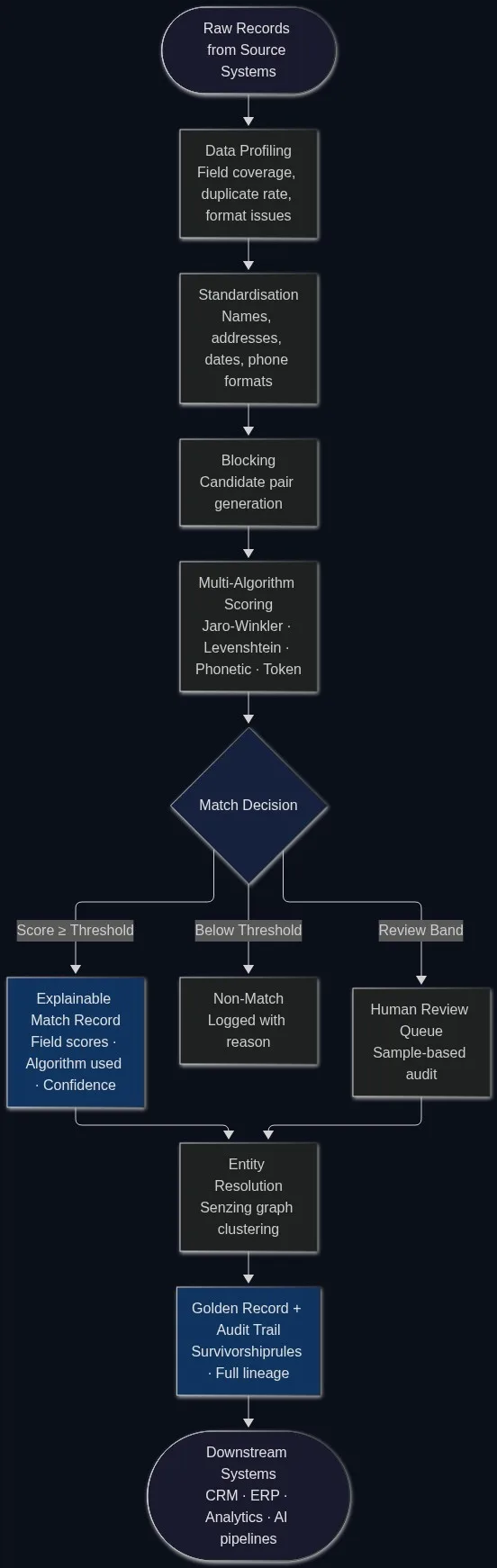
A reliable unification process follows six defined stages. Skip one and the output degrades at every stage downstream.
Stage 1: Profile Every Source Dataset
Before any record moves, run AI data profiling across all source datasets. Measure completeness (what percentage of name fields are populated?), uniqueness (what percentage of email addresses appear more than once within the same dataset?), and consistency (how many distinct formats exist for phone numbers?). These numbers drive every threshold decision later.
A concrete example: a healthcare organisation profiling three source systems found 34 distinct phone number formats across 1.2 million records. Without profiling, those formats would have broken every downstream blocking rule.
Stage 2: Standardise Before You Match
Data standardisation converts raw values into a consistent canonical form. Name fields: title-case, expanded abbreviations, stripped punctuation. Address fields: parsed to component parts (street number, street name, unit, city, state, ZIP). Phone fields: E.164 format. Date fields: ISO 8601.
Standardisation before matching reduces false negatives by 30 to 50 percent. A record pair that scores 62/100 on raw strings often scores 89/100 after standardisation — pushing it past a merge threshold it would never have reached otherwise.
Stage 3: Block to Control Comparison Volume
Comparing every record against every other record is O(n²). At 5 million records, that is 12.5 trillion comparisons — not feasible in any operational pipeline. Blocking generates candidate pairs by grouping records that share one or more blocking keys: first three characters of surname, first five digits of ZIP code, Soundex code of company name.
Multi-pass blocking uses several independent blocking keys and takes the union. This catches pairs that miss one key due to a typo but match on another. Typical candidate pair reduction: 99.9 percent of the total comparison space, with less than 0.5 percent miss rate on true matches.
Stage 4: Score With Multiple Algorithms
No single matching algorithm handles all field types accurately. Match Data Pro applies a weighted composite score across field-specific algorithms:
| Campo | Algoritmo | ¿Por qué? |
|---|---|---|
| Nombre | Jaro-Winkler | Prefix-sensitive, handles transpositions |
| Apellido | Levenshtein + Phonetic | Edit distance plus sound-alike variants |
| Empresa | Índice de clasificación de fichas | Word-order independent, handles “Ltd” vs “Limited” |
| DIRECCIÓN | CASS verification + fuzzy | Canonical address first, then similarity |
| Teléfono | Exact after normalisation | No ambiguity once E.164 formatted |
| Correo electrónico | Exact + domain-level fuzzy | Catches typos like “gmial.com” |
Field weights reflect data quality and business importance. If email completeness is 40 percent, reduce its weight. If company name is the most reliable discriminator in your dataset, increase its weight. Match Data Pro’s configurable fuzzy matching engine lets you set both algorithm choice and field weight per job, without code changes.
Stage 5: Resolve Entities With Graph Clustering
Pairwise scoring tells you whether Record A matches Record B. It does not tell you that Record A, Record B, and Record C all refer to the same entity. That requires entity resolution using graph-based clustering: treat each record as a node, each match as an edge, and cluster connected records into a resolved entity group.
Match Data Pro integrates Senzing entity resolution, which applies a pre-trained probabilistic model to build and maintain entity graphs in real time. Senzing processes incremental updates — a new record arriving from a CRM import is compared against the existing entity graph and assigned to the correct cluster or starts a new one, without reprocessing the entire dataset.
Stage 6: Apply Survivorship Rules and Produce the Golden Record
Once records are clustered, survivorship rules decide which field value from which source becomes the authoritative value in the golden record. Common rules:
- Most recent non-null: Use the most recently updated value that is not empty.
- Source priority: CRM address beats marketing platform address if the CRM was updated more recently.
- CASS-verified: Always prefer the CASS-verified address component over an unverified one.
- Frequency majority: If three of five records agree on a phone number, use it.
The output is a golden record with a unique entity ID, full field provenance (which source contributed each value), and a lineage audit trail showing every record that contributed to the merge.
Address Verification as a Unification Accelerator
Address fields are present in almost every dataset and are among the most inconsistently stored. Unifying across systems without first standardising and verifying addresses produces false non-matches: “123 Main St Apt 4B, New York, NY 10001” and “123 Main Street, Apartment 4B, New York, 10001-2345” score only 71/100 on a raw string comparison but are identical addresses.
Match Data Pro’s CASS address verification pipeline standardises every US address to USPS canonical form and appends ZIP+4 before the matching stage runs. After CASS verification, those two address strings become identical, and the match score rises to 100/100 on the address component. For international addresses, the same normalisation logic applies using country-specific postal standards.
Organisations that run CASS verification before fuzzy matching typically see a 15 to 22 percent increase in true-positive match rate on address-heavy datasets — without changing any matching thresholds.
Keeping Unified Data Clean: Automation and Monitoring
Data unification is not a one-off project. New records arrive daily from web forms, imports, and system integrations. Each new record is a potential duplicate of an existing golden record. Without automation, the duplicate rate returns to baseline within six to twelve months.
Match Data Pro’s automated job scheduling lets you configure recurring unification runs — nightly, weekly, or triggered by import events. The live fuzzy search API handles point-of-entry deduplication: before a new record is committed, the API scores it against the existing entity graph and surfaces potential matches for confirmation or auto-merge based on configurable thresholds.
Monitoring completes the loop. Set alerts on duplicate rate, match confidence distribution, and null-rate drift. If the marketing team starts entering addresses in a new format that the standardisation rules do not cover, the null rate on the address component will spike — a detectable signal before it corrupts a downstream report.
Want to see the full pipeline in action on your data? Book a demo and we will walk through a live unification job on a sample of your records.
Data Unification Use Cases by Industry
Servicios financieros
A bank consolidating retail and commercial customer records across a core banking system, a CRM, and a KYC platform uses unification to build a single customer view for AML screening. Without it, the same individual may pass through three separate watchlist checks with three different identity profiles, missing connections that entity resolution would have surfaced.
Sanidad
An integrated delivery network linking EHR, pharmacy, lab, and insurance billing records needs patient-level unification before any population health analysis is possible. Duplicate patient records across systems inflate readmission rates and distort quality metrics. Healthcare entity resolution resolves these at scale using demographic blocking and probabilistic scoring.
Retail and E-Commerce
A retailer with 8 million customer records split across a loyalty platform, an e-commerce system, and an in-store POS uses unification to build a customer 360 view. The same customer has three separate records — one with a mobile number, one with an email, one with a postal address. Unification links all three into a single profile and eliminates duplicate campaign sends that inflate suppression costs.
Preguntas frecuentes
What is data unification and how does it differ from data integration?
Data unification resolves which records across different systems refer to the same real-world entity and merges them into a single authoritative golden record. Data integration moves data between systems without resolving identity conflicts. Integration is a prerequisite for unification but does not replace it. You need both: integration to bring data together and unification to deduplicate and resolve it.
How long does a data unification project take?
A focused unification project covering 2 to 4 source systems and up to 5 million records typically takes 4 to 8 weeks from profiling to production golden records. The timeline depends on data quality at source, the number of systems involved, and how complex the survivorship rules are. Match Data Pro’s cloud SaaS platform eliminates infrastructure setup time — most teams are running their first profiling job within 24 hours of signing up.
What is a golden record in the context of data unification?
A golden record is the single authoritative representation of an entity — a customer, company, or location — created by merging all duplicate records for that entity using survivorship rules. Each field in the golden record carries provenance metadata showing which source system supplied the value and when it was last updated. The golden record is the output that downstream systems consume.
Can data unification work without a shared ID across systems?
Yes. Most enterprise unification projects lack a shared identifier. Match Data Pro resolves identity using composite fuzzy scoring across name, address, phone, and email fields — no common primary key required. Blocking reduces the comparison space to manageable candidate pairs, and multi-algorithm scoring identifies matches that exact joining would miss entirely.
How do you prevent new duplicates from re-entering a unified dataset?
Prevention requires two mechanisms: point-of-entry matching via a live API that scores new records against the existing entity graph before they are committed, and scheduled batch deduplication to catch duplicates that arrive through bulk imports or system migrations. Match Data Pro’s live fuzzy search API handles real-time prevention. Scheduled jobs handle batch imports. Together they maintain a steady-state duplicate rate below 2 percent.