
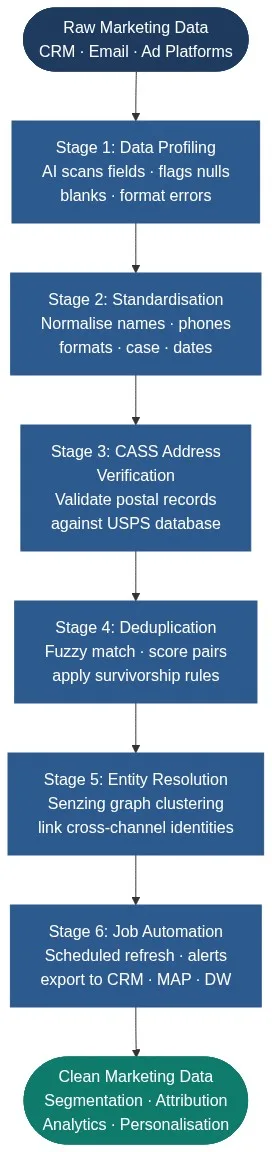
Marketing data quality problems cost organisations more than wasted ad spend. Duplicate contacts, wrong email addresses, and unstandardised name fields corrupt segmentation, skew attribution models, and produce campaign reports that no one should trust. The fix is a structured, automated pipeline: profile your data to expose errors, standardise formats, verify addresses, deduplicate records, and resolve cross-channel identities into a single customer view.
Ready to clean your marketing data? Start a free trial of Match Data Pro and run your first data quality profile in minutes.
Why Marketing Data Degrades Faster Than Any Other Domain
B2B contact data decays at roughly 25 to 30 percent per year. People change jobs, companies rebrand, addresses move, and email domains expire. Marketing automation tools and CRM systems compound the problem by accepting new contacts without validation — creating a growing backlog of unreliable records.
Common patterns that break marketing data quality include:
- Duplicate contact records — the same person entered from a web form, a trade show scan, and a manual CRM import. Three records, three different email addresses, zero consolidated history.
- Inconsistent name formats — “J. Smith”, “John Smith”, “JOHN SMITH”, and “Smith, John” are the same person. String-match filters treat them as four separate contacts.
- Undeliverable addresses — postal addresses stored without USPS verification accumulate errors that waste direct mail budget and inflate database size.
- Misspelled or transposed emails — “jsmith@acme.con” and “jsmth@acme.com” pass CRM validation rules but bounce on send.
- Missing or blank fields — 15 to 40 percent of CRM records typically have incomplete company name, phone, or region fields that block segmentation.
Each of these issues is measurable. The first step is knowing exactly how bad the problem is.
Stage 1: Profile Your Marketing Data to Expose the Real Problem
You cannot fix what you have not measured. AI data profiling scans every field across your contact, account, and campaign datasets and returns a structured quality report: completeness rates, format consistency scores, value distribution, duplicate density, and pattern anomalies.
What a profiling run reveals
A profiling run on a 200,000-record marketing database typically finds:
- Duplicate rate: 12 to 22 percent (24,000 to 44,000 duplicate contact records)
- Address validity: 68 to 78 percent (46,000 to 64,000 unverified or malformed addresses)
- Email completeness: 81 to 89 percent (22,000 to 38,000 records missing a usable email)
- Company name inconsistency: 31 percent (62,000 records with format variants)
These numbers translate directly into budget waste. If your email deliverability rate is 78 percent because of dirty addresses, you are paying platform costs on contacts that cannot be reached. If 18 percent of your accounts are duplicated, your lead routing logic is splitting history and assigning the same prospect to two reps simultaneously.
Stage 2: Standardise Fields Before Matching or Segmenting
Raw marketing data arrives in dozens of inconsistent formats. Standardisation normalises every field to a canonical form before any matching or segmentation logic runs.
Field-level standardisation rules that matter
Effective data standardisation applies transformation rules at the field level:
- Name fields: Apply title-case, strip salutations (“Dr.”, “Mr.”, “Mrs.”), expand initials to full names where a reference table exists.
- Company names: Normalise legal suffixes (“Inc” to “Inc.”, “LLC” stays “LLC”, “Ltd” to “Ltd.”), strip punctuation variants, lowercase for matching keys.
- Phone numbers: Strip formatting characters, apply E.164 format, separate extension values into a dedicated field.
- Dates: Parse and convert all date formats to ISO 8601 (YYYY-MM-DD) to prevent regional format ambiguity.
- State and country codes: Map full names to ISO codes (“California” to “CA”, “United States” to “US”).
Without standardisation, fuzzy matching algorithms work against inconsistent inputs and produce false negatives — two records for the same person that score below the match threshold because “J Smith” and “John Smith” look less similar than they are.
Stage 3: Verify Addresses and Remove Undeliverables
Unverified addresses inflate your database, waste direct mail spend, and skew geographic segmentation. CASS (Coding Accuracy Support System) address verification, as used in Match Data Pro’s address cleansing pipeline, validates every postal address against the USPS database, corrects street abbreviations, appends ZIP+4 codes, and flags records that cannot be delivered.
For US-based marketing databases, a CASS pass typically corrects 8 to 14 percent of addresses and removes 3 to 6 percent as undeliverable. For organisations running direct mail campaigns at scale, that correction rate translates to measurable cost savings on print and postage.
Stage 4: Deduplicate Contacts and Accounts
Deduplication is the stage that most marketing teams attempt first but get wrong. A simple email-match rule catches obvious duplicates but misses 60 to 70 percent of real-world pairs where emails differ across records.
Why exact-match deduplication fails
Consider these two records in a typical CRM:
| Campo | Registro A | Disco B |
|---|---|---|
| Nombre | Jennifer | Jen |
| Apellido | Martinez | Martínez |
| Correo electrónico | jmartinez@acme.com | jen.m@acme-corp.com |
| Teléfono | 415-555-0192 | (415) 555-0192 |
| Empresa | Acme Inc. | ACME Corporation |
An exact-match rule finds zero matches here. A fuzzy matching pipeline scores this pair at 87 to 92 percent similarity on a composite of Jaro-Winkler (name), phonetic (last name with accent), and token-based (company) algorithms — well above a 75 percent match threshold.
Match Data Pro’s data deduplication engine uses configurable, field-weighted fuzzy scoring. You set the algorithm per field, weight each field by its discriminating power, and define the threshold bands for automatic merge, manual review, and automatic reject. Survivorship rules then determine which field values carry forward into the merged golden record.
Book a demo to see deduplication in action on a sample of your own marketing data: Schedule a demo with the Match Data Pro team.
Stage 5: Resolve Cross-Channel Identities with Entity Resolution
Deduplication within a single system is not enough. Most marketing teams operate across CRM, marketing automation, paid advertising platforms, web analytics, and event platforms. A contact exists in all of them — with different identifiers in each.
Entity resolution links these cross-channel identities into a single master record without requiring a shared primary key. Match Data Pro uses Senzing entity resolution — a graph-based probabilistic matching engine that clusters records across systems using weighted field evidence. A Salesforce lead, a HubSpot contact, a LinkedIn ad click attribution record, and a Marketo email subscriber can all resolve to the same person even when name spellings, email addresses, and phone formats differ across platforms.
What entity resolution enables for marketing teams
- Accurate attribution: One contact, one journey. Revenue attribution models receive a single resolved identity across all touchpoints.
- Suppression lists that actually work: Unsubscribes applied to one email variant propagate to all identity variants for the same person.
- Account-based marketing (ABM): Contact-to-account linkage at scale, with all contacts correctly rolled up to their parent company entity.
Stage 6: Automate the Pipeline and Monitor Continuously
A one-time data cleanse is not a data quality program. Contacts enter your database every day from web forms, events, enrichment vendors, and third-party list imports. Without an automated pipeline, quality degrades within weeks of a manual clean.
Match Data Pro’s automated data cleansing runs scheduled jobs that process new and changed records through the full pipeline: profile, standardise, address-verify, deduplicate, entity-resolve, and export back to your CRM or marketing platform. Job automation supports configurable schedules, alert thresholds, and export connectors for Salesforce, HubSpot, and flat-file targets.
Pair the pipeline with a data quality dashboard that tracks key metrics over time: duplicate rate, email deliverability rate, address validity percentage, and field completeness by segment. When a metric crosses a threshold, an alert fires before the problem propagates to a campaign or report.
The result: marketing analytics and reporting built on data you can trust. Segment sizes that reflect real counts. Attribution models that credit the right channels. Campaign performance metrics that match what sales actually sees in the CRM.
Preguntas frecuentes
What is marketing data quality and why does it matter?
Marketing data quality measures the accuracy, completeness, consistency, and uniqueness of contact and account records used in campaigns, segmentation, and attribution. Poor quality data inflates database size, reduces email deliverability, breaks lead routing, and corrupts attribution models — directly reducing marketing ROI and campaign effectiveness.
How often should I run a marketing data quality audit?
Run a full data quality audit at least quarterly, and configure automated profiling to run on every batch of new records entering your CRM or MAP. B2B contact data decays at 25 to 30 percent per year, so quarterly audits catch material degradation before it affects active campaigns. Monthly or weekly automated runs catch new entries in near real time.
Can fuzzy matching find duplicates that email matching misses?
Yes. Fuzzy matching compares names, phone numbers, company names, and addresses using algorithms that tolerate spelling variants, format differences, and partial matches. A composite fuzzy score across multiple fields catches 60 to 70 percent more duplicates than an email-only exact match rule, particularly for records where email addresses differ across source systems.
What is CASS address verification and do I need it for marketing data?
CASS (Coding Accuracy Support System) is a USPS certification that validates postal addresses against the official US address database, corrects abbreviations, and appends ZIP+4 codes. If you run direct mail campaigns or use postal address for geographic segmentation, CASS verification is essential. It typically corrects 8 to 14 percent of addresses and eliminates 3 to 6 percent of undeliverables.
How long does it take to clean a 200,000-record marketing database?
With an automated platform, profiling a 200,000-record database takes under 10 minutes. Standardisation and address verification typically complete within 20 to 40 minutes. Deduplication and entity resolution run in under 60 minutes for most datasets at this scale. The full pipeline from raw to clean can complete in under two hours, compared to weeks of manual effort.