The Model Context Protocol (MCP) gives AI agents a standardised way to call external tools — and for data teams, that means every fuzzy match, deduplication job, entity resolution query, and address verification can now be invoked directly from an AI workflow without writing custom integration code. MCP transforms data quality from a batch process teams schedule manually into a live capability that any AI agent can trigger, inspect, and act on.
Ready to see what an MCP-connected data quality pipeline looks like in practice? Start a free trial of Match Data Pro — no contract required.
What Is the Model Context Protocol?
MCP is an open protocol that standardises how AI models and agents communicate with external tools, data sources, and APIs. Think of it as a universal adapter between an LLM and the software services it needs to call. Instead of writing a bespoke plugin for every tool, developers define a single MCP server that exposes capabilities as named, schema-validated tool calls.
An AI agent built on any compliant framework — LangChain, Claude, GPT-based systems, custom pipelines — can connect to the same MCP server and invoke its tools using a shared protocol. The agent sends a structured tool call; the MCP server routes it to the underlying capability; the result comes back in a structured format the agent can reason over.
For data teams, this matters because it turns data quality operations into first-class AI tools. Profiling, cleansing, deduplication, entity resolution, and address verification all become callable capabilities rather than isolated scripts or GUI workflows.
Why Data Quality Is a Natural Fit for MCP
Data quality work has always involved orchestration. You profile a dataset, discover issues, apply cleansing rules, run deduplication, resolve entities, verify addresses, then hand clean records downstream. Each step depends on the previous one. That dependency chain is exactly what AI agents are good at managing — provided they have reliable tool calls to invoke at each stage.
Without MCP, connecting an AI agent to a data quality platform requires custom API wrappers, one-off integration code, and brittle prompt engineering to interpret unstructured API responses. Every new agent framework breaks those wrappers.
With MCP, the agent calls a tool by name — profile_dataset, run_deduplication, resolve_entity — and gets back a structured result it can parse and act on. The protocol handles authentication, schema validation, and error signalling. The agent handles logic and sequencing.
The five MCP-callable data quality operations
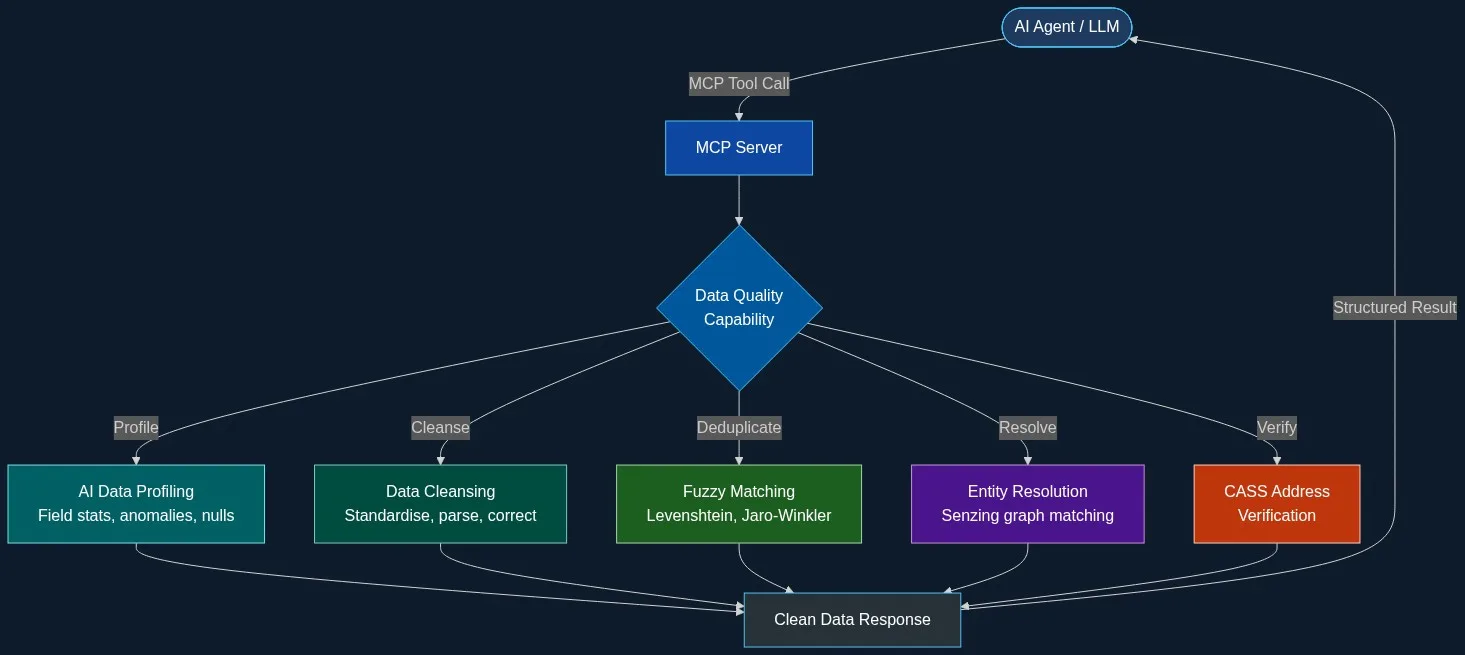
A well-designed MCP server for data quality exposes five core tool categories:
- Profile: Scan fields for null rates, format anomalies, outliers, and value distributions. Returns quality scores per field and per dataset.
- Cleanse: Standardise casing, parse compound fields, correct format errors, strip noise characters, apply domain-specific rules.
- Deduplicate: Run fuzzy matching deduplication using configurable algorithms (Levenshtein, Jaro-Winkler, phonetic) with threshold control and survivorship rules.
- Resolve entities: Link records across datasets that refer to the same real-world person, organisation, or location using entity resolution in automated pipelines.
- Verify addresses: Submit addresses for CASS-certified postal validation and correction, returning standardised, deliverable records.
How an AI Agent Uses MCP to Clean Data: A Five-Step Pipeline
The workflow starts when an agent receives a task: clean and deduplicate the Q3 CRM export before it loads into the analytics warehouse. Without MCP, the agent would need to write SQL, call REST endpoints with custom auth, and parse unstructured JSON. With MCP, the sequence is deterministic and auditable.
Step 1: Profile
The agent calls profile_dataset(file_id="crm_q3.csv"). The MCP server returns a structured quality report: 12% null rate in company_name, 8% format anomalies in phone, 3,400 suspected duplicate clusters. The agent reads the report and decides which operations to run next.
Step 2: Cleanse and standardise
The agent calls cleanse_dataset(rules=["normalise_phone_us", "title_case_name", "strip_salutation"]). The MCP server applies the rules and returns a cleaned file reference. AI data profiling at this stage identifies which fields need the most aggressive correction before matching begins — reducing false positives downstream.
Step 3: Deduplicate
The agent calls run_deduplication(algorithm="jaro_winkler", threshold=0.88, fields=["name","email","phone"]). The MCP server runs the matching job, scores candidate pairs, and returns a merge plan with survivorship recommendations. The agent auto-approves merges above 0.94 and queues pairs between 0.88 and 0.93 for human review.
Step 4: Entity resolution
Deduplication finds duplicates within a dataset. Entity resolution links records across datasets. The agent calls resolve_entities(source_a="crm_q3", source_b="billing_system"). The MCP server uses Senzing’s graph-based matching to identify that “Acme Corp.”, “ACME Corporation”, and “Acme Incorporated” all refer to the same entity — linking 847 records across two systems without a shared identifier.
Step 5: Address verification
The agent calls verify_addresses(file_id="merged_output"). CASS-certified validation corrects street abbreviations, appends ZIP+4 codes, and flags undeliverable records. The agent receives a pass rate and a corrected file. Connecting LLM workflows to a clean data foundation works this way at scale — no human touches a UI between ingestion and a verified, analysis-ready dataset.
What Data Teams Need to Know Before Deploying MCP
Tool schema design matters
MCP tool calls must have precise, schema-validated parameters. An agent calling run_deduplication needs to know exactly which field names and algorithm identifiers are valid. Poorly specified schemas cause agents to hallucinate parameter values — sending algorithm="fuzzy" when the valid values are "levenshtein", "jaro_winkler", or "soundex". The MCP server should return an enum of valid values in its tool definition and reject unknown inputs with a descriptive error.
Security and data exposure
Calling data quality tools via MCP means the agent has access to production records. Role-based access controls, field-level masking for PII, and audit logging of every tool call are not optional. Every tool invocation should log the agent ID, parameters sent, result returned, and timestamp. This gives compliance teams a complete record of which AI systems touched which data.
Idempotency and job state
Deduplication and entity resolution jobs are expensive operations. If an agent retries a failed call, it should not trigger a duplicate job. MCP servers for data quality should return a job ID on long-running operations and expose a get_job_status(job_id) tool so agents can poll for completion rather than retry blindly.
Threshold transparency
An agent that auto-merges records without a clear threshold policy creates data loss. MCP tool responses should include confidence scores and the algorithm weights used, so agents can implement consistent routing logic: auto-merge above threshold X, queue for review between X and Y, reject below Y. Teams can read more about the downstream risk in our article on why AI hallucinates when data quality is poor.
Match Data Pro as an MCP-Connected Data Quality Platform
Match Data Pro exposes its full data quality capability set through an MCP server, making every core operation available as a named, schema-validated tool call.
AI-powered fuzzy matching covers Levenshtein, Jaro-Winkler, Soundex, and token-based algorithms with configurable weights per field. Agents choose the algorithm combination that fits the data type — name fields use Jaro-Winkler; phone fields use exact numeric comparison with tolerance for digit transposition; free-text fields use token-ratio scoring.
Entity resolution via Senzing links records across siloed systems using graph-based probabilistic matching. Agents can resolve millions of cross-system record pairs per hour without hand-crafted rules. See how it works in our deep dive on Senzing entity resolution.
CASS address verification runs through the MCP server as a single tool call. The agent submits a file reference; the server returns standardised, ZIP+4-appended, deliverable addresses.
Data profiling returns structured quality metrics — completeness, consistency, format conformance, duplicate density — that the agent uses to decide which downstream tools to invoke and with what parameters. Full details in our guide to AI data profiling.
Job automation lets agents schedule recurring data quality pipelines triggered by cron, webhook, or on-demand call. Each run produces an audit log the agent or a human reviewer can inspect.
Match Data Pro is cloud SaaS with no long-term contract. Teams connect their AI agent stack in hours, not weeks. Book a demo to see the MCP integration in action, or register for a free trial and connect your first agent today.
Frequently Asked Questions
What is the Model Context Protocol and why does it matter for data quality?
MCP is an open protocol that lets AI agents call external tools using a standardised interface. For data quality, it means agents can invoke profiling, cleansing, deduplication, entity resolution, and address verification as named tool calls — without custom integration code for each framework or platform.
Can an AI agent run deduplication on its own using MCP?
Yes. An agent connects to an MCP server, calls run_deduplication with field names, algorithm choice, and threshold parameters, and receives back a structured merge plan with confidence scores. High-confidence pairs merge automatically; borderline pairs are routed for human review. No manual UI interaction is required.
How does MCP handle long-running data quality jobs like entity resolution?
A well-designed MCP server returns a job ID immediately for long-running operations. The agent then polls a get_job_status tool until the job completes. This prevents duplicate job submission on retry and lets the agent continue other tasks while resolution runs in the background.
Is it safe to give an AI agent access to production customer data through MCP?
Safety depends on implementation. Production deployments should use role-based access controls, field-level PII masking, and a full audit log of every tool call — recording the agent ID, parameters, result, and timestamp. Never grant an agent broad write access without approval gates and a review queue for high-risk merges.
Does Match Data Pro have an MCP server I can connect to my AI agent?
Yes. Match Data Pro exposes its full capability set — fuzzy matching, deduplication, entity resolution (Senzing), CASS address verification, data profiling, and job automation — as MCP tools. Agents connect in hours. No long-term contract is required. Start at members.matchdatapro.com or read the MCP server overview.