
Agentic deduplication pipelines automatically detect, score, and merge duplicate records without a human in the loop for every decision. A well-configured pipeline routes high-confidence matches directly to survivorship rules, flags borderline cases for targeted human review, and passes unique records through untouched — processing millions of rows in a single unattended run.
Manual deduplication does not scale. A single CRM of 500,000 contacts can contain 80,000–120,000 duplicate pairs when data has been imported from multiple sources over several years. Reviewing those pairs by hand at 60 seconds each would take over 1,300 analyst-hours. Agentic pipelines reduce that labour cost by 90% or more, while producing a consistent, auditable match log. Book a demo to see how Match Data Pro automates this end to end.
What Makes a Deduplication Pipeline “Agentic”
Traditional deduplication is a manual, batch-by-batch exercise: upload a file, configure a rule, review output, export. An agentic pipeline does something different. It operates continuously, makes rule-based decisions autonomously, and only escalates to a human when confidence falls below a defined threshold.
Three components define an agentic deduplication system:
- Autonomous decision-making: records above a match threshold are merged and flagged as golden records without waiting for a reviewer.
- Configurable escalation: records in the grey zone — typically scores between 0.75 and 0.91 — route to a human review queue, not to a blanket reject pile.
- Feedback loops: reviewer decisions on borderline cases update match weights over time, narrowing the grey zone for future runs.
Match Data Pro’s AI-powered fuzzy matching engine supports all three. Thresholds, weights, and survivorship rules are configured once per project. Subsequent runs — triggered on a schedule or via API — execute without manual intervention.
The Seven-Stage Agentic Deduplication Pipeline
Each stage below is discrete, auditable, and — in Match Data Pro — configurable without writing code.
Stage 1 — Ingest
Data arrives via file upload, database connector, or API. Match Data Pro’s import connectors accept CSV, Excel, SQL databases, Salesforce, HubSpot, and more. Each source is mapped to a canonical schema at import time, so field names and data types are consistent before any matching begins.
Stage 2 — Profile
The platform runs AI data profiling across every field: completeness rates, value distributions, format patterns, and outlier flags. A typical profiling result for a CRM contact dataset might look like this:
| Field | Completeness | Format Issues | Likely Duplicates |
|---|---|---|---|
| Correo electrónico | 94% | 3% (missing @domain) | 11% |
| Phone | 78% | 12% (mixed formats) | 8% |
| Company Name | 88% | 7% (abbreviations) | 19% |
| First Name | 99% | 1% (numeric entries) | 14% |
Profiling output drives the cleansing configuration for the next stage. Fields with high format-error rates get targeted parsing rules applied automatically.
Stage 3 — Cleanse and Standardise
Automated data cleansing and standardisation runs before matching. This includes name parsing (separating first/last/suffix), phone normalisation to E.164 format, company suffix standardisation (LLC vs L.L.C. vs Limited Liability Company), and null value handling. Addresses are parsed, standardised, and verified using CASS-certified address verification.
Standardising before matching dramatically improves match recall. Two records for “Robert Johnson, Acme Corp., 123 Main St” and “Bob Johnson, ACME Corporation, 123 Main Street” become structurally comparable after cleansing — even though they would score poorly on a raw string comparison.
Stage 4 — Block
Blocking reduces the comparison space from O(n²) to a manageable set of candidate pairs. A dataset of 1 million records has 500 billion possible pairs. Blocking on phonetic surname code and ZIP code might reduce that to 15 million candidate pairs — a 99.997% reduction before a single fuzzy score is computed.
Match Data Pro supports multiple simultaneous blocking keys, so a record that fails one block (wrong ZIP due to a typo) can still be found by another (matching phonetic code).
Stage 5 — Match and Score
Each candidate pair is scored across multiple fields using a weighted combination of fuzzy matching algorithms: Levenshtein edit distance for names, Jaro-Winkler for short strings, token-set ratio for company names, Soundex/NYSIIS for phonetic similarity, and exact match for tax IDs or emails. Each field score is multiplied by its configured weight and summed to a composite similarity score between 0 and 1.
Example: two contact records compared field by field:
| Field | Record A | Record B | Score | Weight | Contribution |
|---|---|---|---|---|---|
| First Name | Robert | Bob | 0.62 | 0.15 | 0.093 |
| Last Name | Johnson | Johnson | 1.00 | 0.20 | 0.200 |
| Correo electrónico | rjohnson@acme.com | bob.johnson@acme.com | 0.71 | 0.30 | 0.213 |
| Company | Acme Corp | ACME Corporation | 0.92 | 0.20 | 0.184 |
| Phone | +1-555-200-1234 | +15552001234 | 1.00 | 0.15 | 0.150 |
| Total | 0.840 |
A score of 0.840 falls in the human review zone (0.75–0.91). The pipeline routes this pair to a reviewer rather than auto-merging.
Stage 6 — Decide and Merge
Records scoring at or above the auto-merge threshold (default: 0.92) are sent directly to survivorship rules. The rules define which field value “survives” into the golden record: most recent, most complete, highest-confidence source, or a custom priority order. Records below the reject threshold pass through as unique. The match merging and survivorship engine in Match Data Pro applies these rules automatically, producing a clean golden record for each matched cluster.
Stage 7 — Export and Automate
Deduplicated golden records are exported back to the source system, pushed via API, or written to a data warehouse. Match Data Pro’s job automation layer lets you schedule this entire pipeline — ingest, profile, cleanse, match, merge, export — as a recurring job. Daily, weekly, or event-triggered runs keep downstream systems continuously clean without analyst involvement.
The deduplication API also enables real-time duplicate checking at point of entry: before a new CRM record is committed, a live fuzzy search checks it against existing records and surfaces near-matches for the user to review or suppress.
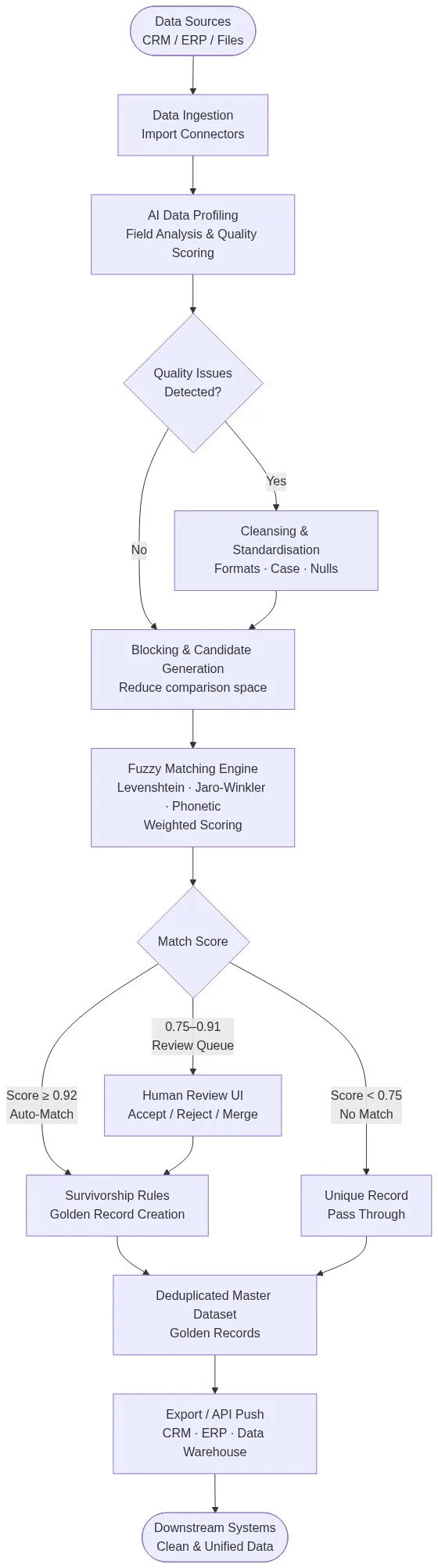
Figure 1: The end-to-end agentic deduplication pipeline in Match Data Pro — from multi-source ingestion through AI profiling, fuzzy scoring, and survivorship to golden record output.
Threshold Configuration: The Core Engineering Decision
The single most important configuration choice in any agentic deduplication pipeline is the threshold split: where does auto-merge end and human review begin?
There is no universal right answer. The correct thresholds depend on your data’s error profile, your downstream risk tolerance, and the cost of false positives vs. false negatives. A financial services firm merging customer accounts cannot tolerate false merges — a 0.95 auto-merge threshold is appropriate. A marketing team deduplicating a cold outreach list may set it at 0.88 to reduce redundant outreach without losing leads to over-caution.
Match Data Pro recommends a three-zone configuration:
- Auto-merge zone (0.92+): the pipeline merges without human input. Typically covers 60–75% of duplicates found.
- Review zone (0.75–0.91): borderline pairs queue for a human decision. Typically 10–20% of duplicates.
- Reject zone (below 0.75): no match. Records treated as unique.
Calibrate thresholds by running a sample of 1,000–5,000 records through the pipeline and manually reviewing the output at each score band. Adjust weights and thresholds until precision and recall meet your target before running the full dataset. Match Data Pro’s matching rule scoring tools let you tune weights and preview score distributions before committing to a production run.
Common Failure Modes and How to Avoid Them
Over-blocking: Missing Duplicates at Candidate Generation
If your blocking keys are too restrictive, genuine duplicates never enter the candidate pool — and the matching engine never sees them. A typo in a surname initial can cause a record to miss a phonetic block. Solution: use multiple overlapping blocking keys and monitor the candidate-pair count per block. If a block returns zero or very few pairs for a large dataset, the block is likely too narrow.
Threshold Drift: Auto-Merge Zone Shrinks Over Time
As data quality improves, the review queue should shrink. If it grows, your weights have drifted out of calibration with the current data. Re-run threshold calibration every quarter or after any significant data import event. Match Data Pro logs every match decision with its contributing field scores, making recalibration straightforward.
Survivorship Conflicts: Wrong Field Value Survives
Survivorship rules must be explicit. “Most recent” sounds safe, but the most recently updated record in a CRM is sometimes the one with the most errors (a sales rep who entered bad data yesterday). Build survivorship rules that consider both recency and source reliability. Match Data Pro allows field-level survivorship rules with source-priority weights, so you can prefer email from Salesforce but address from a verified import file.
Agentic Deduplication in Practice: Three Use Cases
CRM Deduplication at Scale
A SaaS company running HubSpot with 400,000 contacts built up over eight years of growth, acquisitions, and import events. A one-time post-merger deduplication job found 67,000 duplicate clusters. Survivorship rules preserved the most complete contact record in each cluster. The pipeline ran overnight; the review queue contained 9,200 borderline pairs that two analysts cleared in four hours the next day.
Daily Inbound Lead Deduplication
A B2B marketing team receiving 2,000–5,000 inbound form submissions per day needed to suppress duplicates before routing to sales. They used Match Data Pro’s live fuzzy search API as a pre-insert check: each new lead is scored against existing records in under 200ms. Leads scoring above 0.88 against an existing contact are suppressed and flagged for CRM enrichment instead of creating a new record.
Multi-Source Customer Master
An enterprise with customer records across four systems — an ERP, a legacy CRM, a billing platform, and a support ticketing system — used Match Data Pro’s entity resolution pipeline to build a unified customer master. Records were ingested from all four systems, profiled, cleansed, and matched. The pipeline produced 1.4 million golden customer records from 2.1 million raw inputs — a 33% reduction — with a full audit trail linking every golden record back to its constituent source records.
Getting Started with Match Data Pro
Match Data Pro is a cloud SaaS platform with no long-term contract required. You can configure and run a complete agentic deduplication pipeline — ingest, profile, cleanse, match, merge, export — without writing code. Import connectors, fuzzy matching rules, survivorship logic, and job scheduling are all configurable through the platform UI.
Start a free trial and run your first deduplication job today. Or book a demo to walk through a real-world use case with our team.
Frequently Asked Questions
What is agentic deduplication?
Agentic deduplication is a pipeline that identifies and merges duplicate records autonomously, using configurable match thresholds to decide which pairs to auto-merge, which to route to human review, and which to treat as unique — without requiring a human to inspect every candidate pair.
How is agentic deduplication different from traditional deduplication?
Traditional deduplication requires manual configuration for each run and human review of all matched pairs. Agentic deduplication runs autonomously on a schedule, routes only borderline cases to reviewers, and applies survivorship rules automatically — reducing analyst time by 80–90% on large datasets.
What match threshold should I use for auto-merging records?
Most teams start with an auto-merge threshold of 0.92 and a review zone of 0.75–0.91. The right value depends on your data quality and risk tolerance. Calibrate by manually reviewing a 1,000–5,000 record sample at each score band before committing to a production threshold.
Can an agentic pipeline handle real-time duplicate checking, not just batch runs?
Yes. Match Data Pro’s live fuzzy search API checks each incoming record against the existing dataset in under 200ms at the point of entry. This prevents duplicates from being created rather than cleaning them up after the fact — the most efficient deduplication strategy.
What happens when survivorship rules conflict across source systems?
Field-level survivorship rules resolve conflicts by assigning priority to specific source systems for specific fields. You can prefer email from your CRM but address from a verified import file, with recency as a tiebreaker. Match Data Pro logs every survivorship decision so the golden record is fully auditable.