
Entity resolution in automated pipelines identifies records that refer to the same real-world entity — customer, company, location, or asset — and links them without a human reviewing every pair. A properly configured pipeline routes high-confidence matches to auto-link, low-confidence pairs to a small review queue, and clear non-matches to rejection, keeping manual effort to under 5% of total record volume. The result is a continuously updated set of golden records that downstream systems can trust.
If your team is reviewing thousands of match pairs by hand, the pipeline is doing the hard work for the wrong reason. Book a demo to see how Match Data Pro automates this end to end.
Why Manual Review Breaks at Scale
At 10,000 records, a human reviewer can catch most duplicate pairs in a day. At 10 million records, the same approach produces tens of billions of candidate pairs. Even after blocking reduces comparisons to manageable clusters, the residual volume easily exceeds what analysts can process.
Manual review also introduces inconsistency. Two reviewers will disagree on whether “Acme Corp.” and “Acme Corporation LLC” are the same entity. One will flag it as a match; the other will not. Over thousands of decisions, this variance corrupts downstream analytics and trust in the data.
Automated entity resolution solves both problems. It applies the same scoring logic to every pair, routes decisions by confidence band, and reserves human review for the genuinely ambiguous cases — typically 2 to 5% of volume. Agentic entity resolution takes this further by letting AI orchestration layers trigger and manage the entire pipeline without operator intervention.
The Seven-Stage Automated Entity Resolution Pipeline
Below is the flowchart for a complete automated entity resolution pipeline, from raw ingestion to golden record output.
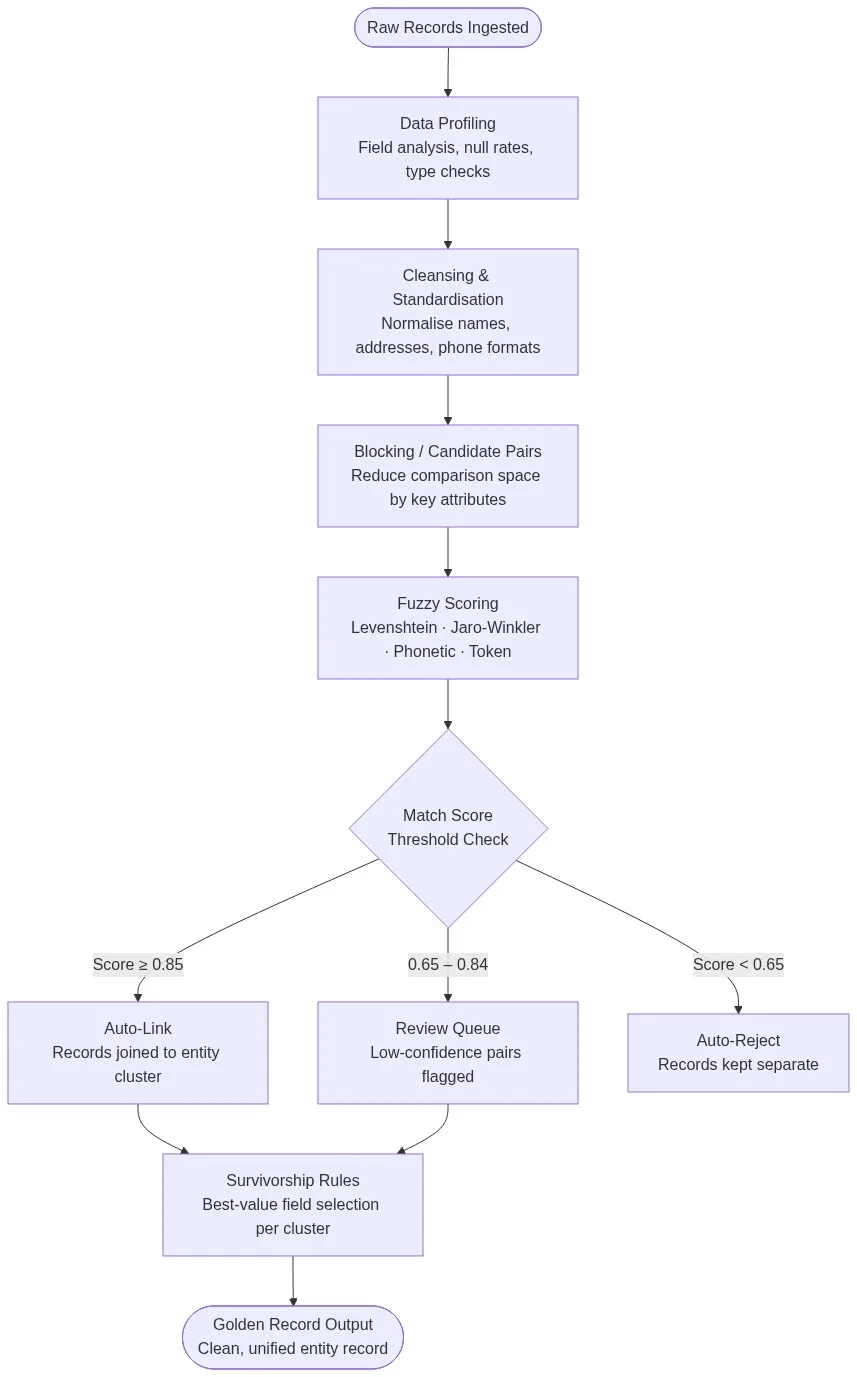
Stage 1: Ingest and Profile
AI data profiling runs first. The pipeline examines every field for null rates, type consistency, value distributions, and format anomalies. If the “company_name” field is 40% null or the “phone” field mixes international and domestic formats, those issues surface before any matching starts. Catching them here prevents false positives downstream.
Stage 2: Cleanse and Standardise
Raw records are normalised before comparison. Names are title-cased and stripped of punctuation artifacts. Phone numbers are converted to E.164 format. Addresses are parsed into components — street number, street name, unit, city, state, ZIP — and verified against CASS-certified reference data. A record that enters as “123 main st ste 4b, new york ny 10001” exits as “123 Main St Suite 4B, New York, NY 10001-1234”.
Standardisation matters because fuzzy data matching scores similarity, not identity. Two records that are structurally identical after normalisation will score 1.0 and auto-link without consuming comparison budget on trivial string differences.
Stage 3: Block into Candidate Pairs
Comparing every record against every other record at 10 million rows produces 50 trillion pairs. Blocking collapses that to a tractable set by grouping records that share at least one key attribute — first three characters of surname, ZIP code, or phone area code. Only pairs within the same block are compared.
Multi-pass blocking applies several independent blocking keys and takes the union. A record missing a surname match may still block on ZIP plus phone prefix. This keeps recall high while cutting comparison cost by 99.9% or more.
Stage 4: Score with Multi-Algorithm Fuzzy Matching
Each candidate pair is scored using a weighted combination of data matching algorithms tuned to each field type:
| Field | Algorithm | Why |
|---|---|---|
| Person name | Jaro-Winkler + phonetic (Soundex/NYSIIS) | Handles transpositions and nicknames (Rob / Robert) |
| Nombre de empresa | Token-set ratio | Word-order variants (“IBM Corp” vs “Corp IBM”) |
| DIRECCIÓN | Levenshtein on parsed components | Unit suffix variants (“Ste” vs “Suite” vs “#”) |
| Phone | Exact after normalisation | E.164 removes all formatting noise |
| Correo electrónico | Domain-aware exact + fuzzy local part | Catches transposed characters in username |
Field scores are combined into a composite match score using configurable weights. A name match carries more weight than a ZIP match. The final score falls between 0.0 and 1.0.
Stage 5: Route by Confidence Threshold
Three bands handle all outcomes:
- Score ≥ 0.85 — Auto-link. Records are joined to an entity cluster without review. This band typically covers 80 to 90% of true duplicates.
- Score 0.65 to 0.84 — Review queue. Pairs are flagged for human review. A trained analyst handles hundreds per hour at this stage, not tens per hour for the full volume.
- Score < 0.65 — Auto-reject. Records are kept as distinct entities. Rejections are logged for audit purposes.
Thresholds are tunable. A financial services team running KYC checks sets the auto-link threshold at 0.92 to minimise false positives. A marketing deduplication job tolerates 0.80 to catch more near-duplicates. Explainable entity resolution surfaces the field-level scores behind every decision so analysts can validate and adjust thresholds with evidence.
Stage 6: Apply Survivorship Rules
When two records link to the same entity, one value per field must survive into the golden record. Survivorship rules and golden records define which source wins field by field. Common rules include:
- Most recent. Take the field value from the record with the latest modified timestamp.
- Most complete. Prefer the longer, more specific value (“Suite 4B” over “Ste 4b”).
- Source priority. CRM data wins over legacy flat-file imports for name fields.
- Majority vote. For multi-source clusters, take the value that appears in at least two of three sources.
Survivorship runs per field, so the golden record can take the phone from Source A, the address from Source B, and the email from Source C — each chosen by its own rule.
Stage 7: Publish the Golden Record
The resolved, merged record is written back to the target system — CRM, MDM platform, data warehouse, or API endpoint. Export connectors handle format translation: Salesforce objects, HubSpot contacts, Snowflake tables, or flat CSV files. Each golden record carries a provenance log listing every source record that contributed to it.
Where Senzing Fits in an Automated Pipeline
Senzing entity resolution is the graph-based probabilistic engine at the core of Match Data Pro’s entity resolution stack. It maintains an in-memory entity graph that updates in real time as new records arrive. When a new record is ingested, Senzing evaluates it against the existing graph — not just pairwise against other records — and determines whether it belongs to an existing entity cluster or creates a new one.
This graph approach handles a problem that pairwise matching cannot: transitive relationships. If Record A matches Record B and Record B matches Record C, but A and C share no direct overlapping fields, pairwise comparison misses the three-way cluster. Senzing resolves the full cluster in one pass.
Senzing also arrives pre-trained on international name variations, corporate entity suffixes (LLC, GmbH, Pty Ltd), and known alias patterns. That eliminates weeks of rules development before a pipeline goes live.
Running Entity Resolution on Sensitive Data
Many pipelines process records that include PII: full names, Social Security Numbers, dates of birth, financial account identifiers. In those contexts, the entity resolution engine must operate on data that never leaves the security boundary.
Match Data Pro supports on-premise deployment for exactly this scenario. The matching and resolution engine runs inside your private cloud or on your own servers. No PII transits to an external service. See the detailed guidance on operating AI workflows on sensitive data for the tokenisation and access-control architecture that supports regulated environments.
How Match Data Pro Automates the Full Pipeline
Match Data Pro combines every stage above into a single configurable platform:
- AI data profiling runs automatically on ingestion and flags field-level quality issues before matching begins.
- Configurable fuzzy matching lets teams choose algorithms and weights per field, then save the configuration as a reusable job definition.
- Senzing entity resolution handles the probabilistic clustering layer with a pre-trained model and real-time graph updates.
- CASS address verification standardises US postal addresses to USPS delivery-point precision before they enter the matching step.
- Job automation schedules recurring runs — nightly deduplication, triggered on CRM import, or continuous stream processing — with no operator required per run.
- Import/export connectors move data in and out of Salesforce, HubSpot, Snowflake, SQL Server, Oracle, CSV, and Excel without custom ETL code.
- Live fuzzy search API exposes the entity graph for real-time lookups — so a CRM form can query for near-duplicate contacts before a new record is created.
No long-term contract is required. Trials start at members.matchdatapro.com/en/register and give full access to the matching engine, Senzing integration, and job automation from day one.
Frequently Asked Questions
What is entity resolution in a data pipeline?
Entity resolution is the process of identifying records across one or more datasets that refer to the same real-world entity — such as a customer, company, or address — and linking or merging them into a single authoritative record. In an automated pipeline, this happens through profiling, standardisation, fuzzy scoring, threshold routing, and survivorship, with no manual review required for high-confidence matches.
How do you avoid false positives in automated entity resolution?
False positives are controlled by setting the auto-link threshold high — typically 0.85 or above — and routing borderline matches to a human review queue instead of auto-linking them. Using multi-algorithm composite scoring (name, phone, address, email together) reduces false positives compared to single-field matching. Explainability tools let analysts audit any auto-linked pair and adjust thresholds based on observed error patterns.
What is blocking and why does entity resolution need it?
Blocking groups records by shared key attributes so only plausible pairs are compared. Without blocking, comparing 10 million records pairwise produces 50 trillion comparisons — computationally infeasible. Blocking reduces that to millions of comparisons while retaining the pairs most likely to be true matches. Multi-pass blocking with several independent keys keeps recall high even when a single key is missing or corrupted.
Can entity resolution run in real time, or only in batch?
Both modes are supported. Batch entity resolution processes an entire dataset in one scheduled run — common for nightly CRM deduplication. Real-time entity resolution evaluates each new record against the existing entity graph as it arrives, which is how Match Data Pro’s live fuzzy search API works. The same matching logic applies in both modes; the difference is trigger timing and latency tolerance.
How are survivorship rules configured in an automated pipeline?
Survivorship rules are configured per field, not per record. Each field is assigned a rule — most recent, most complete, source priority, or majority vote — that determines which value is written to the golden record when two linked records disagree. In Match Data Pro, rules are set in the job configuration UI and applied consistently across every merge in that job run, with field-level conflict logs available for audit.