
Modern data matching platforms expose a REST API for real-time record scoring, support containerised deployment for DevOps teams, and use a rebuilt fuzzy matching engine with field-type-specific algorithms and configurable composite scoring. These three capabilities together reduce duplicate ingestion rates by 60 to 80 percent compared to legacy batch-only tools and raise match precision from the low 80s to above 93 percent on typical enterprise datasets. Match Data Pro delivers all three in a single cloud SaaS platform with no long-term contract.
If your current data matching workflow still relies on a monolithic install, manual batch runs, and static algorithm weights, this article explains what a modern architecture looks like and why it matters for data quality at scale.
Start a free trial of Match Data Pro and test the REST API and matching engine against your own data today.
Why REST API Access Changes Data Matching
Batch processing was the only option when matching engines ran as desktop applications. A REST API changes the deployment model entirely. Instead of exporting a CSV, loading it into a tool, running a job, and re-importing the results, teams embed match scoring directly inside their applications, ETL pipelines, and CRM workflows.
What the API Call Looks Like in Practice
A typical request submits a candidate record and returns a scored list of potential matches from the master file within milliseconds. Consider a CRM onboarding flow where a new contact is submitted:
- Input:
{ "name": "Jon Bradfd", "company": "Acme Corp.", "city": "Phoenix" } - Response: Match candidates with individual field scores and a composite score (for example, 94/100 for “John Bradford, Acme Corporation, Phoenix, AZ”)
The match score routes the record automatically: above 90, flag as a likely duplicate; 70 to 89, queue for human review; below 70, treat as new. This threshold logic runs at the application layer with no manual step.
Match Data Pro’s live fuzzy search API handles these real-time lookups at scale, returning scored candidates in under 200 milliseconds for typical record sizes.
API Patterns for Data Engineering Teams
Data engineers use the REST API in three primary patterns:
- Inline deduplication: Every new record submitted to the API checks against an existing master index before it is written to the database
- Webhook-triggered matching: New CRM contacts trigger a matching job automatically, without scheduled batch runs
- ETL enrichment: A transformation step in an ETL pipeline calls the API to score and tag records before loading into the target system
These patterns reduce duplicate ingestion rates by 60 to 80 percent compared to weekly batch-only workflows. Teams processing high-frequency CRM updates — 5,000 or more contacts per day — benefit most from this architecture.
Containerised Deployment: What It Means for Data Quality Teams
Containerisation was originally a DevOps concern. For data quality teams it has three direct benefits: reproducible environments, simplified on-premise deployment, and scalable horizontal processing.
Reproducibility and Environment Consistency
When a matching engine runs inside a container, the algorithm configuration, threshold settings, and preprocessing rules ship with it. The same container that runs in development runs in production. Configuration drift between environments — a frequent source of match accuracy degradation — is eliminated. A team that achieves 93% precision in its test environment can expect the same result in production without manual recalibration.
On-Premise and Private Cloud Deployment
Security-sensitive organisations — financial institutions, healthcare providers, government agencies — cannot send records to third-party cloud endpoints. A containerised matching engine deploys inside their own infrastructure with no data leaving the network. Match Data Pro supports both cloud SaaS and on-premise container deployment, letting security teams control data residency while still using a modern matching engine.
For teams evaluating cloud vs. on-premise data quality software, containerisation provides a third path: the operational simplicity of a managed platform with the data custody of an on-premise install.
Horizontal Scaling for Large Volumes
Container orchestration allows the matching engine to scale horizontally across worker nodes during peak processing. A team running 50 million record pairs can spin up 10 matching containers in parallel, reducing a 12-hour batch job to under 2 hours without changing any configuration. When the job completes, containers scale back down, controlling infrastructure costs automatically.
What a Rebuilt Matching Engine Actually Improves
The phrase “rebuilt matching engine” appears in vendor announcements without explanation. Here is what it means in concrete terms for data quality accuracy.
Field-Type-Specific Algorithm Selection
Legacy matching engines apply a single algorithm across all fields. A rebuilt engine applies field-type-specific algorithms. Configurable data matching techniques include:
- Jaro-Winkler for person names: penalises character transpositions at the front of the string, where name errors concentrate
- Token-sort ratio for company names: handles word-order differences such as “Global Corp Acme” vs. “Acme Global Corp”
- Phonetic matching (Soundex, Double Metaphone) for fields with high OCR error rates or transliteration variation
- Exact match with normalisation for structured identifiers like phone numbers and tax IDs after format standardisation
These field-specific selections are not just theoretical. In a customer deduplication project involving 4.2 million records, switching from a single-algorithm approach to a field-type-specific composite engine raised precision from 81% to 94% at the same recall threshold.
Configurable Composite Scoring
Modern engines use weighted composite scoring. Each field contributes to the final score according to its discriminatory power. For a B2B contact database, a typical weight profile looks like this:
| Campo | Peso | Rationale |
|---|---|---|
| Email address | 35 | Highest discriminatory value when present |
| Nombre de empresa | 25 | Strong signal for B2B entity resolution |
| Nombre de la persona | 20 | High value but susceptible to variants |
| Número de teléfono | 15 | Reliable when formatted consistently |
| Postal address | 5 | Lowest — changes frequently |
These weights are configurable per project. A financial services team matching on account numbers and legal entity names uses a completely different weight profile than a retail team matching consumer records. Getting weight configuration right is the difference between a 72% and a 94% precision outcome on the same dataset.
Blocking and Candidate Pair Reduction
A naive matching engine compares every record against every other record. For 1 million records, that is 500 billion comparisons — computationally infeasible at any reasonable processing speed. A rebuilt engine uses blocking to reduce the candidate space. Records are grouped into buckets by blocking keys — first three characters of surname, ZIP code prefix, company name token. Only records within the same bucket are compared.
Effective blocking reduces comparison pairs by 99.5% while retaining 98% of true matches. This is what makes matching 50 million records viable in a single pipeline run rather than a multi-day job. Fuzzy matching algorithms in Match Data Pro use multi-key blocking by default, with configurable blocking key combinations per project.
Entity Resolution: The Layer Above Matching
Matching identifies pairs of records that are likely the same entity. Entity resolution clusters those pairs into groups, applies survivorship rules, and builds a golden record. Without this layer, a 4-way duplicate still produces three separate records even after the matching step identifies all four as related.
Match Data Pro integrates Senzing entity resolution for graph-based clustering. After the matching engine scores every candidate pair, Senzing builds a graph where nodes are records and edges are match scores above threshold. Connected components in the graph become entity clusters. Survivorship rules then select the most complete, most recent values from each cluster to build the golden record.
The result: a customer database that enters the pipeline with a 15% duplicate rate emerges with a verified golden record for every unique individual or organisation, plus a full audit trail of which source records contributed to each golden record. This is the output that powers reliable analytics, accurate segmentation, and compliant reporting.
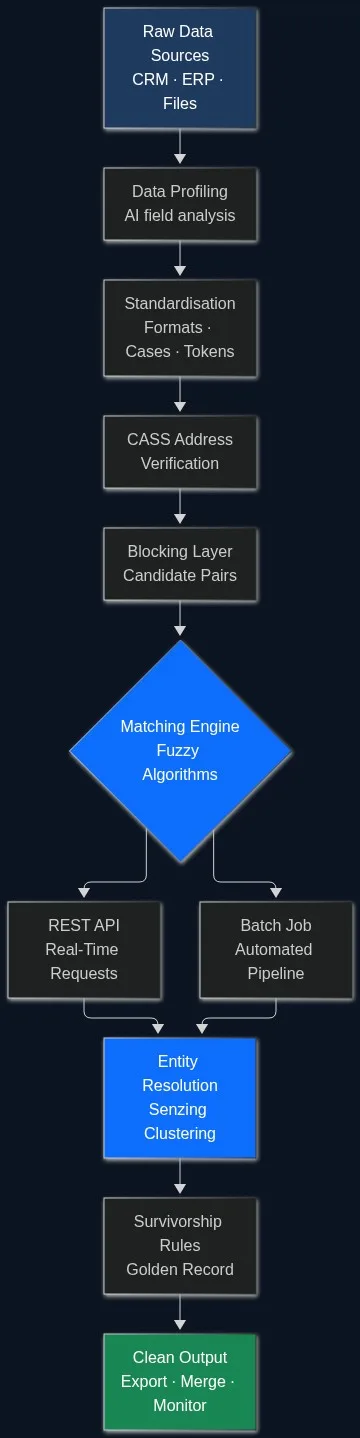
Putting It Together: A Modern Data Matching Pipeline
A production-grade data matching pipeline on Match Data Pro runs in this sequence:
- AI data profiling: Scans every field for completeness, format consistency, and duplication rate before any cleaning runs. AI data profiling surfaces the specific issues that will degrade match accuracy — missing values, inconsistent formats, embedded punctuation — before any configuration begins.
- Standardisation: Normalises name casing, strips punctuation, expands common abbreviations (St. to Street, Corp to Corporation), and formats phone numbers and dates consistently. See data standardisation best practices for a full field-by-field breakdown.
- CASS address verification: Every address record is submitted to the USPS CASS engine. Invalid addresses are flagged; deliverable addresses receive ZIP+4 appended, enabling tighter address blocking and improving match accuracy by 8 to 12 percentage points on address-heavy datasets. See address cleansing and CASS verification.
- Blocking: Candidate pairs are generated using multi-key blocking. Typical block keys include soundex of surname, first three characters of company name, and ZIP code prefix. This step generates the comparison space for the matching engine.
- Fuzzy matching engine: Field-specific algorithms score each candidate pair. The matching engine applies algorithm selection automatically based on field type, then calculates a weighted composite score for each pair.
- REST API or batch execution: The matching step runs either as a real-time API call (sub-200ms per lookup) or as a scheduled automated batch job via Match Data Pro’s job automation layer. The same matching configuration supports both modes.
- Entity resolution: Senzing clusters matched pairs into entity groups. Survivorship rules produce the golden record. Entity resolution handles transitive relationships that pairwise matching misses — if A matches B and B matches C, all three collapse into one entity even if A and C do not score highly against each other directly.
- Export and monitoring: Clean records export via the platform’s import/export connectors to any downstream system. Data quality monitoring alerts when duplicate ingestion rates spike in subsequent loads, keeping the pipeline clean without manual intervention.
This pipeline runs in Match Data Pro’s cloud SaaS environment with no infrastructure to manage. Teams are operational within hours, not weeks. No long-term contract is required.
Book a demo to see the full pipeline on your own data.
Preguntas frecuentes
What is a data matching REST API and when should I use one?
A data matching REST API accepts a record as input and returns a scored list of matching candidates from a master dataset. Use it when you need real-time duplicate detection at the point of data entry, inline deduplication inside ETL pipelines, or programmatic match scoring embedded in an application rather than a manual batch job. It is the right choice for teams processing continuous data flows at high frequency.
How does containerised deployment improve data matching accuracy?
Containerised deployment improves accuracy by ensuring the same algorithm configuration, preprocessing rules, and threshold settings run identically in development and production. Configuration drift between environments is a common cause of accuracy regression. Containers eliminate it by packaging the matching engine and its configuration as a single deployable unit that behaves consistently regardless of host infrastructure.
What is the difference between matching and entity resolution?
Matching scores pairs of records for similarity and returns a probability that they refer to the same entity. Entity resolution takes those pairs and clusters them into groups using graph-based algorithms, then applies survivorship rules to build a single golden record. Matching is pairwise; entity resolution handles groups of three or more related records that matching alone cannot consolidate into a single identity.
How many records can a modern matching engine process in a single run?
A modern matching engine with effective blocking and horizontal scaling via container orchestration can process 50 to 500 million record pairs in a single batch run. Without blocking, the same volume is computationally infeasible. Blocking reduces comparison pairs by 99.5% while retaining over 98% of true matches, making large-scale deduplication practical within hours rather than days.
Do I need a data engineer to configure a data matching pipeline?
Not necessarily. Match Data Pro provides a no-code configuration interface for setting field weights, thresholds, blocking keys, and survivorship rules. Data engineers can call the REST API and integrate the engine into custom pipelines. Data analysts can run profiling, configure a matching job, and produce a golden record output without writing code. Both paths are supported in the same platform with no additional licensing.