When evaluating data quality software, deployment model is one of the first decisions your team needs to make. Cloud SaaS delivers immediate value with zero infrastructure overhead, while on-premise gives security-first organisations full data custody. This guide breaks down both models across five dimensions — security, scalability, cost, time-to-value, and integration — so you can choose the right fit for your data quality program.
Ready to see both options in action? Book a demo and we will walk through the deployment model that fits your requirements.
Why Deployment Model Matters for Data Quality Software
Data quality tools are not generic business software. They ingest sensitive customer records, financial data, and healthcare identifiers. They run fuzzy matching, deduplication, and entity resolution jobs that process millions of rows. The deployment model shapes what is technically possible, what is permissible under your data governance policy, and what your team can realistically operate.
Three factors make this decision harder than it looks:
- Data residency obligations. GDPR, HIPAA, and sector-specific regulations may restrict where data can be processed or stored.
- Integration depth. Deep integrations to ERP, CRM, or data warehouse systems can favour on-premise when those systems also live on-premise.
- Operational capacity. Cloud shifts infrastructure maintenance to the vendor. On-premise puts it back on your team.
Before comparing models, map your organisation’s requirements against these three factors. Most teams underestimate integration complexity and overestimate the burden of cloud security.
Cloud SaaS Data Quality: Capabilities and Tradeoffs
A cloud SaaS deployment means the vendor hosts the platform, manages infrastructure, and handles upgrades. Your team logs in, configures matching rules, uploads datasets, and runs jobs. No servers to provision, no patches to apply.
What cloud SaaS does well
Cloud platforms excel at three things: fast onboarding, elastic scale, and continuous improvement. A typical SaaS data quality deployment is live within hours rather than weeks. Elastic compute means a job that processes 50,000 records today can handle 50 million next quarter without infrastructure changes.
Match Data Pro’s cloud SaaS platform delivers AI-powered fuzzy matching and Senzing entity resolution with no long-term contract. Teams can start a free trial, load their data, and run their first deduplication job the same day. The platform includes AI data profiling, configurable matching rules, survivorship logic, and job automation — all accessible via browser or REST API.
Cloud SaaS limitations to plan for
Cloud SaaS introduces network latency for very large file transfers. Some highly regulated environments prohibit data leaving an internal network entirely. And vendor lock-in is a real consideration: if your matching configuration is built on proprietary rule formats, migrating to another platform in two years carries a cost. Evaluate export capabilities and API completeness before committing.
A useful benchmark: if your datasets are under 100 million records per job, and your regulatory regime permits third-party cloud processing, cloud SaaS is almost always the faster, lower-cost path.
On-Premise Data Quality: Capabilities and Tradeoffs
On-premise deployment runs the data quality software stack inside your own data centre or private cloud. Your team controls the infrastructure, the data never leaves your perimeter, and you own the compute capacity.
When on-premise is the right call
Four situations consistently tip the decision toward on-premise:
- Air-gapped networks required by government or defence contracts
- Strict data residency rules that prohibit third-party cloud processing of PII
- Existing on-premise ERP or data warehouse with high-volume batch feeds that would create large network transfer costs in a cloud model
- Security policies requiring full audit of every system that touches sensitive records
For teams in these situations, Match Data Pro supports on-premise and private cloud deployment. The same fuzzy matching engine, AI workflows for air-gapped environments, CASS address verification, and Senzing-powered entity resolution run inside your own infrastructure. Read how entity resolution works in regulated, security-first environments.
On-premise cost and operational reality
On-premise has a higher upfront cost. Hardware, licensing, database infrastructure, and the internal team time to install, configure, and maintain the stack add up quickly. A realistic first-year cost for an enterprise on-premise data quality deployment — including hardware, software, and one FTE for administration — typically runs $150,000 to $400,000 depending on scale.
Ongoing, expect 15 to 25 percent of initial cost per year for maintenance, upgrades, and staff time. Cloud SaaS, by contrast, rolls these costs into a predictable monthly subscription.
Deployment Decision Framework: Five Dimensions
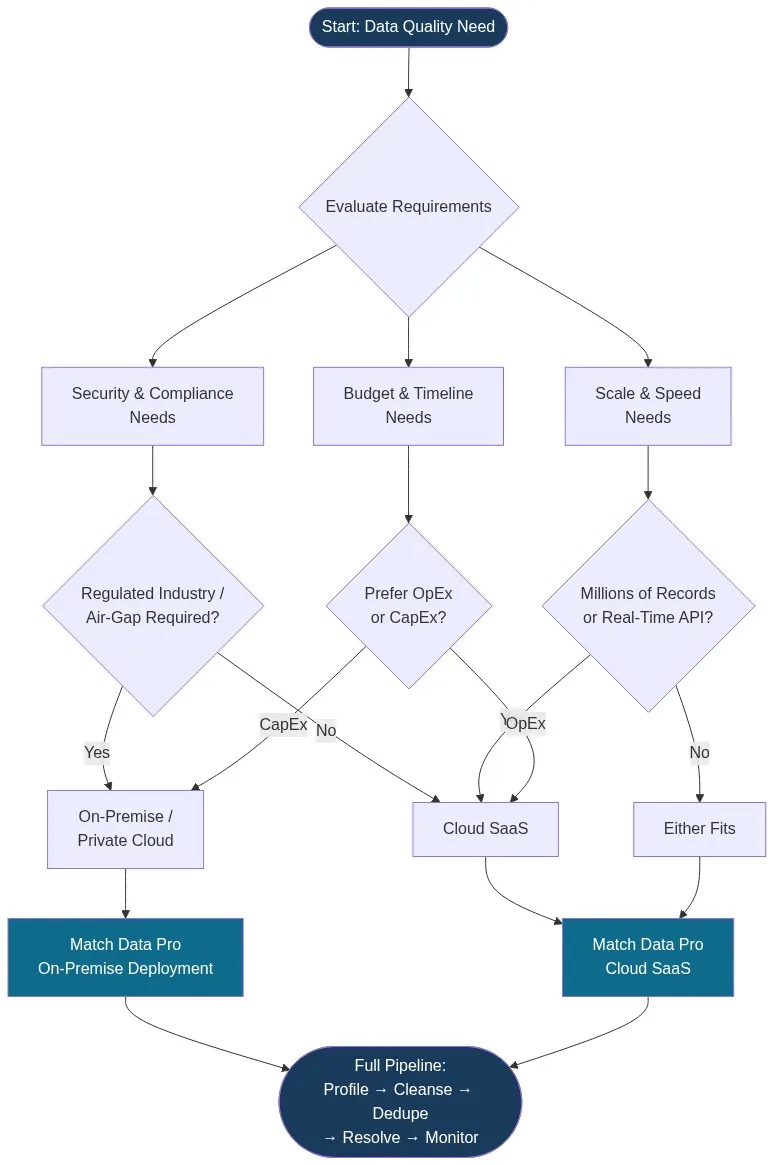
Use this framework to score your situation. Each dimension identifies when cloud SaaS or on-premise is the preferred choice.
| Dimension | Cloud SaaS Preferred When | On-Premise Preferred When |
|---|---|---|
| Security / Compliance | Third-party cloud processing is permitted; SOC 2 Type II satisfies auditors | Data residency rules prohibit external processing; air-gap required |
| Escalabilidad | Record volumes vary; elastic compute avoids over-provisioning | Fixed, high-volume batch workloads; existing compute is underutilised |
| Cost Model | OpEx preferred; no capital budget for hardware; monthly pricing needed | CapEx budget available; long-term volume justifies owned infrastructure |
| Time to Value | Need matching jobs running within days; no IT provisioning queue | Willing to invest 4 to 12 weeks for long-term control |
| Integration | Source systems accessible via API or SFTP; cloud connectors available | Source systems on-premise with high-volume batch feeds; low-latency required |
Hybrid Deployment: When You Need Both
Some organisations run a hybrid model: cloud SaaS for non-sensitive or lower-volume datasets, on-premise for regulated data domains. This is increasingly common in financial services and healthcare, where a marketing database might live in cloud SaaS while patient or account records are processed on-premise.
A hybrid approach requires a platform that supports both models without duplicating configuration work. Match Data Pro’s architecture allows teams to integrate via REST API with on-premise systems while running cloud-hosted jobs for other workflows. Matching rules, field weights, and survivorship configurations are portable across both environments.
The risk in hybrid deployments is configuration drift: matching rules diverge between environments, producing inconsistent results. Establish a single source of truth for rule configuration and propagate changes through version-controlled templates.
What to Evaluate in Any Deployment Model
Regardless of which model you choose, these capabilities should be non-negotiable in a data quality platform:
- AI-powered fuzzy matching. Exact matching misses 20 to 40 percent of real duplicates in typical CRM and ERP datasets. Configurable algorithms — Levenshtein, Jaro-Winkler, phonetic, token-based — are essential. See how fuzzy matching algorithms work.
- Deduplication with survivorship. Identifying duplicates is only half the job. The platform must merge records and produce a clean golden record. Read about survivorship rules and golden records.
- Entity resolution. For organisations linking records across multiple source systems, probabilistic entity resolution — powered by Senzing — is required for accuracy at scale.
- Data profiling. Before running any matching job, understand your data: field completeness, value distributions, format inconsistencies. Data profiling is the essential first step in any quality program.
- Address verification. CASS-certified address standardisation catches formatting and deliverability issues that fuzzy matching alone cannot resolve. See the address data cleansing guide.
- Job automation and connectors. Manual data quality runs do not scale. Look for scheduled job automation and import/export connectors for your source systems.
Match Data Pro delivers all of these capabilities in both cloud SaaS and on-premise deployment models. Explore the full data quality software comparison to see how platforms stack up.
Start evaluating today: Register for a free trial — no contract, no sales call required. Or book a demo to discuss your deployment requirements with the Match Data Pro team.
Frequently Asked Questions
Is cloud SaaS data quality software secure enough for financial services?
Yes, for most use cases. Cloud SaaS platforms built to SOC 2 Type II standards encrypt data in transit and at rest, support role-based access controls, and provide audit logs for every data operation. For institutions with strict data residency rules or air-gap requirements, on-premise deployment remains the right choice.
How long does an on-premise data quality deployment take?
A typical on-premise deployment takes four to twelve weeks from infrastructure provisioning to first production job. Variables include server configuration, network setup, and integration work with source systems. Cloud SaaS deployments, by contrast, can be operational within a day or two.
Can I migrate from on-premise to cloud SaaS later?
Yes, but plan for configuration migration effort. Matching rules, field mappings, and survivorship configurations need to be exported, validated, and re-applied in the cloud environment. Platforms that use open or documented rule formats make this significantly easier than proprietary configuration formats.
What record volume is cloud SaaS data quality suitable for?
Cloud SaaS handles datasets from thousands to hundreds of millions of records. Elastic compute scales jobs automatically. The practical threshold where on-premise becomes cost-competitive is typically 500 million or more records per job, combined with a predictable daily batch cadence where owned infrastructure is more economical.
Does Match Data Pro support both cloud and on-premise deployment?
Yes. Match Data Pro runs as a cloud SaaS platform with no long-term contract and a free trial available at members.matchdatapro.com. It also supports on-premise and private cloud deployment for organisations that require full data custody, air-gapped operation, or strict data residency compliance.