
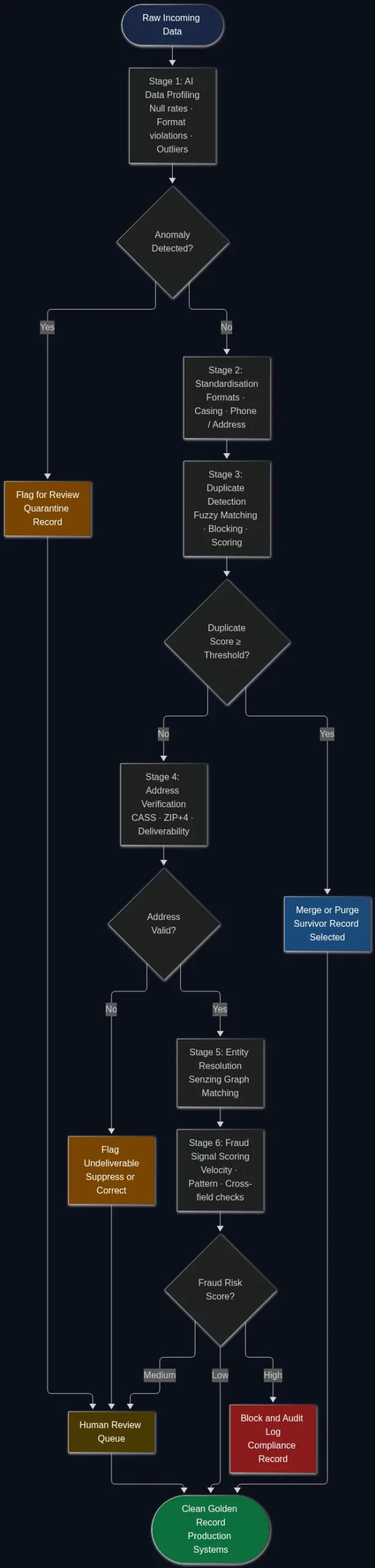
Fraudulent data enters your systems through synthetic identities, batch injections, and simple human error — and once it is inside, it corrupts every downstream report, compliance check, and customer record that depends on it. The fastest way to stop it is a layered detection pipeline: profile every incoming record for anomalies, standardise and deduplicate with fuzzy matching, verify addresses against a certified postal database, and apply entity resolution to surface hidden cross-record fraud patterns. Match Data Pro automates all six stages so bad data is flagged or blocked before it ever reaches production.
Ready to see it in action? Start a free trial and run your own data through Match Data Pro’s fraud-aware detection pipeline in minutes.
What Is Fraudulent Data and Why Does It Enter Your Systems?
Fraudulent data is any record that misrepresents a real-world entity — either deliberately or through systemic errors that create phantom identities. The three most common sources are:
- Synthetic identity fraud. An actor combines real and fabricated fields (valid SSN, invented name, unverifiable address) to create a record that passes basic validation but does not represent a real person or business.
- Batch injection. Automated scripts submit thousands of near-identical records in quick succession, overwhelming manual review queues. Email domains cycle through disposable providers; phone numbers are sequential.
- Legitimate but dirty entry. CRM imports, form submissions, and third-party data feeds introduce misspellings, transposed digits, and stale addresses that duplicate real records and create ghost identities over time.
Each source requires a different detection technique. Synthetic fraud is best caught by cross-field consistency checks and entity resolution. Batch injection is caught by velocity monitoring and duplicate scoring. Dirty entry is caught by profiling and standardisation. A single-layer approach misses at least two of the three.
Stage 1: AI Data Profiling to Surface Anomalies Early
AI data profiling is the first line of defence. Before any matching or verification runs, profiling scans every incoming field and measures:
- Null rates per field (a sudden spike in missing phone numbers signals batch injection).
- Format violations (phone numbers with too few digits, postcodes outside expected ranges).
- Value distribution shifts (a single email domain accounting for 40% of new submissions in one hour).
- Outliers and impossible values (date of birth in 1700, revenue field containing text).
Profiling produces a quality score per record and per field. Records that breach configurable thresholds are quarantined for review before they reach any downstream system. This single step typically catches 20-35% of fraudulent or severely degraded records without any matching logic.
What to Look for in a Profiling Anomaly
Consider this example. A financial services firm ingests 50,000 new lead records from a third-party list provider. Profiling reveals:
- 18% null rate on the phone field (normal baseline: 3%).
- 11% of email addresses use the same two disposable domains.
- ZIP codes cluster in a single state despite claimed nationwide coverage.
None of these individually fail a basic format check. Together, they signal the entire batch requires elevated scrutiny.
Stage 2: Standardisation Before Comparison
You cannot reliably compare records that are formatted inconsistently. Data standardisation resolves format variation so that matching and scoring operate on uniform inputs. Key transformations include:
- Uppercasing and stripping punctuation from names and addresses.
- Normalising phone numbers to E.164 format (+1 303 555 0100 from “303-555-0100” or “(303) 555.0100”).
- Parsing address strings into discrete components: street number, street name, unit suffix, city, state, ZIP.
- Converting date formats to ISO 8601 (2024-03-15 rather than 03/15/24 or March 15 2024).
Standardisation reduces false negatives in the matching stage. Two records that represent the same fraudulent actor but are stored with different formatting will only be detected as duplicates if both are normalised to the same canonical form first.
Stage 3: Fuzzy Matching and Duplicate Detection
Fuzzy matching catches the near-duplicate records that exact matching misses. A fraudulent actor submitting “Jon Smth” and “John Smith” at the same address will pass an exact deduplication check and produce two records. Fuzzy scoring catches it.
Match Data Pro’s data matching engine applies a configurable multi-algorithm approach:
- Levenshtein distance for name and address fields (edit distance of 1-2 on a full name scores above 85).
- Jaro-Winkler for person names (rewards prefix similarity, handles transpositions).
- Token-ratio matching for company names where word order varies (“Acme Corp LLC” vs “LLC Acme Corporation”).
- Phonetic matching (Soundex, Double Metaphone) for names where spelling varies by region or transliteration.
Blocking narrows the candidate pair space before scoring. For a 10 million record dataset, comparing every pair is computationally prohibitive. Blocking on ZIP code plus first letter of surname reduces the candidate set by 99%+ while preserving recall on genuine near-duplicates.
Records that exceed the duplicate threshold are routed to a merge-or-purge decision. Records that score in the grey zone (60-85 on a 0-100 scale) are queued for human review rather than auto-merged.
Before/After: Duplicate Detection Catching a Synthetic Identity
| Campo | Record A (existing) | Record B (incoming) | Puntuación |
|---|---|---|---|
| Nombre | Michael Torres | Mikhael Torrez | 88 (Jaro-Winkler) |
| DIRECCIÓN | 142 Oak St, Denver CO 80203 | 142 Oake Street, Denver CO 80203 | 91 (Levenshtein) |
| Teléfono | 720-555-0147 | 720-555-0147 | 100 (exact) |
| Correo electrónico | m.torres@gmail.com | mikhael.t@protonmail.com | 22 (token) |
| Compuesto | Weighted average across all fields | 82 — Review queue | |
Identical phone, near-identical name and address, but a completely different email. This pattern is a classic synthetic identity attempt. An exact match system would pass both records. The weighted fuzzy composite flags it.
Stage 4: CASS Address Verification
A fraudulent record almost always has an address problem. Either it is completely fabricated, or it is a real address appended to the wrong identity. CASS address verification validates every address against the USPS Coding Accuracy Support System database and returns:
- Deliverability status (deliverable, undeliverable, vacant).
- ZIP+4 appended to the five-digit ZIP (enabling carrier-route precision matching).
- DPV (Delivery Point Validation) confirmation that the address accepts mail.
An address that fails CASS is a strong fraud signal. Combined with a fuzzy name match and velocity anomaly, an undeliverable address moves the record into the high-risk block queue.
Stage 5: Entity Resolution to Surface Hidden Patterns
Entity resolution is where individual-record fraud detection becomes network fraud detection. Where fuzzy matching compares pairs, entity resolution builds a graph of all records and clusters those that share identity signals — email domain, device fingerprint, shared phone number, overlapping address components.
Match Data Pro uses Senzing entity resolution, a pre-trained graph-based probabilistic engine. Senzing evaluates every incoming record against the full existing entity graph and returns a resolved entity ID plus a confidence score. A new record that connects to three existing blocked entities immediately inherits their risk rating.
This is how ring fraud is caught. Ten synthetic identities submitted from different IP addresses, with different names and email addresses, but sharing a phone number suffix or address building number, collapse into a single high-risk entity cluster.
Stage 6: Fraud Signal Scoring and Automated Response
After profiling, standardisation, deduplication, address verification, and entity resolution, each record carries a composite fraud risk score. Match Data Pro’s job automation layer applies configurable rules:
- Low risk (0-30): Record passes to production. Added to the golden record via survivorship rules.
- Medium risk (31-69): Record enters a human review queue with all scoring evidence displayed — field-level scores, entity cluster membership, address validation result.
- High risk (70-100): Record is blocked and written to an immutable audit log with full lineage. Compliance teams receive an automated alert.
Every decision is logged with before/after field values, algorithm weights, and the timestamp of each pipeline stage. This satisfies audit requirements under GDPR, SOX, and industry-specific frameworks without manual documentation.
Integrating Fraud Detection into Existing Pipelines
Match Data Pro connects to existing systems through import/export connectors and a live fuzzy search API. The two primary integration patterns are:
Batch Mode
Upload a CSV, Excel, or database extract. The pipeline runs all six stages and returns a clean file plus a flagged file with risk scores and reason codes. Run nightly, weekly, or on demand before major data loads.
Real-Time API Mode
POST a single record or small batch to the Match Data Pro REST API at the point of data entry. The API returns a risk score, duplicate match candidates, and address validation status within milliseconds. Use this in CRM intake forms, loan application portals, or account creation flows to block fraudulent data before it is ever written to your database.
The data quality monitoring dashboard tracks fraud signal rates, block rates, and review queue volumes over time. A spike in blocked records on a Tuesday morning is an early indicator of a coordinated batch injection attempt.
Want to see the full pipeline on your own data? Book a demo and we will walk through a live deduplication and fraud-scoring run against a sample of your records.
Preguntas frecuentes
What is fraudulent data and how does it differ from dirty data?
Fraudulent data is intentionally deceptive — synthetic identities, fabricated fields, or records engineered to evade detection. Dirty data is unintentionally incorrect — typos, stale addresses, format errors. Both damage operations, but fraudulent data requires additional velocity monitoring, entity resolution, and cross-field consistency checks that standard cleansing alone does not provide.
How does fuzzy matching help detect fraudulent records?
Fuzzy matching scores similarity between incoming records and existing ones on a 0-100 scale using algorithms like Levenshtein, Jaro-Winkler, and phonetic encoding. A fraudster submitting a name with a one-character variation and an identical phone number scores high enough to be flagged as a likely duplicate, even though no exact field matches. Exact matching would let it through as a new record.
Can I run fraud detection in real time at the point of entry?
Yes. Match Data Pro’s live fuzzy search API accepts a record POST and returns a composite risk score, duplicate candidates, and address validation status in real time. This enables CRM forms, loan portals, and account creation flows to screen every submission before it is written to the database, eliminating the cost of remediation after the fact.
What is entity resolution and why does it matter for fraud?
Entity resolution builds a graph across all records and clusters those sharing identity signals — phone numbers, address components, email domains. Where fuzzy matching detects duplicate pairs, entity resolution detects rings: ten synthetic identities that individually appear clean but collectively share a building number or phone suffix. Senzing entity resolution within Match Data Pro resolves these clusters automatically with no hand-crafted rules.
How long does it take to implement a fraud detection pipeline?
With Match Data Pro, a batch fraud detection pipeline is operational in hours, not months. Connect your data source via CSV upload or native connector, configure field mappings and matching thresholds, and run your first profiling scan immediately. Real-time API integration typically takes one to three days depending on your existing intake system. No long-term contract is required — start with a free trial at members.matchdatapro.com.