
CRM deduplication identifies duplicate customer records across your system, merges them into a single verified record, and puts controls in place to stop new duplicates forming. Done right, it reduces wasted outreach by 20–30%, improves segmentation accuracy, and gives sales and marketing a single reliable view of every customer.
This guide covers how CRM duplicates form, how a structured deduplication pipeline finds and merges them, and how Match Data Pro automates every stage without manual record-by-record review.
Ready to clean your CRM? Start a free trial of Match Data Pro and run your first deduplication job in minutes.
Why CRM Duplicates Are Harder to Find Than They Look
Duplicate customer records rarely share identical field values. Real duplicates look like this:
| Record A | Record B |
|---|---|
| Jon Smith | Jonathan Smith |
| jsmith@acme.com | j.smith@acme.com |
| +1 (212) 555-0198 | 212-555-0198 |
| 123 Main St, New York, NY | 123 Main Street, NY, 10001 |
An exact-match query returns no duplicate. A WHERE email = email join finds nothing because both email formats differ. Yet these records clearly represent the same person.
Duplicates enter CRM systems through several predictable paths:
- Web form submissions that bypass deduplication checks
- Import jobs from CSV files with no pre-cleanse step
- System migrations where two databases merge without matching
- API integrations from marketing tools, support platforms, or data brokers
- Manual entry by multiple reps entering the same prospect
Research consistently puts the duplicate rate in enterprise CRM systems between 10% and 30% of total records. At 100,000 contacts, that is up to 30,000 records that inflate costs, distort reporting, and dilute campaign performance.
See The Real Cost of Duplicate Records for a full breakdown of the downstream financial impact.
The Six-Stage CRM Deduplication Pipeline
Effective CRM deduplication runs as a structured pipeline, not a one-time batch job. Each stage builds on the last. Skipping any stage increases false positives (wrong merges) and false negatives (missed duplicates).
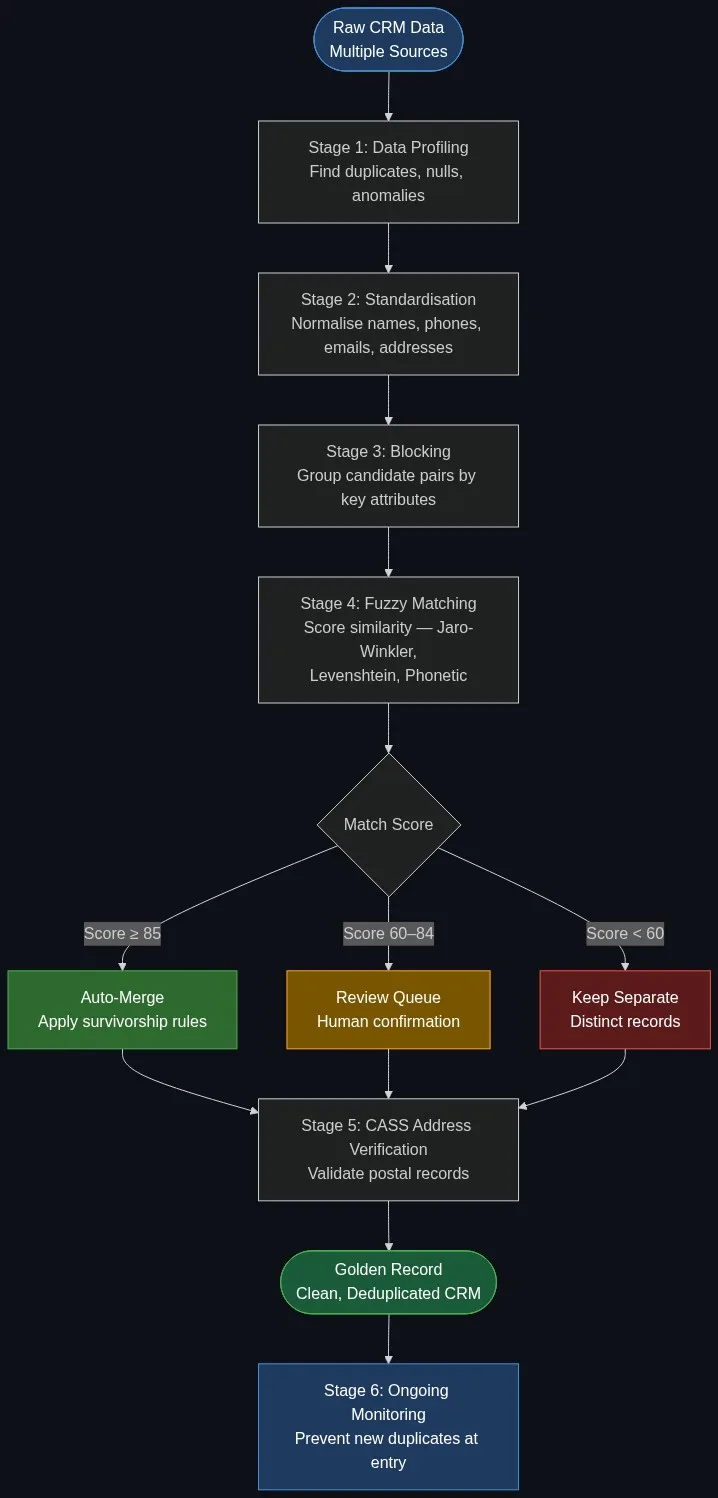
Stage 1: Data Profiling
AI data profiling scans every field across your CRM dataset and surfaces the scope of the problem before you touch a single record. It counts nulls, identifies format inconsistencies, measures field population rates, and flags probable duplicate clusters.
A profiling report on a 200,000-record CRM typically reveals:
- Phone numbers stored in 8–12 different formats
- Name fields with mixed case, prefixes, and suffixes applied inconsistently
- Address fields with abbreviated street types (St vs. Street vs. Str.)
- Email domains with typos (gmial.com, hotmali.com)
Profiling makes the cleansing and matching stages faster because it tells you exactly which transformations to apply.
Stage 2: Standardisation
Before any matching runs, every field must be normalised to a consistent format. Match Data Pro’s data cleansing and standardisation engine applies field-specific rules:
- Names: strip prefixes and suffixes, expand abbreviations (Jon to Jonathan), normalise case
- Phone numbers: strip formatting characters, normalise to E.164 (+12125550198)
- Emails: lowercase, remove trailing spaces, flag known domain typos
- Addresses: parse into components (number, street, suffix, city, state, ZIP), then standardise each component
Standardisation alone resolves a large proportion of apparent duplicates. Two records for “212-555-0198” and “+1 (212) 555-0198” become identical after normalisation and can be matched deterministically without any fuzzy scoring.
Stage 3: Blocking
Comparing every record against every other record at 200,000 contacts produces 20 billion comparisons. That is computationally expensive and slow. Blocking reduces the comparison space by grouping records into candidate pairs that share a common attribute.
Common blocking keys for CRM data:
- First three characters of the last name plus ZIP code
- Normalised phone number prefix
- Email domain plus first character of the local part
- Company name Soundex code
Match Data Pro applies multiple overlapping blocking keys in parallel so records that share any common attribute enter the comparison pool, reducing miss rates from imperfect blocking.
Stage 4: Fuzzy Matching and Scoring
Within each candidate pair, fuzzy matching computes a similarity score for each field using the algorithm best suited to that field type:
| Field | Algorithm | Why |
|---|---|---|
| Person name | Jaro-Winkler | Handles transpositions and prefix variations |
| Nombre de empresa | Token sort ratio | Handles word-order differences (Acme Corp vs. Corp Acme) |
| Address line | Levenshtein normalised | Handles abbreviations and minor typos |
| Surname phonetic | Double Metaphone | Handles Smith / Smyth / Smythe |
Each field score is weighted according to its reliability. Email carries high weight because it is less likely to contain typos than a free-text name field. The weighted composite score determines routing:
- Score 85+: auto-merge, apply survivorship rules immediately
- Score 60–84: route to a human review queue with the matched pair and score breakdown
- Score below 60: keep as separate records
Thresholds are configurable. A healthcare team might set the auto-merge threshold at 92 to reduce false merges. A marketing operations team cleaning a lead list might accept 78 for higher recall. See deterministic vs. probabilistic matching for guidance on setting thresholds by use case.
Stage 5: Merge and Survivorship
Merging is not simply deleting the secondary record. Survivorship rules determine which field value from which record becomes the canonical value in the golden record. Common survivorship logic includes:
- Most recent: take the value from the record with the latest modified date
- Most complete: prefer the record with fewer null fields
- Source priority: CRM record wins over imported CSV value
- Verified status: CASS-verified address beats unverified address
Match Data Pro’s survivorship and golden record engine applies these rules at the field level so the output record inherits the best available value from every matched source. The merge history is preserved in the audit trail so any merge can be reviewed or reversed.
Stage 6: Address Verification
After merging, run CASS address verification on every postal address in the golden record. CASS validation confirms deliverability, appends ZIP+4, and standardises the address to USPS format. Records with undeliverable addresses are flagged for suppression rather than silently passed into downstream systems.
Address verification also catches a class of duplicates that fuzzy matching misses: two records with different names but the same verified delivery point. A verified delivery point match is a strong signal that two contacts live at the same address.
Preventing CRM Duplicates at Entry
Deduplication cleans existing records. Prevention stops new duplicates from forming. Match Data Pro’s live fuzzy search API integrates at the point of data entry to flag probable matches in real time before a new record is committed.
The API accepts a partial record (name, email, or phone) and returns ranked candidate matches with similarity scores. Your web form or CRM integration queries the API on submit. If a match above the configured threshold is returned, the UI can prompt the user to confirm whether they are entering a new contact or updating an existing one.
This real-time check intercepts the two highest-volume duplicate creation paths: web form submissions and manual CRM entry. Combined with scheduled batch deduplication, it keeps the duplicate rate below 2% in most production environments.
CRM Deduplication: Common Edge Cases
Real customer data generates edge cases that simple deduplication tools handle poorly. Here are the most common ones and how a production pipeline addresses them.
Nicknames and legal names
Bill Gates and William Gates. Bob Johnson and Robert Johnson. Nickname dictionaries map common informal names to their legal equivalents before scoring. Without them, a Jaro-Winkler comparison between “Bob” and “Robert” scores 0.62, below most merge thresholds, and the duplicate is missed.
Business vs. personal contact
The same individual may appear as “Jane Doe” at one company and “Jane Doe” at another, two records that represent distinct business relationships even if it is the same person. Entity resolution with Senzing handles this by modelling the person-organisation relationship rather than just matching name fields.
Household-level deduplication
For B2C use cases, the same household may have legitimate separate records for different family members. Household-level grouping applies address matching to cluster records by delivery point without merging distinct individuals within the same household.
Transposed digits in phone numbers
Data entry errors frequently produce 212-555-0918 instead of 212-555-0198. Levenshtein edit distance catches single-digit transpositions at a normalised score of 0.89. Without normalised edit distance on phone fields, these pairs fail to match.
How Match Data Pro Handles CRM Deduplication
Match Data Pro runs all six pipeline stages in a single automated job. You configure match rules, thresholds, and survivorship logic through the UI without writing custom code. The platform connects to CRM systems via import/export connectors or API and supports batch runs on a schedule or real-time deduplication via the live fuzzy search API.
Key capabilities for CRM deduplication:
- AI-powered fuzzy matching across name, email, phone, address, and custom fields
- Configurable match rules and thresholds per field and per project
- Survivorship rule engine for golden record creation
- CASS address verification integrated into the merge pipeline
- Live fuzzy search API for point-of-entry duplicate prevention
- Job automation to schedule recurring deduplication runs
- Full audit trail with merge history for every record change
No long-term contract is required. Match Data Pro runs as cloud SaaS with a free trial available immediately. Larger teams with data residency requirements can also deploy on-premise.
Want to see the platform in action on your own data? Book a demo and we will walk through a live deduplication run against a sample of your CRM records.
Frequently Asked Questions
What is CRM deduplication?
CRM deduplication is the process of identifying duplicate customer or contact records within a CRM system, merging them into a single authoritative golden record, and applying controls to prevent new duplicates from entering. It uses fuzzy matching to find records that differ in format but represent the same real-world person or organisation.
How do I find duplicate records in my CRM?
Finding duplicates requires a profiling step followed by fuzzy matching across name, email, phone, and address fields. Exact-match queries miss the majority of real duplicates because field values differ due to formatting, nicknames, and data entry errors. A dedicated deduplication platform applies multiple algorithms and weighted scoring to surface all candidate pairs.
What is a survivorship rule in CRM deduplication?
A survivorship rule determines which field value is retained in the merged golden record when two matching records have different values for the same field. Common rules include most-recent value, most-complete record, and source priority. Survivorship logic ensures no data is lost during a merge — it is selected and preserved, not deleted.
How often should I run CRM deduplication?
Run a full batch deduplication job at least monthly. High-volume CRM systems that receive large imports or high web form traffic should run weekly. Supplement batch runs with a real-time duplicate check at the point of data entry using a live fuzzy search API to intercept duplicates before they are committed to the database.
What is the difference between CRM deduplication and entity resolution?
CRM deduplication identifies and merges duplicate records within or across systems into a golden record. Entity resolution is broader: it models relationships between records at an entity level, linking a person across multiple organisations, roles, or systems without necessarily merging them. For complex B2B CRM use cases with account hierarchies, entity resolution handles cases that standard deduplication misses.