
Inaccurate data in financial services is not a housekeeping problem. It is a regulatory and operational risk that costs firms millions in fines, failed audits, and flawed decisions. Regulators including the SEC, FINRA, the FCA, and Basel III supervisors treat data accuracy as a governance obligation, not a best practice. When client records contain conflicting names, stale addresses, or mislinked accounts, every downstream process from KYC to capital calculation becomes suspect.
Need to assess your current data accuracy posture? Start a free trial of Match Data Pro and run your first AI-powered data profile in minutes.
Why Financial Services Has a Data Accuracy Problem
Financial organisations accumulate data from dozens of sources: trading systems, core banking platforms, CRM systems, third-party data feeds, and legacy on-premise databases. Each source stores names, addresses, and identifiers in its own format. A single client might appear as “J. Smith”, “John Smith”, “Smith, John R.”, and “John Robert Smith” across four systems. None of those records is wrong on its own. Together, they create four conflicting views of the same person.
The downstream effects are measurable. Duplicate client records inflate AUM figures. Stale addresses fail mail and document delivery. Mislinked accounts expose firms to incorrect risk aggregation. Poor entity matching causes counterparty data to be counted twice in exposure calculations. The real cost of duplicate records in financial environments routinely runs to seven figures once fines, rework, and operational waste are factored in.
Where Inaccuracy Enters the Data
Data inaccuracy in financial services typically enters at five points:
- Manual data entry: Client onboarding forms filled by advisors or clients introduce typos, abbreviations, and non-standard formats from day one.
- System migrations: Data moved from legacy cores to modern platforms loses formatting, truncates fields, or creates duplicate records when matching logic is not applied.
- Third-party feeds: Market data vendors and reference data providers use their own identifiers and formats, which do not always align with internal records.
- Mergers and acquisitions: Combining two firm databases without a deduplication pass creates immediate duplicate populations and conflicting golden records.
- Record decay: Client addresses, phone numbers, and employment data become stale at 20–30% per year without active verification and refresh.
Regulatory Pressure: What Supervisors Actually Require
Regulatory frameworks increasingly mandate explicit data accuracy controls. The requirements vary by jurisdiction but converge on the same operational demand: firms must be able to demonstrate that their data is correct, complete, and traceable.
Key Regulatory Drivers
| Regulation | Data Accuracy Requirement | Consequence of Failure |
|---|---|---|
| BCBS 239 | Risk data must be accurate, complete, and timely across all systems | Capital add-ons, regulatory censure |
| MiFID II / MiFIR | Transaction and client reference data must be accurate at point of reporting | Transaction reporting fines up to €5M |
| GDPR / UK GDPR | Personal data must be accurate and kept up to date | Fines up to 4% of global annual turnover |
| AML / KYC (FATF) | Customer identity data must link to verified, de-duplicated records | Enforcement actions, license risk |
| CCAR / DFAST | Stress test inputs require reconcilable, accurate data lineage | Supervisory objections to capital plans |
BCBS 239 is the most demanding framework for data quality governance. It requires risk data aggregation capabilities that span business lines and legal entities with a complete audit trail. Meeting it means having not just accurate data but demonstrable processes that produce and maintain that accuracy. Data audit trails are a core requirement, not an optional add-on.
Operational Risk: Where Inaccurate Data Breaks Financial Workflows
Beyond regulatory risk, data inaccuracy generates operational failures that accumulate quietly. Three workflows break most often when data accuracy is low.
Client Identity and KYC
KYC programmes depend on resolving every client record to a single verified identity. When a client appears under multiple spellings across onboarding, CRM, and trading systems, compliance teams either miss screening hits or run redundant checks. A client named “Mohammad Al-Rashid” in the CRM and “M. Alrashid” in the core banking platform looks like two people to a naive system. Entity resolution in financial services links these records using fuzzy scoring on name, date of birth, address, and national identifier fields so the compliance team sees one verified entity, not two suspicious fragments.
Risk Aggregation and Reporting
Capital calculations, exposure limits, and stress tests all require accurate counterparty and position data. When a counterparty appears under two legal entity names because of a prior acquisition or a data entry variant, the firm may understate its exposure to that entity. Regulators and risk officers catch these discrepancies in attestation processes, but the cost of correcting them post-submission is high. Accurate, unified counterparty records that result from a production-grade data matching pipeline prevent this class of error before reports are filed.
Client Communications and Address Data
Regulatory notices, tax forms, and account statements must reach the right address. Address decay runs at 15–20% per year in consumer financial datasets. A firm with 500,000 clients can expect 75,000–100,000 address records to become stale within twelve months. CASS address verification, applied as a continuous process rather than a one-time batch, keeps records current against the USPS master file and flags records that need manual review before mail returns accumulate.
Building a Data Accuracy Pipeline for Financial Services
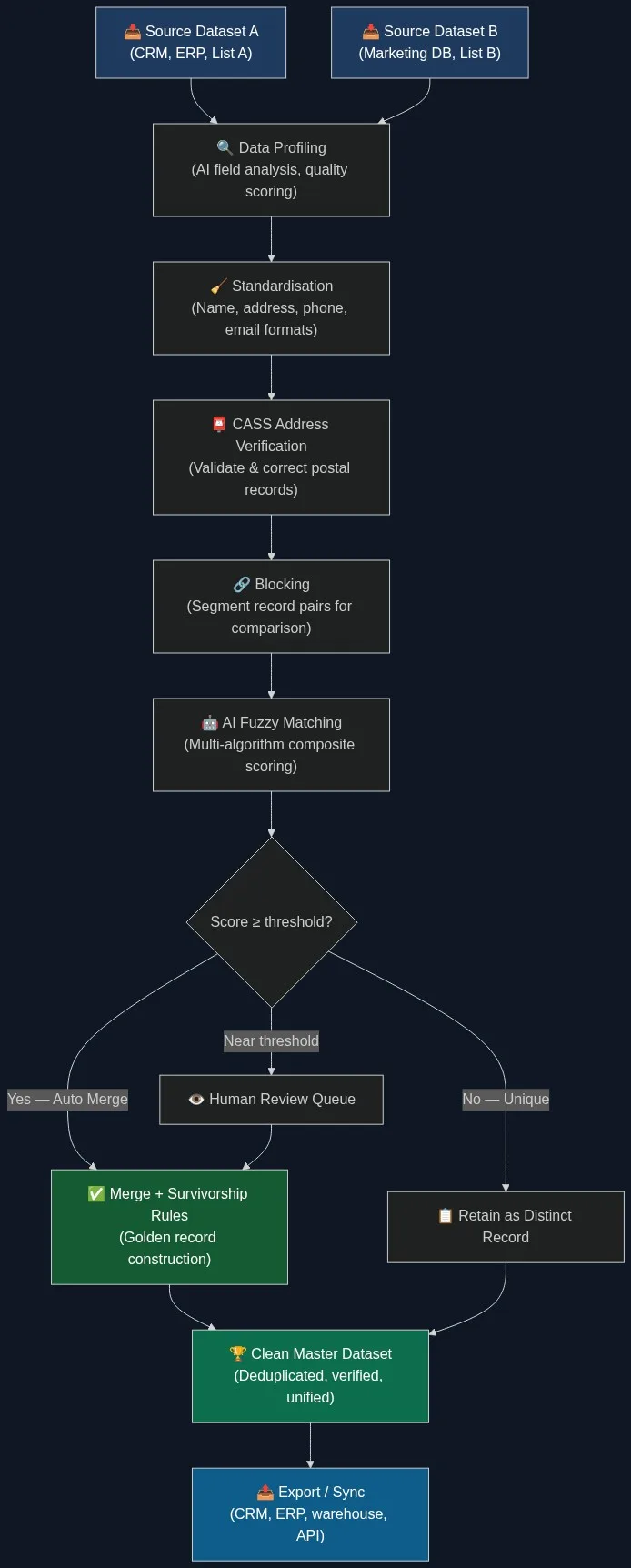
Fixing data accuracy in a financial institution is not a one-time project. It requires a repeatable, automated pipeline that runs continuously as new records enter and existing records decay. The pipeline has six stages.
Fase 1: Perfilado de datos para IA
Before any cleansing runs, you need to know what you have. AI data profiling scans every field across every source system and returns completeness rates, value distributions, format violations, and anomaly flags. A typical financial services profile reveals that 12–18% of client records have missing or malformed date-of-birth fields, and 8–15% have address formats that will not survive standardisation without correction. This baseline defines the scope of work before a single record is touched.
Fase 2: Normalización
Standardisation converts every name, address, phone number, and identifier field to a consistent format before matching runs. “St.” becomes “Street”. “LLC” is expanded or contracted to match the dominant form. Phone numbers are normalised to E.164. Date-of-birth fields are parsed into ISO 8601. Without this step, a fuzzy match engine wastes comparison budget on format differences rather than genuine identity variants.
Stage 3: CASS Address Verification
Every address record is run through CASS-certified verification, which validates the address against the USPS master file, corrects ZIP+4 codes, and flags undeliverable records. For financial firms, this step has dual value: it reduces mail return rates and it flags clients whose contact information has drifted, triggering a review workflow before a regulatory communication fails to deliver.
Stage 4: Blocking and AI Fuzzy Matching
Blocking partitions the record population into comparison groups based on shared tokens (surname initial, postal code, account type) so the matching engine does not compare every record against every other record. Within each block, AI-powered fuzzy matching scores each pair using a composite of Jaro-Winkler on name fields, token-set ratio on address lines, and exact or near-exact matching on national identifiers. A weighted composite score determines whether a pair is an automatic match, a review candidate, or a confirmed distinct record.
Example: two records scored across five fields:
| Campo | Registro A | Disco B | Puntuación | Peso |
|---|---|---|---|---|
| Nombre completo | Mohammad Al-Rashid | M. Alrashid | 0.81 | 30% |
| Fecha de nacimiento | 14 de marzo de 1978 | 14/03/1978 | 1.00 | 25% |
| Línea 1 de la dirección | 42 Broad St | 42 Broad Street | 0.94 | 20% |
| Teléfono | +1-212-555-0174 | 2125550174 | 1.00 | 15% |
| National ID | XXX-XX-7891 | XXX-XX-7891 | 1.00 | 10% |
Composite score: 0.937. At a configured threshold of 0.85, this pair auto-merges. The match decision is logged with field-level scores for the audit trail.
Stage 5: Entity Resolution and Survivorship
Fuzzy matching identifies pairs. Entity resolution clusters groups of records that all refer to the same individual or legal entity across three or more systems. Survivorship rules then determine which field value from which source wins in the golden record. Common rules in financial services: most-recent account record wins for contact details; most-complete legal name wins for identity fields; verified address from CASS always overrides an unverified address. Explainable entity resolution documents each survivorship decision so auditors can trace every field value back to its source.
Fase 6: Supervisión continua y automatización de tareas
A data accuracy programme is not a project with an end date. New records enter daily. Existing records decay monthly. Job automation schedules regular re-profiling, address refresh, and incremental match runs so the golden record population stays current. Alerts fire when completeness rates drop below defined thresholds or when match rates spike (indicating a new source of duplicates has been introduced). Building a financial data quality management programme requires this monitoring layer to be treated as a first-class operational process.
What Match Data Pro Delivers for Financial Services Data Teams
Match Data Pro is a cloud SaaS data quality platform built for teams that need to profile, cleanse, deduplicate, and resolve entity records at scale. For financial services, the platform delivers:
- AI data profiling: Automated field-level analysis that scores completeness, accuracy, and anomaly rates before any processing begins.
- Configurable fuzzy matching: Multi-algorithm composite scoring with field weighting, threshold configuration, and human review routing for borderline pairs.
- Senzing entity resolution: Graph-based probabilistic resolution that clusters records across multiple source systems into verified golden records without hand-crafted rules.
- CASS address verification: USPS-certified address validation applied continuously as records enter or are updated.
- Audit trail and explainability: Every match, merge, and survivorship decision is logged with field-level evidence so compliance and audit teams can trace every record change.
- Job automation: Scheduled pipeline runs for ongoing profiling, incremental matching, and address refresh without manual intervention.
No long-term contract. No infrastructure to provision. Register and start a free trial to run your first financial data quality job today. Or book a demo to see how the platform handles real financial records.
Preguntas frecuentes
What does data accuracy mean in financial services?
Data accuracy in financial services means that every record correctly represents the real-world entity it describes and is consistent across all systems. It covers client names, addresses, identifiers, account relationships, and transaction references. Inaccurate data produces incorrect regulatory reports, failed KYC checks, and flawed risk calculations. Accuracy is maintained through profiling, standardisation, fuzzy matching, entity resolution, and continuous monitoring.
Which regulations require data accuracy controls in financial firms?
The primary frameworks are BCBS 239 (risk data aggregation), MiFID II/MiFIR (transaction reporting), GDPR (personal data accuracy), AML/KYC rules under FATF guidance, and CCAR/DFAST stress testing requirements. Each mandates that data used in regulatory submissions is accurate, complete, and traceable to a documented source with a maintained audit trail.
How does fuzzy matching help with financial data accuracy?
Fuzzy matching identifies records that refer to the same client or counterparty even when names, addresses, or identifiers differ across systems. It scores similarity using algorithms like Jaro-Winkler for names and token-set ratio for address fields, then applies configurable thresholds to route pairs to automatic merge, human review, or retain as distinct. This resolves the multi-system name variant problem that exact matching cannot handle.
What is the role of entity resolution in financial data quality?
Entity resolution clusters all records across every source system that refer to the same individual or legal entity into a single verified golden record. In financial services, it ensures that a client appearing under name variants across onboarding, CRM, and core banking is recognised as one person for KYC, AML screening, and risk aggregation. It goes beyond pairwise fuzzy matching to resolve multi-record identity graphs.
How often should financial institutions run data quality jobs?
Critical identity and compliance data should be profiled and matched incrementally as records enter or change, not on a monthly batch cycle. Address verification should run on any address update and on a scheduled quarterly refresh of the full population. Full deduplication sweeps across all source systems should run at minimum monthly, or after any system migration, data feed change, or acquisition event that introduces new records.