
A financial data quality management program is a structured set of processes that profile, cleanse, standardise, deduplicate, and continuously monitor every dataset that enters or passes through your financial systems. Done properly, it eliminates the errors that corrupt regulatory reports, double-count customers, and undermine risk models — within weeks, not years.
Financial data fails differently than other enterprise data. Amounts transpose. Account numbers share formatting patterns with phone numbers. Customer names appear in dozens of variants across a core banking system, a CRM, and a data warehouse. The cost of leaving these problems unaddressed is concrete: regulators impose fines for inaccurate reporting, duplicate customer records inflate acquisition costs, and bad address data produces undeliverable statements and compliance letters.
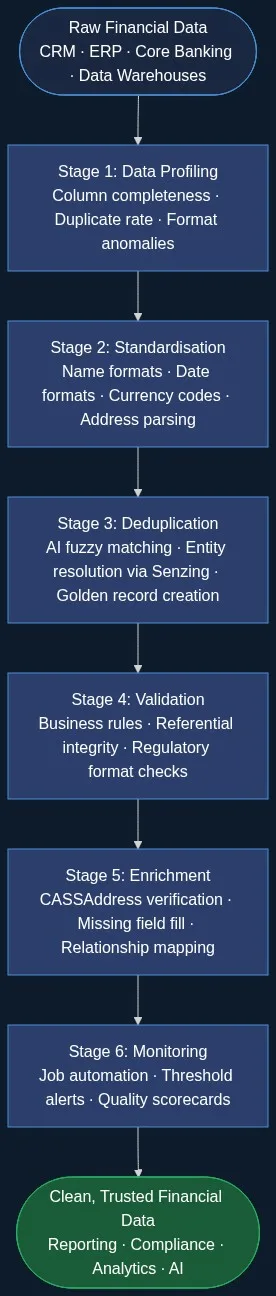
This guide walks through how to build a six-stage financial data quality management program that produces measurable, auditable results.
Why Financial Data Quality Is a Distinct Problem
Financial data carries regulatory weight that other enterprise data does not. A mismatch between the customer name on a transaction and the name in a KYC record is not just a data anomaly — it can trigger a compliance finding. A duplicate customer record in a lending system can result in two credit decisions being made for the same individual.
Common failure patterns in financial data
Here are the most common quality failures across typical financial datasets:
- Name variants: “Robert Williams” in core banking, “Bob Williams” in the CRM, “R. Williams” in the AML screening list. These are the same person. Exact matching fails on all three.
- Address inconsistency: “123 Main Street Suite 400” versus “123 Main St Ste 400” versus “123 Main St #400”. Three formats, one address. Reporting systems treat them as three entities.
- Duplicate accounts: A study of typical banking datasets finds 3 to 8 percent duplicate account records when cross-referencing CRM and core banking systems. At 2 million accounts, that is 60,000 to 160,000 records producing phantom positions.
- Date and currency format conflicts: “01/02/2024” is ambiguous between US (February 1) and European (January 2) formats. Currency fields missing ISO codes force downstream systems to guess.
Stage 1: Data Profiling — Know What You Have Before You Fix It
Profiling is not optional. It is the step that tells you where the problems are, how severe they are, and which datasets to prioritise. AI-powered data profiling in Match Data Pro scans every column for completeness rate, uniqueness ratio, format consistency, and value distribution — producing a quality scorecard before any cleansing work begins.
A typical financial profiling run across a 500,000-record customer dataset might surface:
- 14% of phone fields contain non-numeric characters
- 7.3% of records have no valid postcode
- 3.1% estimated duplicate rate based on name and address similarity
- 23 distinct date formats across transaction history tables
These numbers drive prioritisation. Fix date formats before running deduplication. Fix postcodes before running address verification. Sequence matters.
Stage 2: Standardisation — One Format, Every Field
Standardisation converts raw, inconsistent values into a canonical form that downstream matching and validation can process reliably. This is not transformation for its own sake. It is the prerequisite for every downstream quality step.
What standardisation covers in financial data
- Name standardisation: Expand abbreviations (Corp → Corporation, Ltd → Limited), strip salutations, normalise case. “MR. john SMITH LLC” becomes “John Smith LLC”.
- Address parsing: Split unstructured address strings into structured fields: street number, street name, unit type, unit number, city, state, postcode. This is the prerequisite for CASS address verification.
- Date normalisation: Convert all date fields to ISO 8601 (YYYY-MM-DD). No exceptions.
- Currency codes: Enforce ISO 4217 three-letter codes. Strip currency symbols from amount fields.
- Phone normalisation: Strip formatting, apply E.164 format (+15551234567). Separate country code from national number.
Match Data Pro’s data cleansing and standardisation engine applies configurable transformation rules across all field types in a single batch pass — or in real time via the live fuzzy search API for point-of-entry validation.
Stage 3: Deduplication and Entity Resolution — Collapse Many Records to One
This is the stage where most financial data programs stall. Exact matching catches identical duplicates. It does not catch “Robert Williams / Bob Williams / R. Williams” — the real problem.
AI-powered fuzzy matching scores similarity across multiple fields simultaneously. A weighted scoring model might look like this:
| Field | Algorithm | Weight | Match threshold |
|---|---|---|---|
| Full name | Jaro-Winkler + phonetic | 35% | 0.82 |
| Street address | Token sort ratio | 25% | 0.78 |
| Postcode | Exact | 20% | 1.00 |
| Date of birth | Exact / transposition | 15% | 0.95 |
| Phone | Normalised exact | 5% | 1.00 |
A composite score above 0.85 routes to auto-merge. Scores between 0.65 and 0.84 route to a human review queue. Below 0.65 is classified as distinct.
For complex financial entity graphs — where a corporate customer has multiple subsidiaries, branches, and contact records — Senzing entity resolution maps the full relationship graph. It links a parent company, its subsidiaries, and the individual contacts associated with each entity into a single resolved view — without requiring a shared identifier across systems.
The output is a golden record for each unique entity: one authoritative customer record assembled from the best available field values across all source systems. Survivorship rules determine which source wins for each field — most recent, most complete, or highest-trust source.
Ready to see this in your own financial data? Start a free trial of Match Data Pro — no contract required.
Stage 4: Validation — Enforce Rules at the Field and Record Level
Validation is rule-based. It catches problems that profiling surfaces and standardisation cannot fix by transformation alone — values that are correctly formatted but factually wrong.
Financial validation rule types
- Referential integrity: Every account must have a valid customer ID. Every transaction must reference a valid account. Orphan records fail this check.
- Range checks: Loan amounts above a configurable ceiling flag for review. Negative balance fields on savings products flag as errors.
- Regulatory format checks: LEI codes follow an 18-character ISO 17442 format. BIC codes follow an 8 or 11-character structure. Tax identification numbers follow country-specific patterns.
- Cross-field consistency: An account opened date cannot post-date the first transaction date. A date of birth cannot be in the future.
Validation rules in Match Data Pro are configurable without coding. They run as part of the same pipeline job that handles standardisation and deduplication, so the entire sequence runs as one automated workflow.
Stage 5: Address Verification — Deliverability and Geolocation Accuracy
Financial institutions send regulatory notices, statements, and compliance letters by post. An undeliverable address is not just an operational cost — it can be a compliance failure if a required notice never arrives.
CASS-certified address verification in Match Data Pro validates and corrects US postal addresses against the USPS master file. It appends ZIP+4 codes, corrects street directionals, and standardises unit designators — converting “123 Main St Ste 400” into its verified, deliverable canonical form.
For international financial datasets, address verification applies country-specific postal standards and flags addresses where the postcode does not match the city or region on record.
After address verification, your mailing and compliance datasets contain only deliverable, standardised addresses. Unverifiable addresses are flagged for human review rather than silently passed downstream.
Stage 6: Continuous Monitoring and Job Automation
A one-time data quality project does not stay clean. New records enter daily. Source systems continue to generate inconsistent data. Without ongoing monitoring, quality degrades within weeks of any major cleansing effort.
Automated deduplication jobs in Match Data Pro run on a schedule — daily, weekly, or triggered by a data ingestion event. Each run produces a quality report showing: duplicate rate, validation failure count, records routed to human review, and changes from the previous run.
Quality scorecards track trends over time. A rising duplicate rate in a specific source system signals a data entry problem at the source. A spike in validation failures after a system upgrade signals a schema change that broke a mapping. Monitoring catches these early, before they corrupt reports or regulatory submissions.
Want to see the full pipeline configured for your financial dataset? Book a demo with a Match Data Pro data engineer.
Frequently Asked Questions
How long does it take to build a financial data quality management program?
A baseline program covering profiling, standardisation, deduplication, and validation can be operational in four to eight weeks for most financial datasets. The first profiling run typically completes in hours. The longer timeline covers rule configuration, threshold tuning, and integration with source systems. Ongoing monitoring is automated once the initial pipeline is configured.
What is the difference between data cleansing and data validation in financial data?
Data cleansing corrects or transforms values that are incorrect or inconsistent — normalising name formats, fixing date fields, standardising addresses. Data validation checks whether values conform to defined business rules — referential integrity, regulatory formats, cross-field consistency. Both steps are required. Cleansing without validation leaves rule violations in place; validation without cleansing generates false positives from format inconsistencies.
How does fuzzy matching handle financial customer names differently from exact matching?
Exact matching requires character-for-character identity. “Robert Williams” and “Bob Williams” produce zero match on an exact join. Fuzzy matching scores phonetic similarity, character edit distance, and token-based overlap simultaneously. “Bob Williams” at 1234 Oak St with DOB 1978-04-12 scores 0.89 against “Robert Williams” at 1234 Oak St with DOB 1978-04-12 — well above the auto-merge threshold — because the address and date of birth anchor the match even when the name variant diverges.
What is a golden record in financial data management?
A golden record is the single authoritative version of a customer or account entity, assembled from the best available field values across all source systems. Survivorship rules determine which source wins for each field — for example, the most recently updated CRM record wins for phone number, while the core banking system wins for account open date. The golden record is the version used for reporting, compliance, and downstream analytics.
Does a financial data quality program need to be rebuilt for every system migration?
No. A well-designed program uses import and export connectors that abstract the pipeline from any specific source system. When a source system changes, you update the connector mapping — not the cleansing rules, matching definitions, or validation logic. Match Data Pro’s import/export connectors support CSV, Excel, SQL databases, and REST API sources, so the same quality pipeline runs regardless of which system the data comes from.