
Sustainable data assets are built through repeatable, automated quality and matching practices — not one-off cleansing projects. Organisations that run a seven-stage continuous pipeline (profile, standardise, verify, match, resolve, merge, monitor) achieve duplicate rates below 1.5% and data decay rates roughly 60% lower than those relying on periodic manual fixes. The core insight: data quality degrades at approximately 25–30% per year due to customer moves, company rebrands, and entry errors. Only a closed-loop system prevents that decay from compounding.
Ready to stop treating data quality as a project and start treating it as a practice? Start your free trial of Match Data Pro and run your first automated profiling job today.
Why Data Assets Degrade Without a Sustainable System
Every database decays. The US Postal Service reports that approximately 17% of Americans move every year. Business contact data degrades at 25–30% annually: people change roles, companies merge, phone numbers change, and email domains shift. A customer database that is 95% accurate today will be roughly 70% accurate in three years without active maintenance.
The problem compounds when data enters from multiple sources simultaneously. A CRM receives web form submissions. An ERP receives EDI feeds. A marketing platform ingests list uploads. Each source uses different field formats, naming conventions, and validation rules. Without a continuous matching and cleansing layer, every ingestion event introduces new inconsistencies.
The result is not just dirty data. It is an asset that actively loses value. Analytics built on degraded records produce misleading outputs. AI models trained on duplicated or inconsistent data produce contradictory predictions. A data quality program that runs continuously — rather than annually — is the only practical defence.
The Three Sources of Long-Term Data Decay
- Entry-time errors. Typos, transposed digits, inconsistent abbreviations (St. vs Street, Corp. vs Corporation). These enter at the moment of capture and compound over time as records are copied between systems.
- Source-system divergence. Two systems that once held the same record gradually diverge as each is updated independently. After 18 months, the same customer may have a different address in the CRM, ERP, and billing system.
- Structural change. Real-world entities change. Companies acquire subsidiaries, change names, split into divisions. Without entity resolution, these changes create new duplicate records rather than updating existing ones.
The Seven-Stage Sustainable Data Pipeline
A sustainable data asset strategy runs all seven stages on a schedule — daily, weekly, or on ingestion — rather than as a one-off project. Each stage feeds the next, and the final monitoring stage feeds back into the first.
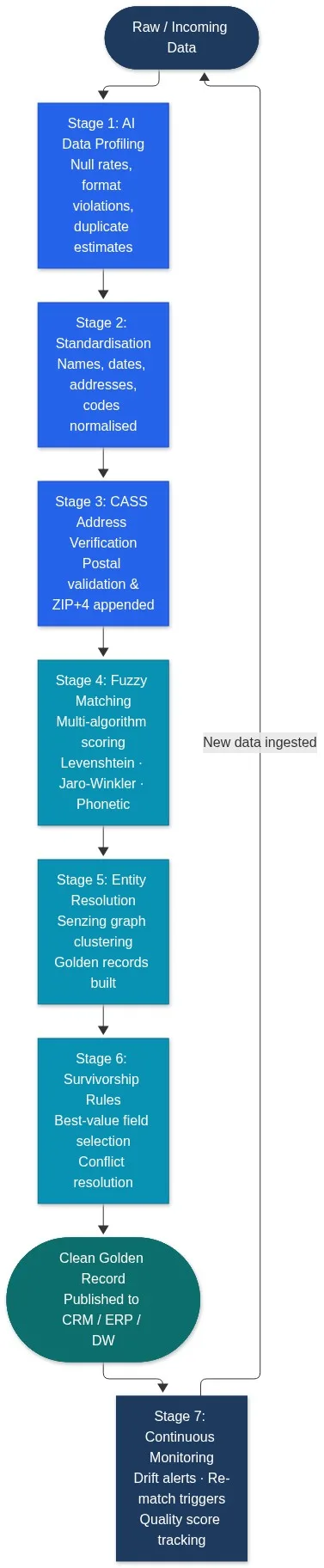
Fase 1: Perfilado de datos para IA
AI data profiling scans every field in every dataset and returns null rates, format violation counts, value distribution anomalies, and estimated duplicate density. This stage should run automatically every time a new data batch arrives. A profiling run on a 500,000-row CRM typically takes under two minutes and flags the top 10 quality issues before any cleansing begins.
Profiling output drives the rest of the pipeline. If null rates on the email field jump from 4% to 18% in a weekly ingest, that signals a form-capture problem upstream — not just a cleansing task. Sustainable data management catches these signals early.
Fase 2: Normalización
Data standardisation converts raw values into consistent formats. Name fields get title-cased and salutation-stripped. Phone numbers get normalised to E.164 format (+1-555-234-5678). Dates get converted to ISO 8601. Company suffixes (Inc., Corp., LLC) get expanded to canonical forms before matching. Without this step, “IBM Corp” and “International Business Machines Inc” score only 41% similar on a character-level algorithm — far below any useful match threshold.
Stage 3: CASS Address Verification
CASS address verification validates every postal address against the USPS database, appends ZIP+4 codes, and flags undeliverable records. This matters for sustainability because verified addresses are stable matching anchors. Two records with verified, identical ZIP+4 codes are far more likely to be the same entity than two records with free-text addresses that partially match. CASS verification typically corrects 8–12% of addresses in a typical B2B dataset.
Etapa 4: Coincidencia aproximada
Fuzzy matching scores record pairs using multiple algorithms in combination. Match Data Pro applies Levenshtein edit distance for short strings like names and codes, Jaro-Winkler for person names where prefixes carry more weight, phonetic encoding (Soundex, Double Metaphone) for names that sound alike but are spelled differently, and token-set ratio for company names with rearranged words.
A single-algorithm approach misses too many real matches. Consider these two records:
| Campo | Registro A | Disco B | Algoritmo | Puntuación |
|---|---|---|---|---|
| Empresa | Accenture PLC | Accenture plc. | Jaro-Winkler | 98 |
| DIRECCIÓN | 161 N Clark St, Chicago | 161 North Clark Street, Chicago IL | Relación entre conjuntos de tokens | 91 |
| Teléfono | 312-693-0000 | +1 312 693 0000 | Exacto normalizado | 100 |
| Dominio | accenture.com | accenture.com | Exacto | 100 |
| Compuesto | Weighted avg | 97 |
At a composite threshold of 85, these records match confidently and merge automatically — no manual review required.
Etapa 5: Resolución de entidades
Entity resolution goes beyond pairwise matching. Match Data Pro integrates Senzing’s graph-based engine to cluster all records that refer to the same real-world entity — even when no two records share enough field overlap for a direct pairwise match. Record A matches Record B on name and phone. Record B matches Record C on address and email. Senzing clusters A, B, and C as one entity even if A and C would not directly match each other.
Stage 6: Survivorship Rules
Once a cluster is identified, survivorship rules select the best value for each field across all contributing records. Rules are configurable: most recent non-null wins, most frequently occurring wins, highest-authority source wins. For a customer’s phone number, the CRM entry may be preferred over the marketing list entry. For an address, the CASS-verified record always wins over an unverified one. This produces a golden record — the authoritative single version of the entity.
Stage 7: Continuous Monitoring
Data quality monitoring closes the loop. After every pipeline run, Match Data Pro tracks quality scores per field and per dataset. If the duplicate rate on a CRM dataset climbs from 1.2% to 4.8% over three weeks, an alert fires and a re-match job is triggered automatically. This is what separates a sustainable system from a periodic cleanup: the system self-corrects without waiting for someone to notice a problem.
Long-Term Matching Practices That Compound Value
Beyond the pipeline mechanics, sustainable data asset management requires operational practices that build quality over time rather than allowing it to drift.
Match at Ingestion, Not After the Fact
The most effective organisations run matching at the point of data entry using Match Data Pro’s live fuzzy search API. When a sales rep types “Microsft” into a CRM search, the API returns “Microsoft” as the top candidate with a 97% match score before the record is created. This prevents the duplicate from entering the system entirely — far cheaper than finding and merging it six months later.
Data deduplication after the fact is always more expensive than prevention at ingestion. A record caught at entry costs seconds to fix. A duplicate found 12 months later — after it has propagated to five downstream systems — can take hours to untangle.
Automate Job Scheduling for Repeatable Runs
Match Data Pro’s job automation layer allows teams to schedule recurring cleansing, matching, and profiling jobs without manual intervention. A nightly job profiles every ingest from the previous 24 hours. A weekly batch job reruns the full entity resolution pass on the customer master. A monthly job audits CASS address freshness and flags records that have degraded since last verification.
This automation is what makes the practice sustainable at scale. A team of two data engineers can maintain a 10-million-record customer master with automated jobs running on a defined schedule — without dedicating full-time headcount to manual quality review.
Define Thresholds and Review Buckets, Then Shrink the Review Bucket
Every fuzzy matching system produces three outcome buckets: auto-match (composite score above 90), manual review (score 70–90), and no-match (below 70). Sustainable practice means working to shrink the manual review bucket over time — not accepting it as a permanent workload.
When teams see a consistently high volume of records in the 70–90 band, the right response is to refine field weights, add blocking keys, or add domain-specific preprocessing rules. Within two to three tuning cycles — typically four to six weeks — most teams reduce manual review volume by 40–60%.
Building Governance Around Long-Term Data Quality
A sustainable data asset is not purely a technical artefact. It requires governance structures that persist beyond individual projects.
Define Ownership for Each Domain
Every data domain — customer, vendor, product, address — should have a named owner accountable for quality scores. When the monthly monitoring report shows the vendor domain’s duplicate rate rising from 2% to 6%, someone is responsible for investigating and resolving it. Without named ownership, quality problems diffuse into collective inaction.
Measure Quality Scores, Not Just Counts
Row counts tell you nothing about quality. A 10-million-row customer table with a 15% duplicate rate contains only 8.5 million unique customers — but decisions based on it assume 10 million. Sustainable data management tracks six dimensions per domain: completeness, accuracy, consistency, timeliness, uniqueness, and validity. Match Data Pro’s profiling output scores all six automatically on every run.
Connect Quality Scores to Business Outcomes
The most durable governance structures tie data quality metrics to business outcomes that executives care about. When the marketing team can demonstrate that every 1% reduction in email bounce rate (driven by address quality) corresponds to a measurable improvement in campaign ROI, the data quality investment becomes self-justifying. Build dashboards that link quality scores to downstream KPIs from day one.
Match Data Pro is designed to integrate with BI tools and data warehouses via its import/export connectors, so quality scores flow naturally into existing reporting infrastructure.
Start Building Your Sustainable Data Asset Today
Sustainable data assets are not built in a sprint. They are built by running the same pipeline — profiling, standardising, verifying, matching, resolving, merging, monitoring — consistently over months and years, refining thresholds as you go, and automating everything that can be automated.
Match Data Pro gives data teams a cloud SaaS platform that covers every stage of this pipeline: AI-powered fuzzy matching, Senzing entity resolution, CASS address verification, data profiling, job automation, and live fuzzy search API — all accessible on a monthly subscription with no long-term contract.
Start your free trial at members.matchdatapro.com and run a full profiling and matching job on your own data within the hour. Or book a demo to see the full seven-stage pipeline applied to a dataset similar to yours.
Preguntas frecuentes
What does “sustainable data assets” mean in practice?
A sustainable data asset is a dataset maintained through continuous, automated quality and matching processes — not periodic manual fixes. It means running profiling, standardisation, deduplication, entity resolution, and monitoring on a defined schedule so that quality scores remain stable or improve over time, even as new data enters from multiple sources daily.
How often should I run matching and deduplication jobs?
Frequency depends on ingestion rate and risk tolerance. High-volume systems — CRM with 500+ new records daily — benefit from nightly deduplication runs and real-time match-at-entry via API. Lower-volume systems can run weekly or monthly batch jobs. At minimum, run a full deduplication pass whenever a significant new data source is integrated, before any major analytics or reporting cycle.
How much of the manual review workload can be automated?
Most teams achieve 70–85% auto-match rates within two to three tuning cycles. With well-configured field weights, blocking keys, and preprocessing rules, the manual review bucket (scores 70–90) typically falls to under 5% of total candidate pairs. Remaining edge cases — multi-entity clusters with conflicting addresses — still benefit from human review, but volume should be manageable.
What is the difference between data deduplication and entity resolution in a sustainable pipeline?
Deduplication removes exact or near-exact duplicate records within or across datasets. Entity resolution goes further: it links all records — including indirect matches — that refer to the same real-world entity, even when no two records share enough fields for a direct match. Both are needed. Deduplication handles straightforward duplicates quickly. Entity resolution handles complex, multi-source identity problems. Run both in sequence for a complete sustainable pipeline.
How does address verification contribute to long-term data sustainability?
CASS address verification standardises and validates postal addresses against the USPS database, appending ZIP+4 codes and flagging undeliverable records. Verified addresses serve as stable matching anchors: two records with identical verified ZIP+4 codes score higher in fuzzy matching, reducing false negatives. Address data degrades at roughly 10–15% annually due to moves and readdressing. Regular re-verification prevents this decay from corrupting downstream matching accuracy.