
Edge computing distributes data processing to the network edge — sensors, IoT gateways, retail kiosks, and factory floors — rather than routing everything through a central data centre. This creates a critical data quality problem: records generated at dozens or hundreds of edge nodes arrive with inconsistent formats, missing fields, and duplicate entries before any centralised matching or cleansing can run. The solution is a two-tier quality pipeline that enforces lightweight rules at the edge and runs full fuzzy matching and entity resolution in the central pipeline.
Start a free trial of Match Data Pro and see how the platform handles real-time and batch data quality across distributed environments.
Why Edge Environments Create Unique Data Quality Problems
Traditional data quality pipelines assume data arrives in one place, in one format, and at a manageable rate. Edge computing breaks all three assumptions.
High velocity, low structure
An IoT-connected manufacturing plant may generate 50,000 sensor readings per minute. Each reading contains device IDs, timestamps, location codes, and measurement values. Device IDs are entered at commissioning — often by field technicians with no data standards mandate. The same device appears as “SEN-042”, “Sensor042”, and “sensor 42” across three nodes.
These inconsistencies make downstream data matching and merging unreliable unless normalisation runs before records reach the central store.
Intermittent connectivity
Edge nodes often run offline for periods. When connectivity resumes, the node transmits a batch of records. Without a deduplication check, the same transaction arrives twice — once from the local buffer and once from a retry mechanism. Downstream systems see the same event as two separate rows, inflating counts and corrupting aggregations.
No shared identifier
Each edge system assigns its own local identifier. A patient in a hospital ward monitoring system is “PAT-7791”. The same patient in the pharmacy dispensing system is “RX-14022”. Without entity resolution, the two records never link and the patient appears as two different people.
The Two-Tier Edge Data Quality Architecture
The most reliable approach is a two-tier pipeline: lightweight quality enforcement at the edge, full processing at the centre.
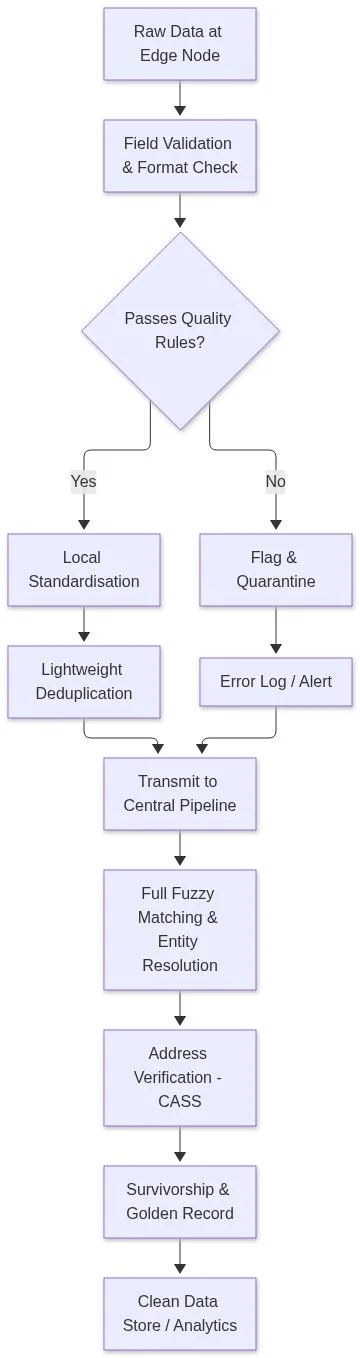
Tier 1: Edge-side quality rules
At the edge, run only what the hardware supports:
- Field validation — reject records missing mandatory fields (device ID, timestamp, location code).
- Format standardisation — normalise date formats (ISO 8601), casing (uppercase device IDs), and unit notation (always “kg”, never “KG” or “kilograms”).
- Range checks — flag temperature readings outside physically plausible bounds.
- Lightweight deduplication — hash the key fields and cache the last N hashes. If the incoming record matches a cached hash within a 60-second window, suppress the duplicate.
These rules require minimal compute. A Raspberry Pi 4 or equivalent gateway can apply them at 10,000+ records per second.
Tier 2: Central pipeline quality
When records reach the central pipeline, run the full quality stack:
- AI data profiling to surface field-level quality scores and anomaly patterns across all edge sources.
- Full data standardisation across all source formats and vocabularies.
- Configurable AI-powered fuzzy matching to identify records that refer to the same real-world entity despite format differences.
- Entity resolution (powered by Senzing) to persist identities across all edge sources and assign a stable global identifier.
- Survivorship rules to build and maintain a golden record from conflicting field values.
Five Specific Data Quality Challenges at the Edge
1. Clock drift and timestamp misalignment
Edge devices rely on local clocks. Without NTP synchronisation, two nodes recording the same physical event can produce timestamps 90 seconds apart. When the records merge at the central store, they appear as separate events. The fix: include a server-received timestamp at ingest, flag records where device timestamp and server timestamp diverge by more than a configurable threshold (typically 30 seconds), and route them through a reconciliation queue.
2. Schema evolution without coordination
Field engineers update firmware on individual nodes. A new firmware version adds a “firmware_version” field that older nodes do not emit. The central pipeline now receives two record schemas simultaneously. The standardisation layer must handle schema drift gracefully — accepting both formats and mapping both to the canonical schema without losing data.
3. Duplicate records from retry logic
Retry mechanisms in messaging protocols (MQTT, AMQP) can deliver a message more than once when acknowledgements are lost during intermittent connectivity. This is a by-design feature, not a bug — but it means the central pipeline must deduplicate aggressively. Match Data Pro’s deduplication engine handles this with configurable blocking keys and time-window matching so that retransmitted records collapse to a single canonical entry.
4. Partial records and missing fields
Battery-constrained sensors may truncate payloads to conserve power. A record arrives with device ID, timestamp, and sensor value — but no location code. Standard deduplication engines fail on null fields. Match Data Pro’s null-tolerant matching assigns field weights dynamically, scoring across only the populated fields and adjusting confidence accordingly. A record scoring 78/100 on three fields can still match confidently against a record scoring 72/100 on the same three fields.
5. Address data at field service nodes
Field service operations — utility meters, broadband installations, delivery confirmation — capture address data at the edge. Field technicians type addresses on mobile devices in irregular formats: “14 Oak St Apt 3B”, “14 OAK STREET APT3B”, “14 oak st #3b”. CASS address verification in the central pipeline standardises all three to the USPS canonical format and appends ZIP+4, making them matchable in downstream analytics.
Applying Edge Data Quality in Practice: Three Use Cases
Industrial IoT: manufacturing sensor data
A global manufacturer runs 1,200 edge nodes across 14 plants. Each node generates 2,000 records per second. The edge tier enforces device ID normalisation and timestamp validation. The central tier runs AI fuzzy matching to link device records to asset master data, deduplicates retransmitted events, and feeds a clean time-series store. Before the two-tier pipeline, the duplicate rate was 4.1%. After implementation, it dropped to 0.3%.
Retail: point-of-sale transaction matching
A retail chain operates 450 POS terminals across 60 stores. Each terminal runs offline when network connectivity fails and transmits a backlog when it reconnects. Without a deduplication pipeline, the same transaction appeared in the central database 1.6 times on average during outages. With hash-based edge suppression and central fuzzy deduplication, the duplicate rate fell to under 0.1%.
Healthcare: bedside monitoring to EHR
Patient monitoring equipment generates records with local patient IDs. The hospital EHR uses a different ID scheme. Without entity resolution, the same patient generates two separate records, breaking care continuity. With Senzing entity resolution in the central pipeline, the platform links monitoring records to EHR records with 97% accuracy using name, date of birth, and room-location matching.
How Match Data Pro Handles Edge Data Quality
Match Data Pro is a cloud SaaS platform for complete data quality management. For edge-generated data, it handles the central tier of the two-tier architecture described above.
Key capabilities for edge environments:
- Live fuzzy search API — submit a record via HTTP and receive a match score and entity resolution result in under 200ms, enabling real-time deduplication at the point of central ingestion.
- Configurable fuzzy matching algorithms — Levenshtein, Jaro-Winkler, phonetic, and token-based, with per-field weights. Apply different algorithms to device IDs, names, and addresses in a single match definition.
- Null-tolerant entity resolution (Senzing) — link records with missing fields by scoring across available fields only, without false rejections on nulls.
- CASS-certified address verification — standardise and verify addresses captured at field service edge nodes.
- Job automation with import/export connectors — connect to Kafka, S3, SQL, and REST sources; schedule batch jobs to process edge backlog on reconnect.
- AI data profiling — run quality scoring across all edge sources simultaneously to identify nodes with persistently low-quality output before they contaminate the central store.
No long-term contract. Monthly SaaS with a free trial available at members.matchdatapro.com. Book a demo to walk through a live edge data quality pipeline with your own sample data.
Preguntas frecuentes
What is edge computing data quality and why does it differ from traditional data quality?
Edge computing data quality is the practice of enforcing data standards on records generated at distributed network endpoints — IoT sensors, POS terminals, field devices — before and after they reach a central system. It differs from traditional data quality because edge environments produce data at high velocity, with inconsistent schemas, partial fields, and duplicate records caused by retry logic. A two-tier pipeline — lightweight rules at the edge, full matching and entity resolution at the centre — is the standard approach.
How do you deduplicate records from edge nodes that use retry-delivery protocols?
The most reliable method is hash-based suppression at the edge combined with fuzzy deduplication at the centre. Hash the primary key fields and cache recent hashes with a configurable time window (60 to 300 seconds). At the central pipeline, apply blocking and fuzzy scoring to collapse records that passed the edge cache but were retransmitted during a longer outage. Match Data Pro handles both layers through its deduplication engine and live API.
Can entity resolution handle records with no shared identifier across edge systems?
Yes. Senzing entity resolution in Match Data Pro links records using weighted composite scoring across name, date, location, and any other available field — no shared primary key required. Partial records score lower but still match confidently against records with more populated fields, provided the overlapping fields score above the configured threshold.
How does clock drift at edge nodes affect data quality in a central pipeline?
Clock drift causes records from different nodes to appear as separate events when they describe the same physical occurrence. The fix is dual timestamping: record both the device timestamp and the server-received timestamp at central ingestion. Flag records where the two diverge beyond a threshold, route them to a reconciliation queue, and apply time-window deduplication so records within the tolerance window merge correctly.
What is the difference between edge-side and cloud-side data quality processing?
Edge-side processing applies only fast, low-compute rules: field validation, format normalisation, range checks, and hash deduplication. It runs on constrained hardware with minimal latency impact. Cloud-side processing runs the full quality stack: AI profiling, multi-algorithm fuzzy matching, entity resolution, CASS address verification, survivorship, and golden record construction. The two tiers work together — edge quality reduces noise, central quality resolves identity and builds trusted records.