
Explainable entity resolution makes every match decision transparent: you can see which fields matched, which algorithm fired, what weight each field carried, and the resulting confidence score. Without that layer of visibility, data engineers cannot tune thresholds, compliance teams cannot satisfy audit requirements, and business stakeholders refuse to trust the golden records that come out the other end.
Ready to bring transparency to your matching pipeline? Start a free trial of Match Data Pro and audit every match decision from day one.
Why Black-Box Matching Breaks Trust
Most entity resolution systems produce a yes/no match decision. Record A matches Record B. That is the entire output. For a data engineer running a one-off deduplication job on a small table, that may be enough. For a team managing millions of customer records across a CRM, ERP, and marketing platform, it is not.
Three problems emerge when the matching engine is a black box.
- Threshold calibration is guesswork. If you cannot see that “Robert Smith, 123 Main St” scored 94 against “Rob Smith, 123 Main Street” because the name similarity was 87, the address similarity was 97, and the email was an exact match at 100, you have no basis for deciding whether 94 is the right threshold.
- Errors are hard to fix. A false merge silently collapses two distinct customers into one. Without field-level scores in the audit log, the investigation starts from scratch every time.
- Compliance is impossible to demonstrate. GDPR’s right to explanation, HIPAA patient-matching governance, and financial-services KYC requirements all demand a documented justification for data decisions. A score alone does not meet that bar.
What Explainability Looks Like in an Entity Resolution Pipeline
An explainable pipeline produces a structured decision record for every candidate pair it evaluates. That record contains four categories of information.
1. Field-level similarity scores
Each field is scored independently before the composite score is calculated. A well-designed entity resolution pipeline might score a candidate pair like this:
| Campo | Record A value | Record B value | Algoritmo | Puntuación | Peso | Weighted contribution |
|---|---|---|---|---|---|---|
| Apellido | Thompson | Thomson | Jaro-Winkler | 93 | 0.30 | 27.9 |
| Nombre | William | Bill | Nickname lookup + Jaro | 88 | 0.20 | 17.6 |
| Línea 1 de la dirección | 45 Oak Ave | 45 Oak Avenue | Índice de clasificación de fichas | 96 | 0.25 | 24.0 |
| City/State/ZIP | Austin TX 78701 | Austin TX 78701 | Exacto | 100 | 0.15 | 15.0 |
| Teléfono | 512-555-0192 | 5125550192 | Exacto normalizado | 100 | 0.10 | 10.0 |
| Compuesto | 94.5 |
The composite score of 94.5 is now fully decomposable. A reviewer can see immediately that the name discrepancy (“Thomson” vs “Thompson” and “Bill” vs “William”) was the only source of uncertainty, and they can decide whether the remaining evidence is sufficient.
2. Algorithm identity and configuration
The audit record names the specific algorithm used for each field, plus any configuration parameters: edit-distance tolerance, phonetic variant set, token weights. This is essential when you need to replay the decision after a configuration change. Data matching algorithms vary widely in how they handle edge cases, so the audit log must capture which variant ran.
3. Routing decision and threshold applied
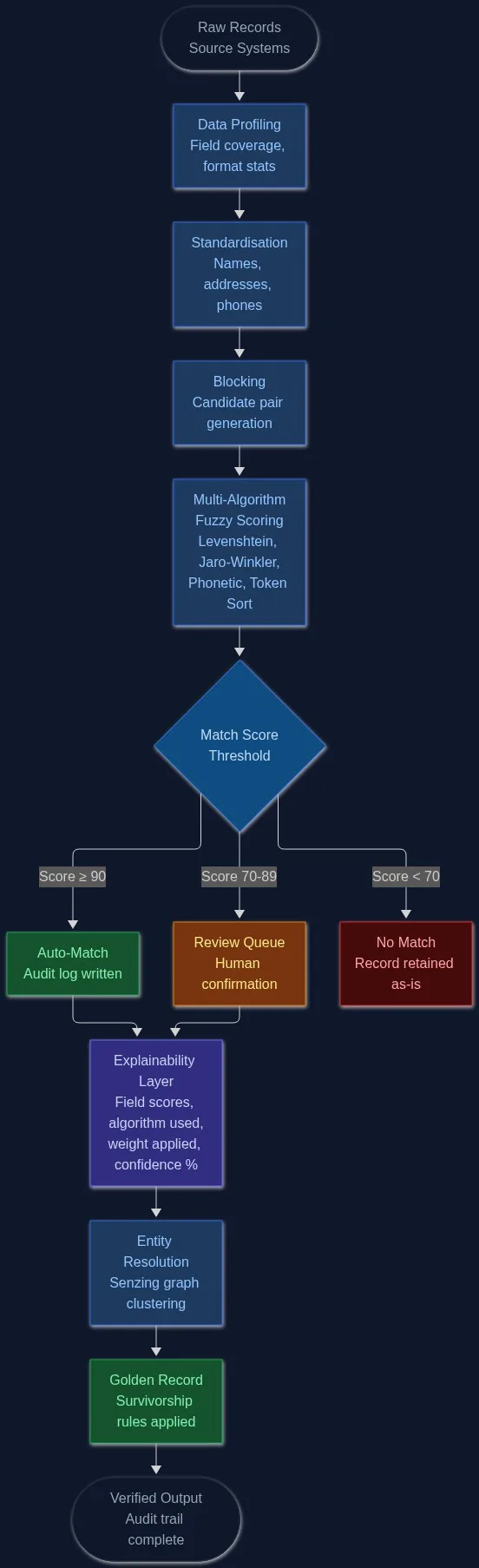
Every pair exits the scoring engine via one of three routes.
- Auto-match (score 90+): merged automatically; audit log written and closed.
- Review queue (score 70-89): routed to human review; reviewer decision appended to the audit record.
- No match (score below 70): both records retained; non-match decision logged with the composite score.
Recording the threshold in force at the time of the decision matters. If you later lower the auto-match threshold from 90 to 85, you need to know which historical merges were made at the old threshold and which at the new one.
4. Timestamps, source records, and downstream impact
The audit record captures the timestamp, the source system identifiers for both records, the golden record ID that resulted, and which downstream systems received the update. This is what makes the record usable for compliance audit trails: you can trace a golden record back to its constituent inputs and forward to every system it touched.
Building an Explainable Pipeline: Stage by Stage
Explainability is not a feature you bolt on after matching. It is a design constraint that shapes every stage of the pipeline.
Fase 1: Análisis de los datos
Before matching begins, data profiling measures field completeness, format distributions, and outlier rates across every source. This determines which fields are reliable enough to carry weight in scoring. A field that is 60% null should not carry a 25% weight; its weight should be redistributed to fields with higher coverage.
Fase 2: Normalización
Field values must be normalised before scoring begins. Phone numbers stripped of formatting characters, names lowercased and trimmed, addresses parsed into components, company suffixes expanded or removed. Data standardisation ensures the algorithm scores semantic similarity, not formatting difference. Skipping standardisation inflates false negatives because “512-555-0192” and “5125550192” look different to a string-distance algorithm but are the same value.
Etapa 3: Bloqueo
Blocking generates candidate pairs. Only records that share a blocking key (a postcode, a name token, a normalised phone prefix) are compared. This reduces an O(n²) comparison space to a tractable subset. The explainability record should log which blocking key triggered each comparison so reviewers can verify the candidate generation logic did not prune valid pairs.
Stage 4: Multi-algorithm fuzzy scoring
Apply a different algorithm to each field based on its data type. Person names benefit from Jaro-Winkler plus nickname lookup. Company names benefit from token sort ratio plus abbreviation expansion. Addresses need a parser before any similarity measure runs. Fuzzy matching algorithms each have blind spots; a composite multi-algorithm approach outperforms any single one.
Stage 5: Explainability layer and routing
Once field scores are computed, the explainability layer assembles the full decision record: field scores, algorithms, weights, composite score, threshold applied, routing decision, and timestamp. This record is written to an immutable audit log before the merge or no-match decision executes.
Stage 6: Entity resolution and survivorship
Graph-based entity resolution clusters pairs into entity groups. A customer who appears in four source systems may generate six pair comparisons, all of which feed a single cluster. Survivorship rules then select the best-quality value for each field across the cluster. The golden record carries a lineage trail: for each field, the source system and original value are recorded. Golden records in MDM are only trustworthy when that lineage is complete.
Cómo Match Data Pro ofrece una resolución de entidades explicable
Match Data Pro is built to make every match decision transparent and auditable. The platform provides field-level scoring breakdowns across its full algorithm library, including Levenshtein, Jaro-Winkler, phonetic, token sort, and exact variants. Each comparison writes a structured decision record to an immutable audit log.
The AI-powered data profiling module runs before any matching job begins, measuring field coverage and recommending weight assignments based on completeness rates. Standardisation is applied at the field level using configurable transformation rules, so the same standardisation logic runs consistently in batch jobs and through the live fuzzy search API.
Entity resolution runs on the Senzing engine, which produces entity graphs with full pair-level provenance. Each node in the graph carries the contributing pair scores and the source system identifiers. Survivorship rules are configurable per field, and the resulting golden record includes a field-level lineage table.
Job automation lets teams schedule matching runs and route exception records to review queues automatically. The review interface surfaces the full decision record for each record pair so reviewers see the same field scores and algorithm identifiers that the automated engine used. For teams requiring complete data unification across multiple systems, Match Data Pro’s import and export connectors bring source data in and push golden records back out, with the audit log maintained throughout.
Book a demo to see the explainability layer in action on your own data.
Common Explainability Failures and How to Avoid Them
Logging only the composite score
A composite score of 85 tells you nothing about why the records were considered a match. Two records could reach 85 via completely different field combinations. Always log the per-field breakdown.
Not recording the threshold in force
When teams tune thresholds over time, historical decisions made under old thresholds become misleading if the threshold is not logged alongside the score. Record the threshold value and the date it was last changed.
Missing algorithm version information
Algorithm updates can subtly change score distributions. If a Jaro-Winkler implementation is updated, scores may shift by 2 to 5 points. The audit log should capture the algorithm version or platform build number so changes can be correlated with score drift.
No human decision capture
When a reviewer overrides an automated decision, that override must be logged with the reviewer’s identifier, the timestamp, and their stated reason. Without this, the audit trail for a human-reviewed record is incomplete. Audit log completeness requires both automated and manual decision records.
Preguntas frecuentes
¿Qué es la resolución explicable de entidades?
Explainable entity resolution is a matching pipeline that records a structured decision log for every candidate pair: the similarity score for each field, the algorithm used, the weight applied, the composite score, the threshold in force, and the resulting routing decision. This makes every match or no-match outcome fully auditable and reproducible.
Why do compliance teams require explainable matching?
Regulations like GDPR’s right to explanation, HIPAA patient-matching governance, and financial-services KYC requirements mandate that data decisions can be justified. A composite score alone does not satisfy that requirement. Field-level decision records demonstrate why two records were merged or kept separate, which is the evidence regulators and auditors need.
How does field weighting affect match explainability?
Field weights determine how much each field’s similarity score contributes to the composite. If a low-completeness field carries excessive weight, the composite score becomes unreliable. Logging the weight alongside each field score reveals this problem immediately: a reviewer can see that a 70% complete phone field is driving 30% of the composite score and flag the configuration for correction.
Can an explainable pipeline handle real-time matching?
Yes. A live fuzzy search API can return field-level scores and algorithm identifiers in a JSON response alongside the match result. The latency overhead of building the decision record is minimal, typically 1 to 5 milliseconds, and the response body adds less than 2KB for a standard 5-field comparison.
How long should entity resolution audit logs be retained?
Retention depends on the regulatory framework. GDPR-scoped processing logs are typically retained for 3 years. HIPAA-covered operations require a minimum of 6 years. Financial-services KYC logs are commonly retained for 7 years under BSA/AML rules. Store logs in an immutable append-only store and index by entity ID, source record ID, and date for efficient retrieval during audits.
Register for a free trial of Match Data Pro and run your first explainable entity resolution job today. No contract required.