
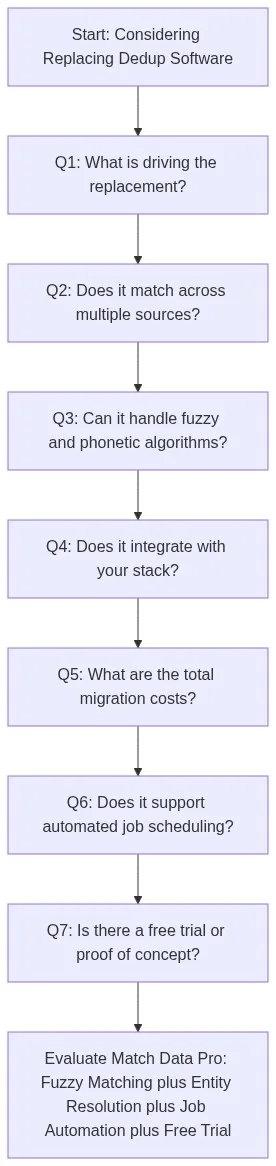
Replacing your data deduplication software is the right call when your current tool misses matches, can’t scale, or blocks your data quality roadmap. But switching platforms carries real migration cost and risk. Before you commit, seven diagnostic questions will expose whether the problem is your software, your configuration, or your data — and what your replacement must do differently.
Ready to see what a modern platform looks like? Start a free trial of Match Data Pro — no contract required.
Why Replacing Deduplication Software Is a High-Stakes Decision
Most teams that replace their deduplication software do so after months of degrading match rates, growing manual review queues, or failed CRM migrations. The decision feels obvious by then. But replacing the wrong tool for the wrong reason — or replacing a good tool when the real problem is bad input data — costs far more than staying put.
Consider the full cost: tool licensing, data migration scripts, retraining, reconfiguring match rules, and validating the new output against production records. On a 10-million-record CRM, that process routinely takes 8–16 weeks of engineering time. Get the questions wrong upfront and you repeat the exercise in two years.
A structured evaluation forces you to separate capability gaps from configuration failures. In our experience, roughly 40% of teams looking to replace their deduplication software would achieve their goals with configuration changes alone. The other 60% have genuine platform limitations. The seven questions below tell you which camp you are in — and what to demand from a replacement.
The 7 Questions to Answer Before You Switch
Question 1: What specific failure is driving the switch?
Low match rate, high false-positive rate, and poor performance are three completely different problems. A low match rate often means the tool is doing exact matching on dirty fields — the fix is standardisation upstream, not a new platform. A high false-positive rate means thresholds are set too low or algorithm weights are wrong — again, a configuration problem. Only failure modes like “can’t match across more than two sources” or “no API for real-time deduplication” are true platform limitations.
Document the failure in measurable terms: “Our current tool misses 22% of known duplicates in our CRM test set” is actionable. “The tool isn’t working well” is not. If you cannot quantify the failure, run a data profiling analysis first to establish a baseline.
Question 2: Does your current tool support multi-source matching?
Most early-generation deduplication tools were designed for single-source deduplication — finding duplicates within one database. Modern data environments require matching across CRM, ERP, marketing automation, and third-party data sources simultaneously. If your tool can only ingest one dataset at a time and apply rules within it, every cross-system duplicate survives.
The capability you need is record linkage across multiple systems — the ability to ingest three or more source tables, apply blocking and fuzzy scoring across all of them, and produce a unified golden record with source attribution. If your current platform cannot do this, it is a genuine platform limitation and replacement is warranted.
Question 3: What matching algorithms does it actually use?
Many tools advertise “fuzzy matching” but implement only a single algorithm — typically Levenshtein edit distance or simple phonetics. That is not enough. A name field like “Jon Smith” versus “Jonathan Smyth” requires Jaro-Winkler plus a nickname expansion table. A company name like “IBM Corp” versus “International Business Machines” requires token-based matching with abbreviation normalisation. An address like “123 Main St” versus “123 Maine Street” requires CASS-standardised parsing before any fuzzy comparison runs.
Ask your current vendor for a list of all supported algorithms and test them against your specific field types. A proper evaluation of fuzzy matching algorithms should include Levenshtein, Jaro-Winkler, Soundex/Metaphone phonetics, and token-set ratio as a minimum. If your current tool forces you to pick one algorithm for all fields, you are leaving match accuracy on the table.
Question 4: How does it integrate with your existing stack?
Switching deduplication platforms does not end with matching logic. The new tool must connect to every system that sends or receives data: Salesforce, HubSpot, SQL databases, flat-file exports, data warehouses, and downstream BI tools. Integration friction is the leading cause of delayed deduplication platform rollouts.
Map your current integration points before evaluating replacements. For each system, ask: does the replacement offer a native connector, a REST API, or a file-based import/export? Match Data Pro provides import/export connectors for the most common enterprise sources, plus a live fuzzy search API for real-time deduplication at the point of record entry. If your current tool requires manual file drops for every run, that alone is worth switching for.
Question 5: What is the true total cost of switching?
Licence cost is the smallest part of a platform migration. The real cost components are:
| Cost component | Typical range |
|---|---|
| New platform licence (year 1) | $5,000 – $50,000 |
| Data migration and ETL rework | $20,000 – $150,000 |
| Match rule re-configuration | 2–8 weeks engineering |
| Output validation and QA | 3–6 weeks analyst |
| Retraining staff | $2,000 – $10,000 |
| Business disruption (frozen dedup runs) | Variable |
A platform that runs on a month-to-month SaaS model with a free trial — like Match Data Pro — lets you complete this cost analysis on real data before signing a contract. Any vendor that requires a multi-year commitment before you can test against your own records is asking you to take an unquantified risk.
Question 6: Does it support survivorship rules and automated job scheduling?
Identifying duplicates is only half the job. The platform must also decide which field values survive the merge — what master data management practitioners call golden record survivorship. Simple rules look like “prefer the most recently updated value” or “prefer the CRM value over the spreadsheet value.” Complex rules involve field-level source trust scores and conditional logic.
Job automation is equally important. Deduplication is not a one-time project. New records enter your CRM daily. Your deduplication platform must run on a schedule — nightly, weekly, or continuously via API — without manual intervention. If your current tool requires a data engineer to manually trigger every job, that is a scalability failure. Ask any replacement vendor specifically how recurring jobs are configured and monitored. Match Data Pro’s job automation engine lets you schedule, chain, and alert on deduplication runs without writing any scripts.
Question 7: Can you run a proof of concept on your own data?
This is the most important question. No benchmark test, vendor demo, or reference customer replaces a head-to-head test on your own production records. Your data has specific characteristics — name formats, address quality, completeness rates, domain quirks — that no generic demo set captures.
A credible replacement platform will let you:
- Import a representative sample (10,000 – 100,000 records) from your actual sources
- Run data deduplication with your own field mappings and threshold settings
- Inspect match pairs with per-field score breakdowns
- Measure precision and recall against a known ground truth set
- Adjust configuration and re-run without engineering involvement
Any vendor that cannot support this workflow is not production-ready for your organisation. Register for a free trial of Match Data Pro and run the proof of concept yourself — no sales call required to get started.
What a Modern Deduplication Platform Must Deliver
Once the seven questions confirm that replacement is the right move, your requirements list should cover these capabilities without compromise:
AI-powered fuzzy matching with configurable algorithms
The platform must support multiple algorithms per field — not a single global setting. Name fields need Jaro-Winkler plus phonetic expansion. Address fields need CASS-standardised parsing before matching. Numeric fields like phone numbers need transposition-tolerant matching. The platform should let you weight each field independently and set per-field thresholds that route borderline pairs to human review.
Match Data Pro’s fuzzy matching engine supports Levenshtein, Jaro-Winkler, Soundex, Metaphone, token-set ratio, and custom scoring rules — all configurable per field, per job.
Entity resolution for cross-system identity
If you operate more than two systems, you need entity resolution — not just deduplication. Entity resolution tracks that “J. Smith at 123 Main St” in your CRM and “Jonathan Smith at 123 Maine Street” in your ERP are the same person, even with no shared customer ID. Match Data Pro includes Senzing-powered entity resolution for graph-based identity matching across any number of sources — no hand-crafted rules required.
Verificación de direcciones CASS
Address fields are the most error-prone field type in any CRM. Without CASS-certified address standardisation, two records at the same physical address can look completely different: “Suite 100” versus “Ste 100” versus “Unit 100.” Standardise addresses to USPS delivery point format before fuzzy matching runs, and your address-based match rate improves by 15–25% with no algorithm changes required.
Data profiling before every run
Any new platform should run automated data profiling on every ingested dataset before matching begins. Profiling exposes null rates, format inconsistencies, outlier values, and completeness scores at the field level. That information drives threshold calibration and prevents a wave of false matches from propagating to your golden record store.
Making the Transition Without Disrupting Operations
Once you have chosen a replacement, run old and new platforms in parallel for at least one full deduplication cycle. Compare match output on the same input set and measure:
- Precision: what percentage of proposed matches are genuine duplicates?
- Recall: what percentage of known duplicates did the new platform find?
- New pairs: are there matches the old platform missed that the new one finds?
- Regressions: are there correct matches the old platform found that the new one misses?
Regressions matter most. A new platform that finds 5% more matches but misses 2% that the old one caught requires you to understand why before you cut over. Most regressions trace back to blocking configuration — the new platform’s blocking rules eliminated candidate pairs that the old platform considered.
Read the full pipeline guide on data deduplication in practice for a step-by-step walkthrough of the transition process, including how to configure blocking, thresholds, and survivorship rules from scratch on a new platform.
For teams currently using their deduplication tool inside a CRM context, see the companion guide on how to dedupe CRM data — it covers field weighting, match rule design, and post-merge validation specific to CRM environments.
When you are ready to evaluate a modern alternative, schedule a demo with the Match Data Pro team — we will run the proof of concept on your own data and show you the match output before you make any commitment.
Preguntas frecuentes
How do I know if my deduplication software actually needs replacing?
Run a controlled test: take 1,000 records with known duplicate pairs and measure how many your current tool finds. If precision is below 85% or recall is below 80% after proper configuration, the platform has genuine capability gaps. If the tool has never been properly configured with field-specific thresholds and algorithm selection, fix the configuration first before replacing the software.
What is the biggest risk when replacing data deduplication software?
The biggest risk is a regression in match output — the new platform misses duplicates the old one caught because of different default blocking or threshold settings. Mitigate this by running both platforms in parallel on the same dataset for one full cycle, comparing output pair-by-pair, and resolving discrepancies before cutting over production jobs.
How long does it take to migrate to a new deduplication platform?
For a well-prepared team with clean source data and documented match rules, migrating to a new deduplication platform takes 4–8 weeks: two weeks for configuration and import connector setup, two weeks for parallel-run validation, and one to two weeks for cutover and monitoring. Poor source data quality or undocumented legacy rules can extend this to 16 weeks.
Do I need entity resolution or just deduplication?
If all your duplicates live inside a single system, deduplication is sufficient. If the same person or company appears across two or more systems — CRM, ERP, marketing database — with no shared ID, you need entity resolution. Entity resolution handles cross-system identity matching at scale, something standard deduplication tools cannot do without significant custom scripting.
Can I switch deduplication platforms without a long-term contract?
Yes. Match Data Pro operates on a month-to-month SaaS model with no long-term contract. You can start with a free trial, run a proof of concept on your own data, scale to full production, and adjust or cancel month to month. This removes the financial risk from the evaluation process and lets you make the switch decision based on measured match quality, not contract pressure.