
APIs that process data in real time introduce a specific problem: errors arrive faster than humans can catch them. The solution is to embed data quality controls directly into the API layer, so every record is validated, standardised, and matched before it reaches your database. This article explains how to build that pipeline and what happens when you skip it.
Start a free trial of Match Data Pro and test real-time fuzzy matching against your own data in minutes.
Why Real-Time Data Quality Is Harder Than Batch
Batch pipelines give you time. You can profile an entire file, quarantine suspicious rows, and re-run the cleanse job overnight. Real-time APIs offer none of that. A webhook fires, a form is submitted, or a point-of-sale event lands, and your system must respond in milliseconds.
The practical consequences compound quickly. A contact record arrives with the name JOHN S MITH, phone +1 (888) 555 01234, and address 123 Main St Ste. 4B Denver CO 8O203 (note the letter O instead of zero in the ZIP). Batch processing catches the ZIP typo during nightly cleansing. Real-time processing must catch it at the point of ingestion, before the record is written, or it pollutes every downstream system instantly.
The challenge is amplified at scale. High-throughput APIs handling 10,000 or 100,000 requests per hour leave no headroom for heavyweight synchronous validation without introducing latency. Data quality logic must be both comprehensive and fast.
The Four Layers of Real-Time Data Quality
Effective real-time data quality is not a single function. It is a stack of four distinct controls applied in sequence, each running in sub-millisecond time per record.
Layer 1: Schema and Format Validation
The first gate rejects structurally invalid payloads before any processing begins. This includes type checks (is the phone field a string of digits?), required-field checks, length constraints, and regex-based format rules for emails, postcodes, and date fields. A well-designed API returns a descriptive 422 response so the sender can self-correct.
At this layer you are catching obvious noise: null required fields, mismatched types, and payloads that exceed field-length limits. These failures cost nothing to detect and save significant downstream remediation.
Layer 2: Standardisation and Normalisation
Records that pass schema validation enter a normalisation step. Here, case is standardised, excess whitespace is stripped, phone numbers are formatted to E.164, state codes are expanded to their canonical forms (CA becomes California, or vice versa, depending on your convention), and name prefixes such as Mr., Dr., and Prof. are either stored separately or removed depending on the schema.
This is not trivial. Consider a name arriving as mcDonald james r. After normalisation it becomes James R McDonald, which is now matchable against existing records. Without normalisation, the fuzzy matching engine in layer 3 must do extra work, and match scores drop.
Layer 3: Fuzzy Matching Against Existing Records
Once a record is clean and standardised, it enters the matching engine. This is where fuzzy matching algorithms compare the incoming record against your existing database to determine whether this is a new entity or a variant of one that already exists.
For name matching, Jaro-Winkler scores perform well on transpositions and abbreviated names. Levenshtein distance catches typos. Phonetic algorithms such as Soundex and Double Metaphone handle names like Smith vs Smyth o Katherine vs Catherine. Address fields benefit from token-based matching: Blvd y Boulevard are equivalent; Ste y Suite are equivalent.
Match confidence is returned as a numeric score, typically 0 to 100. The score drives the routing decision in layer 4. You can read more about how record matching breaks down data silos across systems.
Layer 4: Confidence-Based Routing
The match score determines what happens next. A common threshold model looks like this:
| Confidence Score | Acción | Latency Impact |
|---|---|---|
| 85 to 100 | Auto-link to existing record. Update with incoming data per survivorship rules. | None. Synchronous merge. |
| 50 to 84 | Flag for review. Write to staging queue. Return provisional ID. | Minimal. Async review. |
| 0 to 49 | Insert as new record. Assign new entity ID. | None. Direct write. |
Thresholds are configurable and use-case dependent. A fraud-detection context might raise the auto-link threshold to 92 to reduce false positives. A marketing list context might lower it to 75 to maximise deduplication. Data unification across systems depends on well-calibrated thresholds to avoid collapsing distinct individuals into a single record.
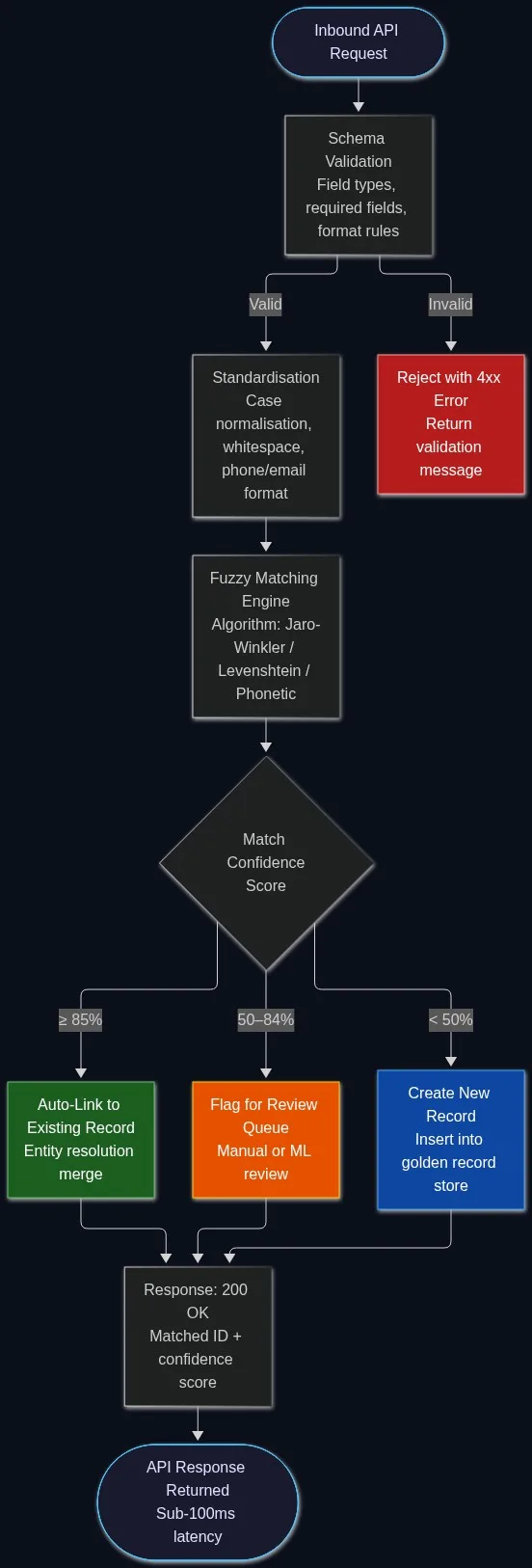
Real-Time API Data Quality Pipeline
The diagram below shows the complete pipeline from inbound API request to response, including the confidence-based routing branches.
Handling Volume: Blocking and Indexing Strategies
Comparing every incoming record against millions of existing records in real time is computationally expensive. The solution is blocking: restricting the comparison space to only the records most likely to match the incoming payload.
Standard Blocking Techniques
Common blocking keys include the first three characters of a surname, the first five digits of a postcode, or a Soundex code for the company name. An incoming record is compared only against records sharing the same blocking key, reducing the comparison space from millions to hundreds or fewer.
Sorted Neighbourhood Method (SNM) is a refinement: records are sorted by a composite key (surname + postcode) and comparisons are limited to a sliding window. This works well for batch but can be adapted for real-time by pre-indexing the sorted order and querying the neighbourhood at request time.
Inverted Index Approaches
High-throughput APIs often use token-inverted indexes. Each record in the database is indexed by its constituent tokens (words, n-grams, phonetic codes). An incoming record queries the index to retrieve candidate matches, which are then scored. This approach scales to tens of millions of records while keeping lookup latency under 20ms.
Match Data Pro’s live fuzzy search API uses this architecture to return ranked match candidates with confidence scores in real time, suitable for integration into web forms, CRM intake flows, and event-streaming pipelines.
Entity Resolution at the API Layer
Fuzzy matching finds probable duplicates. Entity resolution determines canonical identity. At the API layer, entity resolution means deciding not just whether two records are similar, but whether they represent the same real-world entity, and updating the golden record accordingly.
This distinction matters in practice. Consider two records:
- Record A: Acme Corp, 100 Main St, Chicago IL 60601, Tel: 312-555-0101
- Record B: ACME Corporation, 100 Main Street, Chicago, Illinois, 60601, Phone: (312) 555-0101
Fuzzy matching assigns a high confidence score (probably 94+). Entity resolution then merges the two into a single golden record using survivorship rules: prefer the longer company name, the formatted telephone number, and the standardised address components. The result is a single, authoritative record.
This is where entity resolution in master data management becomes critical: without it, every downstream consumer of the API, whether a CRM, a data warehouse, or an analytics pipeline, sees two versions of the same company and cannot reconcile them.
Match Data Pro embeds Senzing-powered entity resolution directly into the matching pipeline, enabling real-time resolution across millions of records without a separate batch job.
Ready to see this in action? Book a demo and we will walk through a live API integration against your existing records.
Modos de fallo habituales y cómo evitarlos
Synchronous Quality Checks That Block the Request
The most common mistake is making the full matching pipeline synchronous and in the critical path of the API response. If your matching engine takes 300ms and you have 1,000 concurrent requests, your API response time blows up. The solution is to decouple: validate and standardise synchronously (fast), but run the full fuzzy match asynchronously and return a provisional ID immediately. The match result updates the record within seconds.
Missing Feedback Loops
Real-time matching without monitoring is a black box. Instrument your pipeline to log match score distributions, false positive rates (cases where two distinct individuals were merged), and false negative rates (cases where duplicates were not detected). These metrics should feed back into threshold tuning. A well-tuned pipeline achieves false positive rates below 2% and false negative rates below 5% for most structured data sets.
Ignoring the Review Queue
Records that land in the 50-84 confidence band are often left in the review queue indefinitely. This creates a growing backlog of unresolved records that neither match correctly nor remain cleanly separate. Set SLAs for queue resolution: 24 hours for customer-facing data, 72 hours for operational data. Use data governance and stewardship workflows to assign ownership and enforce SLAs.
Treating All Matching Errors as Equal
A false positive in a fraud detection context (merging two distinct persons) has a very different cost from a false positive in a marketing context (sending one less promotional email). Configure separate match profiles for different API endpoints and use cases. Data quality teams should own the threshold configuration for each profile.
Preguntas frecuentes
What is real-time data quality in APIs?
Real-time data quality in APIs means applying validation, standardisation, and matching controls at the point of data ingestion, before records are written to a database. Rather than cleaning data in a nightly batch job, the API itself enforces quality rules on every incoming payload, ensuring that errors are caught and resolved at the source rather than propagating through downstream systems.
How fast can fuzzy matching run in a real-time API pipeline?
With blocking and inverted-index techniques, fuzzy matching lookups against tens of millions of records can complete in 15 to 30 milliseconds. The matching itself (scoring a shortlist of 50 to 200 candidates) adds another 5 to 15 milliseconds. End-to-end, a well-architected pipeline returns a match result with confidence score in under 100 milliseconds for the vast majority of requests, without blocking the API response.
What confidence threshold should I use for auto-linking records?
There is no universal answer. For regulated data such as patient records or financial customer identities, set auto-link thresholds at 90 to 95 to minimise false positives. For marketing and CRM data where the cost of a missed duplicate is higher than the cost of a rare false merge, 80 to 85 is a reasonable starting point. Always calibrate thresholds using a sample of your own data, not generic benchmarks.
What is the difference between fuzzy matching and entity resolution at the API layer?
Fuzzy matching compares records and returns a similarity score. It answers the question: how similar are these two records? Entity resolution goes further: it determines whether two records represent the same real-world entity, and if so, produces a single golden record using survivorship rules. At the API layer, fuzzy matching provides the input; entity resolution provides the decision and the merge outcome.
Can real-time data quality APIs handle address validation as well?
Yes. Address validation, including CASS-certified verification and standardisation of street suffixes, unit designators, and ZIP+4 codes, can run synchronously in a real-time API pipeline. CASS verification typically adds 10 to 50 milliseconds of latency per address, depending on the verification service. Addresses that fail CASS verification can be flagged, quarantined, or routed to a correction workflow rather than rejected outright.