
Entity resolution for regulated industries must do two things simultaneously: identify when two records describe the same real-world entity, and produce an auditable trail that proves every decision was sound. A general-purpose matching tool can satisfy the first requirement. Only a purpose-built platform with configurable algorithms, explainability, and a human-review workflow satisfies both.
If your team operates under AML, KYC, HIPAA, GDPR, or SOX obligations, the matching engine is not the only thing you are buying. You are buying a compliance workflow. Here is what that means in practice.
Book a demo to see how Match Data Pro handles regulated entity resolution from data ingestion through golden record creation.
Why Regulated Teams Have Different Entity Resolution Requirements
Standard entity resolution finds duplicates or links records. Regulated entity resolution must also answer the regulator’s question: “Show me exactly why these two records were, or were not, matched.” That answer has to be reproducible on demand, weeks or months after the match ran.
Consider a KYC workflow at a financial institution. A compliance analyst submits a customer record:
| Field | Source A (onboarding form) | Source B (sanctions list) |
|---|---|---|
| Nombre | Mohammed Al-Rashid | Mohamed Alrashid |
| DOB | 1978-03-14 | 1978-03-14 |
| Nationality | UAE | United Arab Emirates |
| Match score | 91 / 100 |
The name differs by transliteration. The DOB is identical. The nationality is an abbreviation variant. A match score of 91 may cross a threshold. But if a regulator audits that decision, you need to show: which algorithm produced the score, what weight each field carried, and who reviewed it. A system that only logs “matched” or “not matched” fails that audit.
This pattern repeats across healthcare (patient identity), financial services (counterparty deduplication), insurance (claims linkage), and government (voter rolls, benefits records). The use case changes; the audit requirement does not.
Six Capabilities That Matter for Regulated Entity Resolution
1. Configurable, Auditable Matching Algorithms
Regulated teams need to explain their matching logic in plain language. That means every algorithm choice — Jaro-Winkler for names, exact match for national ID numbers, phonetic codes for address components — must be documented and reproducible. Deterministic and probabilistic matching approaches each have a place, and the best platforms let you combine both within a single rule set, with field weights that a compliance officer can read and sign off on.
Avoid systems where the match logic is a black box. If you cannot answer “why did this match score 87?”, you cannot defend the decision to a regulator.
2. Full Match Explainability
Explainable entity resolution surfaces field-level scores alongside the composite result. For the Mohammed / Mohamed example above, the output should show:
- Name similarity (Jaro-Winkler): 0.94
- DOB exact match: 1.00
- Nationality normalised match: 0.90
- Composite weighted score: 91 / 100
Every field score, every weight, every normalisation step should be stored with the match record and retrievable via query or export. That is the standard a mature compliance function demands.
3. Configurable Thresholds and Human-Review Queues
Regulated workflows rarely allow fully automated decision-making for high-stakes matches. The platform needs at minimum two thresholds: an auto-accept band (e.g., scores above 95) and a human-review band (e.g., 75-95). Scores below 75 auto-reject. Analysts work only the middle band, which keeps review queues manageable and focuses human judgment where it matters most.
The review interface must log the analyst’s decision, the timestamp, and any override notes. This becomes part of the match record and travels with it downstream.
4. Pre-Built Entity Resolution at Scale
Many regulated datasets are large. A tier-1 bank may hold 40 million customer records across six legacy systems. A national health authority may link 80 million patient identifiers. The engine must handle that volume without degrading accuracy or requiring you to rebuild the model from scratch every year.
Senzing entity resolution, available through Match Data Pro, uses a pre-trained probabilistic model and a graph-based entity store. It resolves records in real time as new data arrives — no nightly batch required. That matters for KYC workflows where a new customer onboarding cannot wait until the next morning’s run to check for a watchlist hit.
5. Data Quality as a Prerequisite
Entity resolution accuracy is bounded by input data quality. A match engine running against uncleansed records will produce false positives and false negatives regardless of how good the algorithm is. Before resolution runs, the pipeline should execute data profiling to surface null rates, format inconsistencies, and outliers, then data cleansing and standardisation to normalise fields before scoring begins.
For example: if Source A stores dates as MM/DD/YYYY and Source B stores them as YYYY-MM-DD, an exact-match DOB rule will fail 100% of the time even on records that are genuinely the same person. Standardise first, then match.
6. Deployment Flexibility and Data Residency
Some regulated organisations cannot send data to a shared cloud environment. Healthcare providers subject to HIPAA, government agencies under FedRAMP requirements, and financial institutions in certain jurisdictions must keep data within defined boundaries. On-premise or private cloud deployment options are not optional extras — they are baseline requirements for those teams.
Match Data Pro runs as both a cloud SaaS and an on-premise deployment, so the choice of where data lives stays with the organisation, not the vendor.
The Entity Resolution Pipeline for Regulated Environments
The diagram below shows the full pipeline that regulated teams should expect their entity resolution platform to support — from raw record ingestion through to a golden record delivered to downstream compliance systems.
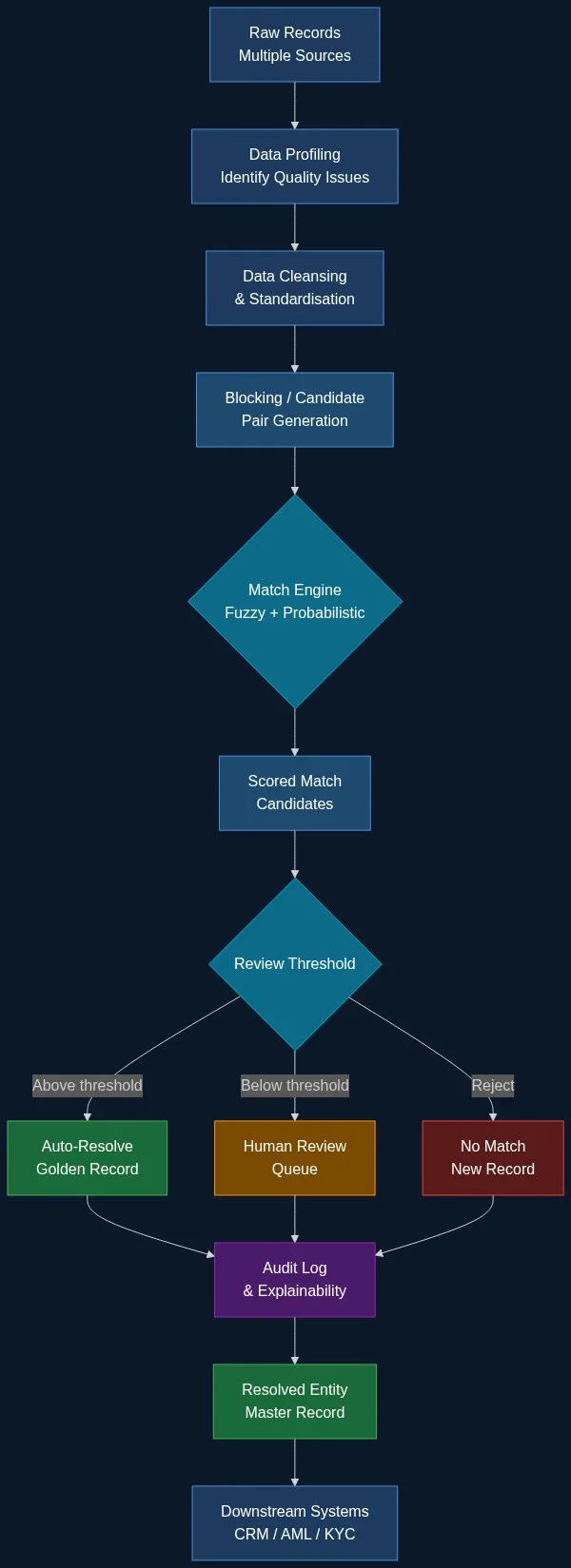
Key stages:
- Profiling: Count nulls, detect format variance, measure field completeness across every source system before a single match runs.
- Cleansing and standardisation: Normalise names (strip titles, expand abbreviations), standardise dates, validate addresses using CASS-certified address verification.
- Blocking: Partition the candidate space so the engine compares only plausible pairs. Without blocking, a 40-million record dataset generates 800 trillion comparisons. Blocking reduces this to a manageable candidate set.
- Matching: Apply fuzzy matching algorithms with per-field weights. Every score is logged.
- Threshold routing: Auto-accept high-confidence pairs, route mid-confidence pairs to analyst review, auto-reject low-confidence pairs.
- Audit logging: Persist every decision — automated or human — with timestamps, scores, algorithm versions, and reviewer identity.
- Golden record: Merge surviving fields using survivorship rules. Export to downstream systems.
Common Failure Modes When Entity Resolution Is Underpowered
Regulated teams often inherit entity resolution setups built for general data quality work, not compliance. Here is what breaks first:
False Negatives on Watchlist Screening
A name matching engine tuned for loose similarity may score “Muhamad Al Rasheed” against “Mohammed Al-Rashid” as a 62 — below the auto-accept threshold — when the records are the same person. Phonetic normalisation (Soundex, Metaphone, or Double Metaphone) closes this gap. A compliance-grade system applies phonetic matching as a complement to edit-distance scoring, not a replacement.
No Recovery Path for Incorrectly Auto-Accepted Matches
When an automated match is incorrect, the platform must support unlink operations with a logged rationale. Systems that write golden records without a correction workflow create permanent data corruption with no audit path. Every merge must be reversible, and every reversal must be logged.
Throughput Collapse at Batch Processing Time
Regulated datasets grow. A system that handles 500,000 records adequately in year one may take 18 hours to process the same dataset three years later. The resolution engine needs horizontal scalability — the ability to add processing capacity without re-architecting the matching logic or rebuilding training data.
How to Evaluate Entity Resolution Software for Your Regulated Team
When shortlisting platforms, use these evaluation criteria:
| Criterion | What to look for | Red flag |
|---|---|---|
| Algorithm transparency | Per-field scores exported with every match result | Only a composite score is returned |
| Threshold configuration | Separate auto-accept / review / reject bands, fully configurable | Single binary pass/fail threshold |
| Human review workflow | Built-in analyst queue with decision logging | Manual spreadsheet process required |
| Real-time capability | Sub-300ms record resolution on new data | Batch-only nightly runs |
| Data residency | On-premise or private cloud deployment option | SaaS-only, no on-premise path |
| Scale | Proven on 50M+ records with documented accuracy metrics | No published benchmarks |
| Integration | REST API, import/export connectors, job automation | File upload only |
The build vs. buy decision for entity resolution in regulated environments almost always favours buying a specialist platform. A custom SQL-based approach cannot provide real-time resolution, phonetic normalisation, and a human-review queue simultaneously — not without a significant engineering investment that most compliance teams do not have budget for.
Match Data Pro combines AI-powered fuzzy matching, Senzing entity resolution, configurable thresholds, explainability logging, CASS address verification, data profiling, job automation, and REST API integration in a single platform. No long-term contract. Start a free trial and run your first entity resolution job against live data today.
Frequently Asked Questions
What is entity resolution and why does it matter for regulated industries?
Entity resolution identifies when two or more records from different sources represent the same real-world entity — a customer, a company, or a location. For regulated industries, it matters because KYC, AML, HIPAA, and similar frameworks require that every identity decision be accurate, documented, and auditable. A match error in a compliance context is not just a data quality problem — it is a regulatory exposure.
How is entity resolution different from simple deduplication?
Deduplication removes duplicate records within a single dataset. Entity resolution links records across multiple datasets that may have no shared identifier, using probabilistic scoring, phonetic matching, and blocking to find cross-source identity matches. Regulated teams typically need both: deduplication within each source system, then cross-source entity resolution to produce a unified view.
What match score threshold should a regulated team use?
There is no universal answer. The correct threshold depends on the risk profile of the use case. KYC watchlist screening typically demands high precision — false negatives are more costly than false positives — so teams set the auto-accept band high (95+) and route more records to human review. CRM deduplication tolerates more false positives and can run with a lower threshold. Always validate thresholds against a labelled test set before deploying to production.
Can entity resolution run in real time for KYC onboarding workflows?
Yes, if the platform is designed for it. Match Data Pro’s Senzing integration resolves new records against the full entity store in milliseconds, which is fast enough to embed into an onboarding API call. Batch-only systems cannot meet this requirement — they require the new record to wait for the next scheduled run before a watchlist hit is surfaced.
Does entity resolution software need to be deployed on-premise for regulated use cases?
Not always, but some regulated organisations require it. Healthcare providers processing PHI, financial institutions in certain jurisdictions, and government agencies often cannot send data to a shared public cloud. Match Data Pro offers both cloud SaaS and on-premise deployment, so the data residency requirement is met without switching vendors or architectures.