
Data matching for privacy compliance means identifying, deduplicating, and linking personal records while satisfying GDPR, CCPA, and equivalent regulations at every stage of the pipeline. The core challenge is structural: effective matching requires comparing name, address, and contact fields across multiple systems, but those fields are exactly the ones privacy law restricts most tightly. Done correctly, a compliant matching pipeline protects personal data and produces cleaner records. Done incorrectly, it creates liability on two fronts.
Start a free trial of Match Data Pro and test privacy-safe fuzzy matching against your own data before you commit to any pipeline design.
Why Data Matching Is a Regulated Activity
GDPR Article 5 establishes six principles for processing personal data: lawfulness, fairness, transparency; purpose limitation; data minimisation; accuracy; storage limitation; and integrity and confidentiality. Data matching touches at least four of these directly.
When you match customer records across a CRM and an ERP, you are processing personal data with a defined purpose (deduplication, identity resolution, or analysis). That purpose must be documented. The fields you compare must be limited to what is necessary. The match decisions you make must be auditable. And every record involved must be traceable if a data subject exercises a right to erasure or access.
CCPA (California Consumer Privacy Act) adds specific requirements around disclosure: consumers must be able to request what data you hold about them, opt out of data selling, and request deletion. If your matching pipeline links a California consumer’s records across five systems and then deletes a record from one, the deletion must cascade correctly or you have an incomplete erasure. The same logic applies under CPRA, the Colorado Privacy Act, and Virginia’s CDPA.
HIPAA applies to patient records specifically. The Safe Harbor de-identification method lists 18 PII identifiers that must be removed before data can be treated as de-identified, but many of them (name, address, DOB, geographic subdivisions) are the same fields most useful for fuzzy matching. Matching under HIPAA therefore requires either a Business Associate Agreement with any tool that processes PHI, or a tokenisation approach that never exposes the raw value to the matching engine. The privacy-preserving AI workflow architecture for handling sensitive records shows how this tokenisation layer operates in practice.
The Five Data Matching Obligations Under GDPR and CCPA
1. Lawful Basis for Matching
Every matching operation requires a documented lawful basis. Under GDPR Article 6, the most common bases for B2B data matching are legitimate interests (Article 6(1)(f)) and contractual necessity (Article 6(1)(b)). Legitimate interest requires a three-part test: the interest is genuine, matching is necessary to achieve it, and the data subject’s rights do not override it.
For CRM deduplication, legitimate interest is generally defensible: having a single, accurate customer record is a genuine business interest that improves service quality and reduces error. For cross-selling analysis that links records across product lines the customer did not expect to be linked, the balance shifts and explicit consent may be required.
Under CCPA, the equivalent question is whether matching constitutes a “sale” of personal information. If you are sharing matched records with a third party in exchange for value, CCPA’s opt-out requirement applies. Internal deduplication within your own systems does not meet this threshold, but sharing a deduplicated dataset with a data broker partner does.
2. Data Minimisation
GDPR Article 5(1)(c) requires that personal data be “adequate, relevant and limited to what is necessary.” For matching purposes, this means you should not load every field into the matching engine when only four are needed to identify a duplicate. A matching job that ingests 40 fields to match on name, address, email, and phone is using 36 fields without purpose.
The practical implication: before any matching job runs, generate a field inventory and explicitly justify which fields enter the pipeline. Fields that do not affect match scores should not enter the processing environment at all. This reduces your exposure surface and makes right-to-erasure compliance faster, since you are tracking fewer data points per person.
3. Accuracy
GDPR Article 5(1)(d) requires that personal data be “accurate and, where necessary, kept up to date.” Data matching directly serves this obligation. A deduplication run that collapses three records for the same person into one accurate golden record is not just operationally useful, it is a compliance requirement. Maintaining multiple conflicting records for the same person — with different addresses, phone numbers, or email addresses — is itself a potential GDPR violation if those inaccuracies cause harm or incorrect decisions.
This is the strongest legal argument for running regular deduplication jobs. The AI-powered data quality pipeline automates accuracy improvement across all five quality dimensions, including uniqueness (no duplicate records) and consistency (the same entity appears with the same values across systems).
4. Right to Erasure
GDPR Article 17 grants data subjects the right to erasure (“right to be forgotten”). When a subject requests erasure, every record linked to that individual must be deleted or pseudonymised across all systems. This is impossible without an accurate entity graph.
If your matching pipeline has never run, you cannot answer the question “how many records does this person appear in across our systems?” A system where “Jon Smith” at 42 Oak Street in the CRM is not linked to “Jonathan Smith” at “42 Oak St” in the ERP means erasure from the CRM leaves a live record in the ERP. The right to erasure is unenforceable without entity resolution. Entity resolution and data linkage across databases is precisely the capability that makes right-to-erasure technically feasible at scale.
5. Audit Trail and Accountability
GDPR Article 5(2) establishes the accountability principle: the data controller must be able to demonstrate compliance. For matching operations, this means every match decision should be logged with the source records involved, the algorithm and score, the confidence threshold applied, and the action taken (auto-merge, review, or no-match).
An audit trail of matching decisions allows a Data Protection Officer to answer a regulator’s question: “On which date and on what basis did you link these two records?” Without that log, the answer is “we cannot say,” which is not an acceptable response under GDPR’s accountability requirement.
The Privacy-Compliant Data Matching Pipeline
The diagram below shows the five-stage pipeline that satisfies both matching accuracy and regulatory compliance requirements. Each stage is designed to operate on the minimum data exposure necessary.
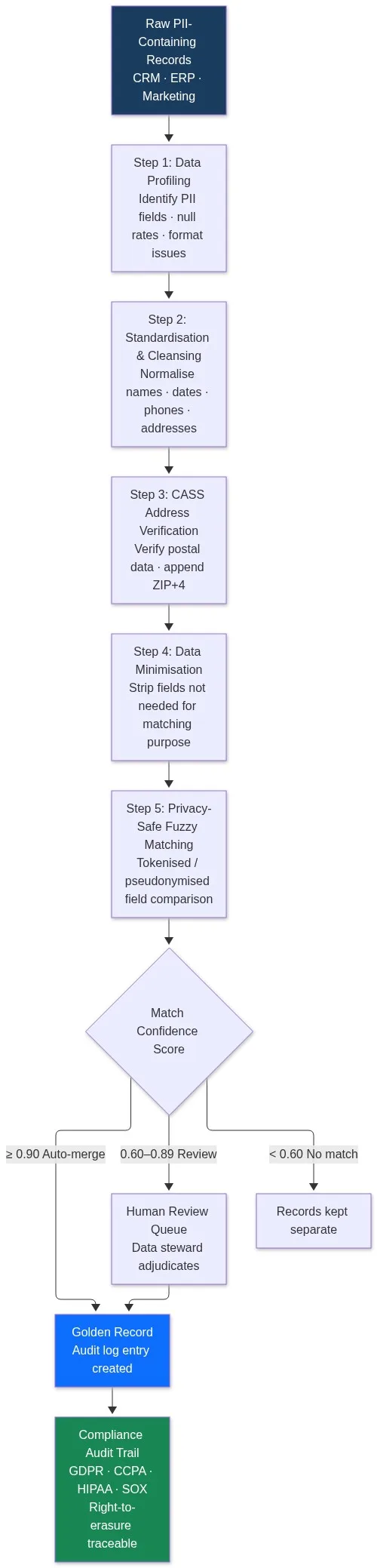
Fase 1: Perfilado de datos
Before any personal data moves, run AI data profiling to map every PII field: names, dates of birth, national IDs, contact details, and any field that could identify an individual. The profiler returns null rates, format distributions, and estimated duplicate rates per field. This output serves two purposes: it configures the downstream matching job, and it creates the data inventory required by GDPR’s Records of Processing Activities (ROPA) obligation under Article 30.
A profiling run on a 1-million-record CRM typically takes under 15 minutes and produces a field-level quality report. That report becomes the starting documentation for any Data Protection Impact Assessment (DPIA) required under GDPR Article 35 when the matching operation involves large-scale processing of personal data.
Stage 2: Standardisation and Cleansing
Standardise fields before matching. Name case normalisation, date format unification to ISO 8601, phone normalisation to E.164, and address component parsing all happen here. This is not purely a data quality step: it also reduces the number of distinct values the matching engine must process, which limits processing scope under the data minimisation principle.
Consider a name field with 47 distinct variants of “William O’Brien.” After standardisation, most collapse to 3-4 canonical forms. The matching engine processes fewer tokens and makes faster decisions with the same accuracy. Standardisation reduces computational exposure to personal data without reducing match quality.
Stage 3: CASS Address Verification
CASS certification validates postal addresses against the USPS database, standardises every component, and appends ZIP+4. For compliance purposes, this step serves the accuracy obligation directly: an address that fails CASS verification cannot be used to identify, contact, or erase a data subject reliably. Real-time address verification at the point of data entry prevents invalid addresses from entering the system, reducing the total PII inventory that needs subsequent matching and erasure management.
CASS verification typically corrects 15-20% of addresses in a mature CRM dataset and flags a further 5-10% as undeliverable. Those flagged records may represent data subjects who have moved and whose contact details are no longer accurate, which triggers both an accuracy obligation and a potential storage limitation review.
Stage 4: Field Selection and Data Minimisation
Before the matching engine runs, strip every field that is not needed to produce a match score. If the job matches on first name, last name, address, and email, every other field (income band, purchase history, support ticket content) should be excluded from the processing environment for this operation. This is not optional under GDPR: it is a direct application of the minimisation principle.
Document the field selection decision in writing. The documentation should state which fields enter the pipeline, why each is necessary, and when the reduced dataset is destroyed after the job completes. For organisations subject to GDPR’s Article 35 DPIA requirement, this documentation forms the core of the technical measures section.
Stage 5: Privacy-Safe Fuzzy Matching
The matching engine applies weighted algorithms per field: Jaro-Winkler for name fields, token-based approaches for addresses, exact matching on normalised phone numbers, and phonetic encoding (Double Metaphone) for name variants that sound alike but are spelled differently. Each candidate pair receives a composite confidence score.
Three-zone threshold routing applies:
| Confidence Score | Acción | Compliance Note |
|---|---|---|
| ≥ 0.90 | Auto-merge to golden record | Audit log entry created with score and algorithm |
| 0.60–0.89 | Proceso de derivación a la cola de revisión humana | Data steward decision logged with rationale |
| < 0.60 | Records kept separate | No merge; each record retains independent erasure obligation |
Every decision at every threshold produces an audit log entry. The log contains: source record identifiers (not raw PII), algorithm used, field-level scores, composite score, threshold applied, action taken, and timestamp. This log is the evidence base for the accountability principle and for responding to individual rights requests.
Right-to-Erasure Implementation at Scale
Right-to-erasure is the compliance obligation most directly dependent on data matching quality. When a subject requests erasure, your team must:
- Identify every record linked to that individual across all systems
- Confirm the erasure is not overridden by a competing obligation (legal hold, contractual retention)
- Delete or pseudonymise all linked records within 30 days (GDPR) or 45 days (CCPA)
- Log the erasure action with timestamps and confirmation that all systems are cleared
Step 1 is impossible without a completed entity resolution run. If your matching pipeline has never linked “Jon Smith” (CRM-00291) to “Jonathan J Smith” (ERP-8812) to “J. Smith” (MKT-55901), you will delete from one system and leave two live records. The security-first data quality buyer guide covers how to evaluate platforms on their audit trail and erasure-tracing capabilities.
The golden record model that Match Data Pro produces assigns a persistent entity ID to every resolved entity. That entity ID becomes the key for right-to-erasure: when a subject requests deletion, you query by entity ID and get back every source record ID across every connected system. The deletion cascades to all of them. Without that cross-reference, erasure compliance at scale requires manual investigation of every system, which is both slow and error-prone.
Cross-Border Data Matching Under GDPR
GDPR Article 46 restricts transfers of personal data to countries outside the EEA without adequate protection. For data matching, this creates a specific constraint: if your matching engine is hosted in the US and you are sending EU citizen records to it for processing, that transfer requires a legal mechanism — Standard Contractual Clauses (SCCs), Binding Corporate Rules, or a valid adequacy decision.
The implications for tool selection are significant. A cloud-only matching platform hosted in a US data centre processes EU personal data in the US, triggering Article 46 requirements. An on-premise or private cloud deployment within the EU eliminates the transfer problem entirely. The decision framework for on-premise versus cloud data quality deployment covers how security-first organisations evaluate residency requirements against operational flexibility.
Match Data Pro is available as cloud SaaS with no long-term contract, and as an on-premise or private cloud deployment for environments where EU data residency is non-negotiable. The same AI profiling, fuzzy matching, and entity resolution capabilities are available in both configurations. No data leaves your environment if you deploy on-premise.
CCPA-Specific Matching Considerations
Consumer Data Requests and Matching
CCPA grants consumers the right to know what personal data you hold about them. When a consumer submits a Data Subject Access Request (DSAR), you must provide a full picture of all data you have linked to that individual. If your records are fragmented across systems with no matching pipeline, the response is incomplete by definition. CCPA compliance requires the same entity-resolved view as GDPR erasure compliance.
Sensitive Personal Information
CPRA (the 2023 CCPA update) added a new category: sensitive personal information (SPI), which includes Social Security numbers, precise geolocation, racial/ethnic origin, health data, and certain biometric information. SPI carries additional processing restrictions: consumers can direct businesses to limit the use of SPI to what is necessary for providing the service.
For matching purposes, this means SPI fields must be treated with elevated caution. If SSN last-4 is used as a matching field (common in healthcare and financial services), that field should be tokenised before entering the matching engine — never passed as a raw value. The live fuzzy search API architecture demonstrates how matching can operate on structural representations of sensitive fields without exposing raw values to the matching layer.
Building a DPIA for a Data Matching Programme
GDPR Article 35 requires a Data Protection Impact Assessment for any processing that is “likely to result in a high risk to the rights and freedoms of natural persons.” Large-scale processing of personal data for profiling, systematic matching, or cross-system consolidation falls into this category for most organisations.
A DPIA for a data matching programme should cover:
- Description of the processing: which systems, which fields, which matching algorithms, what output
- Necessity and proportionality: why matching is necessary, why these fields are needed, why the output is used this way
- Risk assessment: risk of incorrect matches (linking records for two different people), risk of data breach during processing, risk of erasure failure
- Technical measures: tokenisation, field minimisation, threshold model, audit logging, access controls, data retention for matched output
- Residual risk and mitigation: after technical measures, what risk remains and how it is accepted or mitigated
The output of Match Data Pro’s AI data profiling (field inventory, null rates, format distributions, estimated duplicate rates) provides the starting material for the description and proportionality sections. The match decision audit log provides the evidence for the technical measures section. The data quality pipeline framework details how each stage produces documentable, auditable outputs that satisfy regulatory evidence requirements.
Ready to build a compliant matching pipeline? Register for a free trial of Match Data Pro and configure your first privacy-compliant job against your own data, or book a demo to see how the audit trail satisfies GDPR accountability requirements.
Preguntas frecuentes
Does GDPR prohibit data matching entirely?
No. GDPR regulates how data matching is done, not whether it can be done. Matching requires a lawful basis (usually legitimate interest or contractual necessity), field minimisation, an audit trail, and compliance with data subject rights. Many GDPR obligations — especially the accuracy principle and the right to erasure — are easier to satisfy with a well-run matching programme than without one, since you need a complete entity view to respond to individual rights requests.
What fields can be used for fuzzy matching under GDPR?
Any field can be used for matching if there is a documented lawful basis for its processing, the field is necessary for the matching purpose, and it is handled with appropriate technical measures (standardisation, tokenisation for sensitive identifiers, audit logging). Name, address, email, and phone are the most common matching fields and are routinely used under legitimate interest. Special category data under GDPR Article 9 (health data, biometrics, racial/ethnic origin) requires explicit consent or a specific Article 9(2) condition and should be tokenised before entering any matching engine.
How does CCPA affect customer data matching?
CCPA requires that consumers be able to request access to all data you hold about them and request deletion of that data. Both rights depend on you having a complete, matched view of which records belong to which consumer. Internal deduplication and entity resolution within your own systems is not a “sale” under CCPA and does not require an opt-out. Sharing matched datasets with third parties in exchange for value does trigger the opt-out requirement. CPRA adds restrictions on sensitive personal information that apply even to internal processing.
What is a Data Protection Impact Assessment for data matching?
A DPIA is a formal assessment required under GDPR Article 35 for processing that presents high risk to data subjects. Large-scale matching and profiling operations typically qualify. The DPIA documents which fields are matched, why, what technical measures protect the data, what risks remain after mitigation, and how the processing serves a legitimate purpose. Match Data Pro’s profiling output and audit trail provide the technical evidence sections of a DPIA for matching operations.
Can data matching help with the right to erasure?
Yes — it is essentially required. The right to erasure under GDPR Article 17 applies to all records linked to an individual across all your systems. Without entity resolution, you cannot identify all those records reliably. A golden record model with a persistent entity ID allows you to query by that ID and confirm which source records must be deleted, then log the deletion with a verifiable audit trail. Without a matched entity graph, erasure compliance degenerates into manual investigation, which is both slow and legally fragile.