
Security-first organisations need data quality software that delivers full data custody, complete audit trails, and configurable deployment — without forcing a trade-off between capability and control. This buyer’s guide covers the eight criteria that determine whether a platform is genuinely fit for regulated, security-conscious environments, and how to evaluate each one before you sign.
Before evaluating vendors, read how cloud vs. on-premise deployment models differ for data quality so your shortlist reflects your actual infrastructure constraints.
Why Security-First Organisations Have Different Buying Requirements
A standard data quality buyer cares about match accuracy, throughput, and ease of use. A security-first buyer cares about all of that — plus data residency, role-based access, encryption standards, audit logging, and how the vendor handles a breach.
The industries with the highest data sensitivity share a common problem: the data quality tools that perform best were built for speed and ease of setup, not for compliance. Healthcare systems processing patient records under HIPAA, financial institutions managing KYC data under BSA and FINCEN rules, and government agencies operating under FedRAMP or ITAR constraints all need platforms that treat security as a first-class requirement, not an add-on.
Three security failure modes to watch for
- Data egress during matching: some cloud-only platforms transmit records to third-party enrichment services during a match job. Your data leaves your boundary without your explicit consent.
- Shared-tenant storage: multi-tenant SaaS platforms that store match results in shared databases create cross-contamination risk. A misconfiguration exposes one tenant’s golden records to another.
- No field-level access control: platforms that grant users all-or-nothing access to a dataset expose PII fields (SSN, DOB, account number) to analysts who only need aggregated match scores.
The Eight Evaluation Criteria
1. Deployment flexibility and data residency
The first question is where the data lives during processing. Cloud SaaS is fast to deploy and low in operational overhead, but your data traverses the vendor’s infrastructure. On-premise or private cloud deployment gives your team full custody — the data never leaves your perimeter.
A platform that offers both deployment models lets your security architecture, not the vendor’s product roadmap, dictate where processing happens. Match Data Pro supports cloud SaaS for teams that want instant availability, and on-premise or private cloud for teams that require full custody. Both modes run the same engine with the same capability set.
Evaluate: Can the platform run entirely within your network perimeter? Does the vendor provide an on-premise installer or a private cloud image? Are there any capabilities — for example, address verification lookups — that require outbound calls during a job?
2. Role-based access control and field-level permissions
Data quality platforms process sensitive records — names, addresses, national IDs, financial account numbers. Not every analyst needs access to every field. A production-grade platform enforces role-based access control (RBAC) at both the job level and the field level.
Practical example: a RevOps analyst should be able to run a deduplication job on a CRM export and review match scores, but should not see raw SSN or DOB fields in the output. A data steward should be able to approve or reject merge decisions without having write access to the underlying source tables.
3. Audit trail completeness
Every insert, update, delete, and merge decision must be logged — who initiated it, when, which records were affected, and what values changed. A complete data audit trail is not optional in regulated environments; it is the primary evidence you produce during a compliance review.
Evaluate: Does the platform log every survivorship decision made during a merge? Are audit records immutable (write-once)? Can you export audit logs in a format accepted by your SIEM or compliance reporting tool?
4. Encryption in transit and at rest
Data quality jobs read from source systems, process records in memory, and write results to target systems. Every hop is a potential exposure point. At minimum, evaluate:
- TLS 1.2 or 1.3 for all data in transit
- AES-256 encryption for data at rest (match result caches, job logs, golden record stores)
- Key management: does the vendor control the encryption keys, or can you bring your own key (BYOK)?
5. AI fuzzy matching without data leakage
AI-powered fuzzy matching is the core capability you are buying. The security question is: does the matching engine run locally, or does it send records to an external AI inference service?
Match Data Pro’s AI-powered fuzzy matching engine runs within your deployment boundary. Match scoring — Jaro-Winkler, Levenshtein, phonetic, token-ratio, and composite weighted scoring — executes on your infrastructure. No records are transmitted to external model endpoints during a match job.
This matters most for records containing PII. A financial institution matching 4 million customer records for KYC consolidation cannot afford to transmit those records to a third-party AI endpoint, even if the endpoint is encrypted.
6. Entity resolution with a full decision graph
Entity resolution — the process of determining that two or more records refer to the same real-world entity — produces match decisions that directly affect downstream systems. A security-first buyer needs those decisions to be explainable and reversible.
Match Data Pro uses Senzing-powered entity resolution, which maintains a full decision graph showing exactly why records were linked or split. Each decision carries a score, the contributing field weights, and the algorithm applied. This is the audit evidence that satisfies a compliance reviewer asking “why was this customer record merged with that one?”
7. Data profiling before any processing begins
Security-first teams need to understand the sensitivity profile of a dataset before they run any job. AI data profiling scans every field, classifies likely data types (including PII fields), flags anomalies, and scores completeness and uniqueness — before a single match or cleanse job runs.
This lets your data governance team review what categories of data are present in an incoming dataset and apply the correct handling policy before processing begins.
8. Job automation with access controls on pipelines
Automated pipelines — scheduled cleansing, incremental deduplication, nightly entity resolution — are standard in production data operations. The security requirement is that each pipeline step runs under a defined service account with the minimum permissions needed, and that pipeline configuration changes are logged with the same immutability as data changes.
Evaluate: Can you assign separate service accounts to separate pipeline steps? Are pipeline configuration changes captured in the audit log? Can a pipeline be paused by a user with read-only access, or does that require elevated privileges?
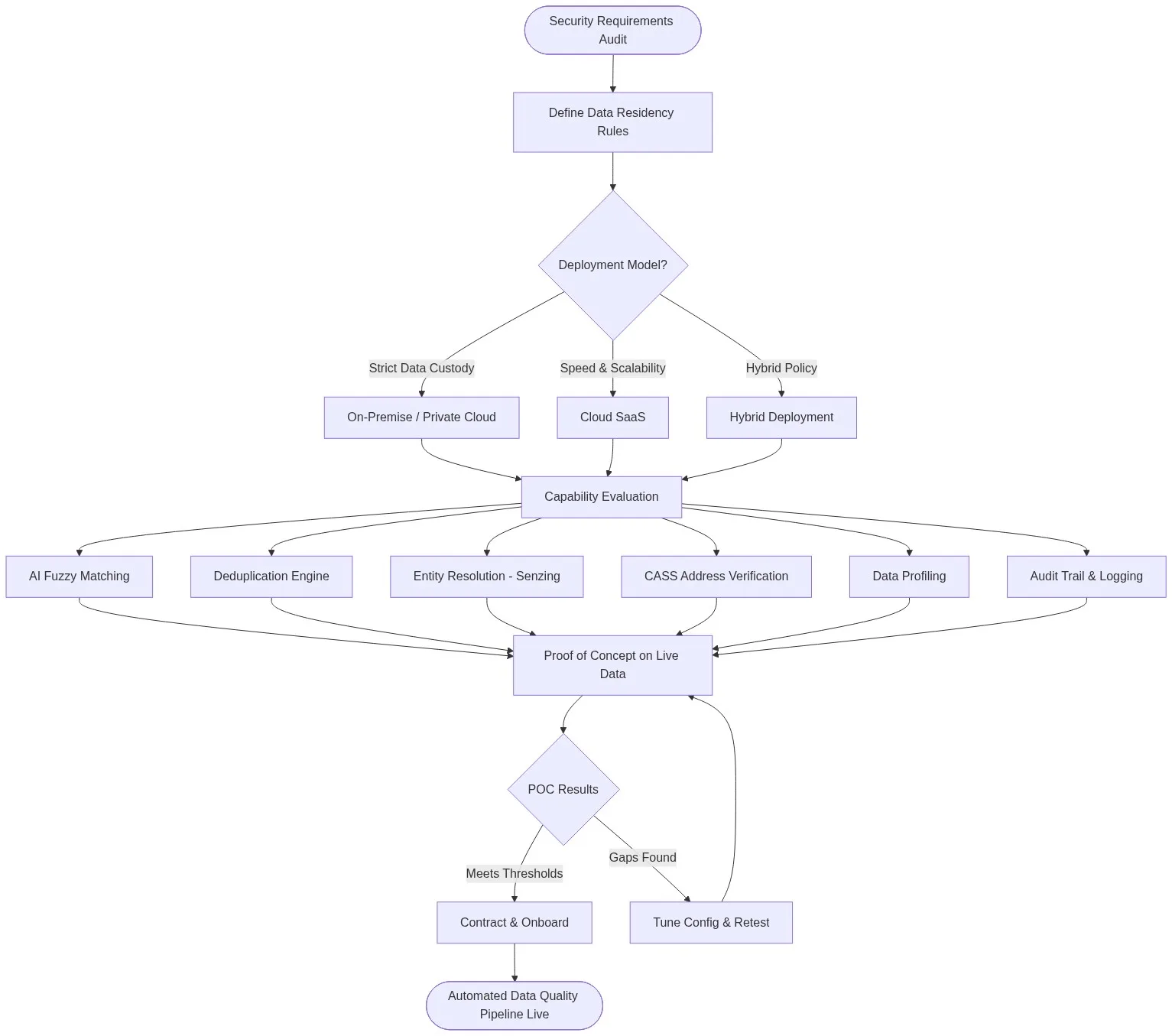
Proof of Concept: What to Test and How
A spreadsheet evaluation of vendor feature lists is not sufficient for a security-first purchase. Run a structured proof of concept (POC) against a real, representative dataset.
POC dataset guidelines
- Use a masked or synthetic version of your real data — same structure, realistic noise levels, no live PII.
- Include records with the edge cases your production data actually contains: nicknames, transposed digits, missing fields, duplicate addresses with unit variants (“Apt 4B” vs “Unit 4B”), and international name formats.
- Target a minimum of 50,000 records. At this volume you will encounter blocking performance limits, memory footprint issues, and any thread-safety bugs in the match engine.
POC success thresholds
Define your thresholds before you start. Typical benchmarks:
| Métrico | Minimum Threshold |
|---|---|
| Match precision | 90% or higher |
| Match recall | 85% or higher |
| Processing speed | 1M records in under 20 minutes |
| Audit log export time | Complete log within 5 minutes of job end |
Common Vendor Claims to Scrutinise
“We are SOC 2 Type II certified”
SOC 2 Type II tells you the vendor has audited controls. It does not tell you whether those controls cover your specific data handling scenario. Ask: does the SOC 2 scope include the data processing environment where your records will be processed, or only the corporate IT environment?
“We support on-premise deployment”
Some vendors offer an on-premise option that is a stripped-down version of the cloud product, missing AI match features, address verification, or real-time API access. Confirm that the on-premise installer ships with the same capability set as the cloud platform.
If you have already considered whether to build or buy data quality tooling, the build vs. buy cost analysis is worth revisiting through a security lens: a custom-built solution gives you control, but maintaining it at security-standard means ongoing patching, penetration testing, and compliance documentation — costs that scale with regulatory complexity.
“Our AI matching is secure”
Ask specifically: where does model inference run? If the answer is “our cloud inference cluster,” your records leave your network. If the answer is “locally within your deployment boundary,” ask for documentation of the inference architecture.
What Match Data Pro Delivers for Security-First Teams
Match Data Pro is a complete data quality platform covering automated data cleansing, AI fuzzy matching, deduplication, Senzing entity resolution, CASS address verification, AI data profiling, import/export connectors, and job automation. It runs on cloud SaaS or on-premise/private cloud — your choice, with no capability gap between the two modes.
Key security-relevant properties:
- All match scoring runs within your deployment boundary
- Complete immutable audit trail on every merge, split, cleanse, and verification action
- Field-level visibility controls on match output
- No long-term contract — monthly SaaS, cancel any time
- Free trial available at members.matchdatapro.com
If your team needs a walkthrough of how the platform handles sensitive data workflows, book a demo and we can walk through the security architecture with your team directly.
Also worth reviewing before finalising your vendor shortlist: 7 questions to ask before replacing your deduplication software — many of the diagnostic questions apply equally to a first purchase.
Preguntas frecuentes
What is the most important security criterion when buying data quality software?
Data residency and deployment model are the highest-priority criteria for security-first organisations. If your data cannot leave your network perimeter, you need a platform that runs entirely on-premise or in your private cloud with no outbound data calls during processing. All other security features — audit trails, encryption, RBAC — are secondary to keeping records inside your boundary.
Can cloud SaaS data quality platforms be secure enough for regulated industries?
Yes, if the platform provides tenant isolation, encryption in transit and at rest, SOC 2 Type II certification scoped to the processing environment, and immutable audit logs. Healthcare and financial services teams regularly use cloud SaaS data quality tools. The key is confirming that the SOC 2 scope covers the data processing environment, not just the corporate network.
What is an immutable audit trail in data quality software?
An immutable audit trail is a write-once log of every data operation — match, merge, cleanse, split — that cannot be edited or deleted after it is written. It records the user or service account that initiated the action, the timestamp, the records affected, and the field values before and after. This is the primary compliance evidence produced during a regulatory review or data breach investigation.
How do I run a proof of concept for data quality software on sensitive data?
Use a masked or synthetic dataset that mirrors your production data structure but contains no live PII. The dataset should include the same noise patterns — name variants, transposed digits, address inconsistencies — as your real data. Define match precision and recall thresholds before the POC starts, and confirm the vendor’s audit log export works within your reporting timeframe.
Does Match Data Pro support on-premise deployment for security-first organisations?
Yes. Match Data Pro supports both cloud SaaS and on-premise/private cloud deployment. Both modes run the same full capability set: AI fuzzy matching, deduplication, Senzing entity resolution, CASS address verification, data profiling, and job automation. There is no stripped-down on-premise version. Contact sales@matchdatapro.com or start a free trial to discuss your deployment requirements.