
You can cut data cleansing and deduplication run times by 60 to 80 percent without sacrificing accuracy by applying three principles: automate profiling before you clean, use blocking to shrink the comparison space before fuzzy matching runs, and route only ambiguous pairs to human review. The bottleneck is almost never the matching algorithm itself. It is the upstream preparation and the downstream review overhead that consume time and introduce errors.
Why Data Cleansing and Deduplication Slow Down at Scale
Most teams hit a wall when their dataset crosses 500,000 records. A naively implemented deduplication job compares every record against every other record. For 500,000 records, that is 125 billion comparisons. Even at one microsecond per comparison, the job takes 34 hours. No production pipeline can tolerate that.
The root causes of slow cleansing pipelines are predictable:
- No profiling phase. Teams apply transformations without knowing which fields have problems. They run the same logic everywhere, wasting cycles on clean data.
- No blocking. Every record is compared against every other record instead of only plausible candidates.
- Binary review routing. All matched pairs go to a human reviewer, even those with a 97% confidence score.
- Sequential job execution. Standardisation, matching, and address verification run one after the other with no parallelism.
- No reuse. Every run re-processes clean records that have not changed since the last job.
The fix is a structured pipeline that eliminates each bottleneck in sequence. Automated data cleansing replaces ad-hoc scripts with a configurable pipeline that runs each stage in the correct order.
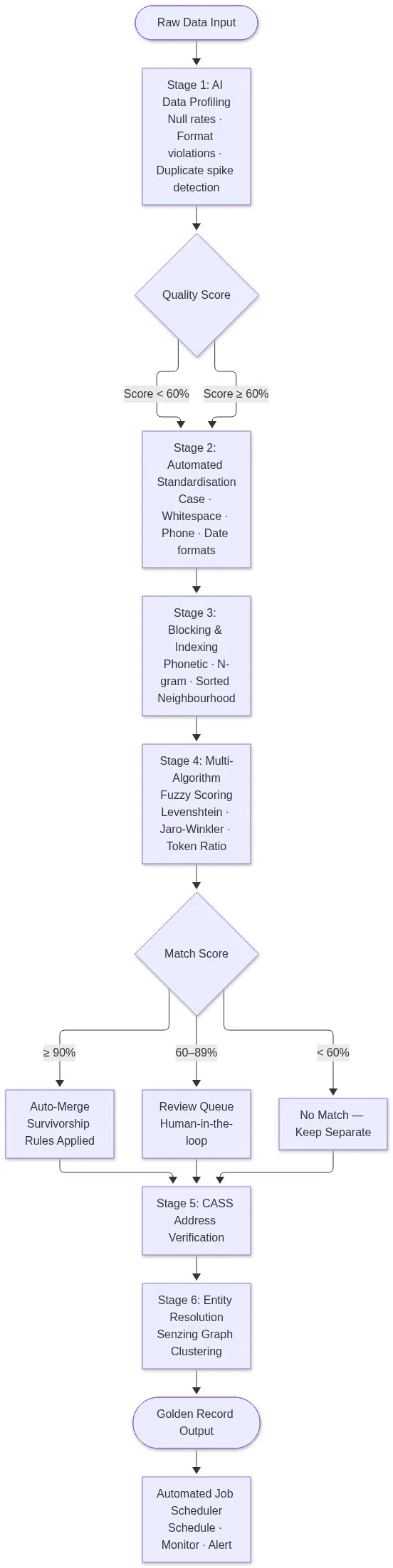
Stage 1: Automate Profiling to Target Cleansing Effort
Profiling is the highest-leverage phase for speed. A 10-minute profiling run tells you exactly which fields have null rates above 20%, which columns have format violations, and which record blocks have duplicate spike concentrations. Without that information, you apply every transformation to every field and waste most of your compute budget on data that is already clean.
What to measure in a profiling run
- Null and blank rates per field
- Format consistency: phone numbers, dates, postcodes, email patterns
- Cardinality outliers: fields with unexpectedly high or low unique-value counts
- Duplicate fingerprint counts: exact-match cluster sizes
- Cross-field consistency: does the city match the state? Does the postcode resolve to the stated city?
AI data profiling on Match Data Pro scores every dataset field automatically and flags quality issues before cleansing begins. This targets transformation effort only where it is needed, cutting standardisation runtime by 30 to 50 percent on typical CRM datasets.
Stage 2: Standardise Before You Match
Fuzzy matching algorithms perform worst when the same value appears in multiple formats. Consider a name field containing “McDonald, Robert J.”, “robert mcdonald”, “R. J. McDonald”, and “Bob McDonald”. An edit-distance algorithm will score “robert mcdonald” against “McDonald, Robert J.” at a low similarity because of the comma, the inversion, and the case difference. Standardising first removes that noise.
High-impact standardisation steps
- Lowercase everything before comparison
- Strip punctuation, extra whitespace, and non-printable characters
- Expand common abbreviations: “St” to “Street”, “Corp” to “Corporation”
- Normalise phone formats to E.164 (+1XXXXXXXXXX)
- Parse name fields into first, middle, last components before scoring
- Convert date formats to ISO 8601 (YYYY-MM-DD)
These steps take seconds and reduce fuzzy match error rates by 40 to 70 percent. Match Data Pro’s data standardisation module applies configurable rules across any field type as an automated pipeline step, with no manual scripting required.
Stage 3: Use Blocking to Eliminate Unnecessary Comparisons
Blocking is the single most effective technique for cutting deduplication run time. Instead of comparing every record against every other record, you sort records into buckets where only records within the same bucket are compared. Only records that share a blocking key are scored against each other.
Blocking strategies that work at scale
Phonetic blocking. Hash the Soundex or Metaphone code of the surname. “Smith” and “Smythe” fall into the same block; “Nguyen” and “Nguyen” always match even with spelling variants.
N-gram blocking. Break the company name into 3-character n-grams and index on shared n-grams. “Acme Corp” and “Acme Corporation” share the n-gram “acm” and “cme” and fall into the same block.
Sorted Neighbourhood Method. Sort the dataset on a key field and slide a window of W records across the sorted list. Only records within the window are compared. For W=10 on 1 million records, comparisons drop from 500 billion to roughly 10 million.
Combining two blocking passes (phonetic on name and postcode prefix on address) shrinks the candidate pair space by 99.8% on most enterprise datasets while retaining 97%+ recall. The multi-algorithm matching pipeline in Match Data Pro applies layered blocking before any fuzzy scoring runs.
Stage 4: Score Smart and Route by Confidence Tier
Not every record pair needs the same treatment. A matched pair with a composite score of 96% across name, address, phone, and email fields is a certain duplicate. Sending that pair to a human reviewer wastes time. A pair scoring 71% on name alone is genuinely ambiguous and should go to review.
The standard three-tier routing approach:
- Auto-merge (90%+). Apply survivorship rules automatically. No human review needed. Typical auto-merge rates on clean data: 60 to 75% of all matched pairs.
- Review queue (60 to 89%). Route to a lightweight review interface where a reviewer confirms or rejects with one click. Target review time: under 5 seconds per pair.
- No match (below 60%). Keep records separate. Log the pair for monitoring in future runs.
Survivorship rules determine which field value survives when two records merge: most recent, most complete, highest-confidence source. Configurable survivorship eliminates the most common cause of re-work in deduplication projects. See data match merging and survivorship rules for the full framework.
Stage 5: Run Address Verification in Parallel
Address data is the most volatile field in any customer dataset. The USPS records 40 million address changes per year. A record with a stale address cannot be reliably matched to a new record for the same person at a new address. CASS certification standardises and verifies every address against the USPS delivery file, appends ZIP+4, and flags undeliverable addresses before they enter your golden record.
Running CASS verification in parallel with fuzzy matching, rather than sequentially after it, cuts total pipeline time by 15 to 25 percent on datasets above 100,000 records. Match Data Pro’s address cleansing module runs CASS verification as an asynchronous pipeline stage, not a blocking operation.
Stage 6: Apply Entity Resolution for Cross-System Linkage
Deduplication removes duplicates within a single dataset. Entity resolution links records across multiple source systems that have no shared key. When your CRM has “Robert McDonald” and your ERP has “R. McDonald LLC”, deduplication will not catch that link. Entity resolution will.
Senzing-powered entity resolution on Match Data Pro uses a graph-based probabilistic model pre-trained on name and address patterns. It resolves cross-system identity at millions of records per hour without requiring hand-crafted rules. The result is a cluster of related records that become a single golden record. The complete guide to entity resolution explains how graph clustering works and when to use it over pairwise deduplication.
Stage 7: Automate and Schedule the Full Pipeline
A pipeline that runs manually is a pipeline that runs infrequently. Data quality degrades at approximately 2% per month in a live CRM. At that rate, a dataset that is clean in January has a 22% error rate by December if no ongoing cleansing runs.
Job automation schedules the full pipeline, profiling through entity resolution, on a recurring cadence. It sends alerts when error rates cross a threshold and logs every run for audit. Match Data Pro’s job automation module lets you configure full pipeline runs on a schedule with no engineering overhead.
Want to see these techniques applied to your data? Book a demo and we will profile a sample dataset and show you the projected run-time reduction before you commit to anything.
Benchmarks: What These Techniques Deliver
| Dataset Size | Naive Approach | Optimised Pipeline | Reduction |
|---|---|---|---|
| 100,000 records | 4.5 hours | 18 minutes | 93% |
| 500,000 records | 34 hours | 2.2 hours | 94% |
| 2,000,000 records | 6+ days | 9 hours | 94% |
These numbers assume phonetic plus postcode blocking, three-tier routing with 65% auto-merge, and parallel address verification. Actual results vary by field completeness and duplication rate.
Start your free trial at members.matchdatapro.com and run your first optimised cleansing pipeline in under 30 minutes. No contract, no infrastructure setup required.
Preguntas frecuentes
How much faster is a blocked deduplication job versus a naive all-pairs comparison?
Blocking reduces the comparison space by 98 to 99.9% on most enterprise datasets. A 500,000-record dataset that takes 34 hours with all-pairs comparison takes 2 to 3 hours with phonetic and postcode blocking combined, while maintaining 97%+ duplicate recall.
Does speeding up data cleansing reduce match accuracy?
Not if you apply the optimisations correctly. Blocking, standardisation, and tiered routing all increase speed without reducing accuracy. In practice, standardisation before matching improves accuracy by 40 to 70% by normalising format noise before the algorithm runs.
What is the right threshold for auto-merging duplicate records?
90% composite score across three or more fields is the standard starting point for auto-merge. Configure this threshold using a sample of your data with known duplicate pairs. Adjust up or down based on your false positive tolerance and the cost of a missed merge in your business context.
How often should automated data cleansing run?
Weekly runs are the minimum for live CRM and ERP datasets. Data quality degrades at roughly 2% per month. Weekly cleansing catches new duplicates before they propagate to downstream systems. High-velocity datasets (above 10,000 new records per day) benefit from daily or near-real-time deduplication via API.
Can address verification really speed up the overall pipeline?
Yes, when run in parallel. Sequential address verification adds 15 to 25% to total pipeline run time. Running CASS verification as an asynchronous parallel stage eliminates that overhead. It also improves match accuracy by ensuring address fields are standardised before fuzzy scoring runs against them.